 Custer
 Siding Built for Ferndale's Coastal Climate
Ferndale sits close enough to Bellingham Bay and the Strait of Georgia that salt-laden air is a real factor in how exterior materials age here, not just a talking point. Add in Whatcom County's long, wet winters, driving rain off the water, and a moss season that can stretch from October well into spring, and you have a climate that is genuinely hard on siding. Homes in and around Ferndale take on more sustained moisture exposure than homes twenty miles inland, and the difference shows up over time in paint failure, swelling, and rot at the most vulnerable points of a house.
We install James Hardie fiber cement siding exclusively, and Ferndale is one of the areas where that decision matters most. This page walks through what local homes actually face, how our installation process is built around this specific climate, and why the material you choose here has a bigger impact on your home's long-term health than almost any other exterior decision you'll make.
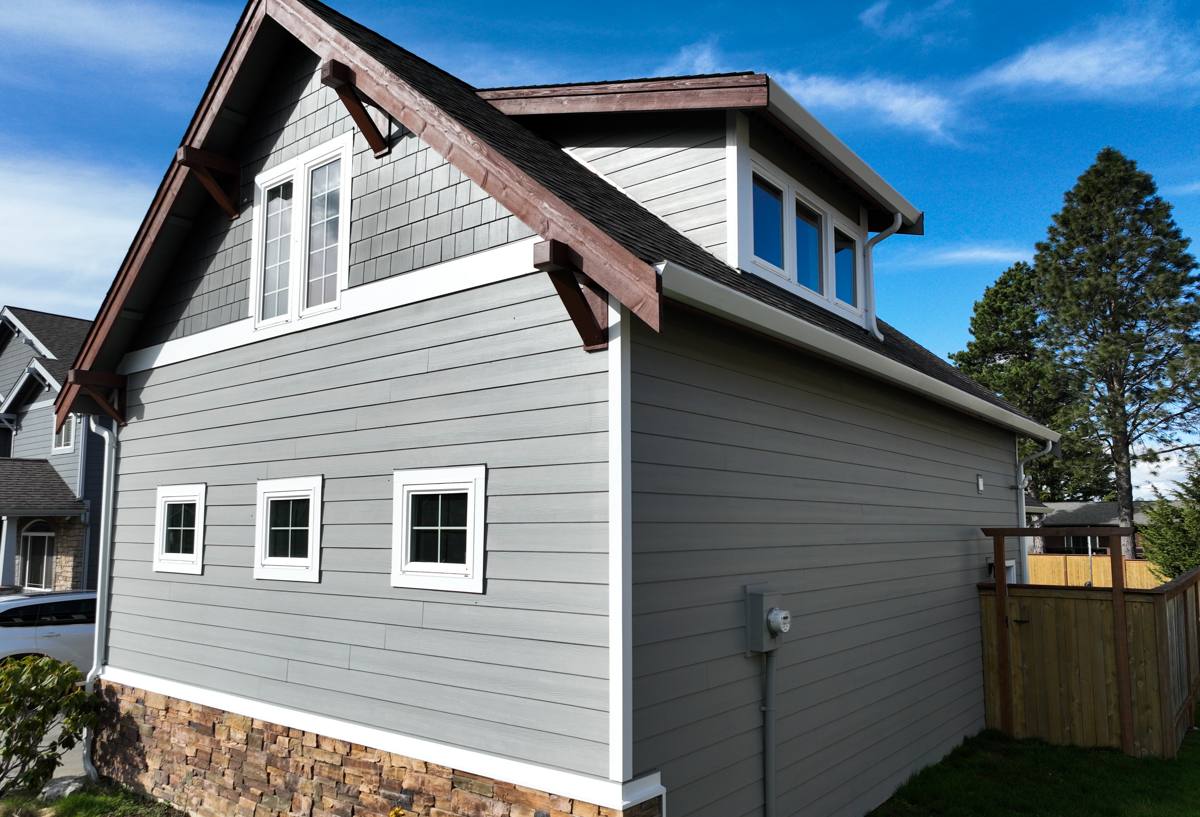
What Ferndale Homes Are Up Against
Salt Air and Moisture Combined
Coastal proximity means airborne salt settles on exterior surfaces and accelerates the breakdown of paint films and certain sealants. On its own, salt air is a maintenance nuisance. Combined with Whatcom County's rain totals and humidity, it becomes a durability problem — moisture gets pulled into any crack or failed seam faster than it would in a drier inland climate, and it doesn't dry out as quickly once it's in.
Driving Rain and Wind-Driven Water
Storms coming off the water don't just drop rain straight down. Wind pushes it sideways into wall assemblies, which means siding here has to perform as a real water-management system, not just a weather-facing skin. Lap joints, butt joints, and trim intersections are where driving rain finds its way in if the installation wasn't detailed correctly the first time.
Moss, Algae, and Shade
Ferndale's tree cover and long damp season create ideal conditions for moss and algae growth on north-facing walls, under eaves, and anywhere airflow is restricted. Moss holds moisture against a wall surface for extended periods, which is exactly the condition that causes wood-based and wood-adjacent siding products to fail early.
Why We Only Install James Hardie
James Hardie fiber cement is engineered specifically to resist the combination of moisture, biological growth, and temperature swings that define this region. It's non-combustible, dimensionally stable, and doesn't absorb water the way wood fiber or wood-composite products do. In a climate like Ferndale's, that matters more than in drier parts of the state.
Hardie's HZ5 product line is specifically engineered for cold, wet, freeze-prone climates — which describes Whatcom County well. The factory-applied ColorPlus finish is baked on under controlled conditions, giving it far better adhesion and UV resistance than field-applied paint, and it comes with its own finish warranty separate from the product warranty. For homeowners near the coast, that finish durability directly addresses the salt-air fading and chalking that plagues field-painted surfaces.
We don't install LP SmartSide, vinyl, Cemplank, Allura, primed spruce, or cedar. Each of those products has legitimate uses elsewhere, but we've made a professional judgment that in this specific climate — salt air, sustained moisture, moss pressure — fiber cement from James Hardie gives homeowners the best combination of longevity, low maintenance, and warranty protection. We'd rather install one product correctly and stand behind it than offer a menu of options with different risk profiles.
How Our Installation Process Works
Assessment and Moisture Check
Every project starts with a walk-around assessment of the existing exterior. We look for current moisture intrusion, soft trim, failed caulk joints, and areas where prior siding or flashing work may have trapped water against the sheathing. This matters more in Ferndale than in drier areas — hidden moisture damage is more common here, and it needs to be addressed before new siding goes on, not covered up by it.
Weather-Resistive Barrier and Flashing
Correct installation starts underneath the siding, not with the siding itself. We install a proper weather-resistive barrier and flashing details at every window, door, and penetration. In a driving-rain climate, flashing errors are the single most common cause of water intrusion behind otherwise sound siding — this is where we spend real time getting it right.
Fastening and Clearances
James Hardie specifies exact fastening patterns, nail placement, and minimum clearances from grade, roof lines, and decks. These aren't arbitrary numbers — they're what keeps water from wicking up into the bottom edge of the siding or pooling where two materials meet. We follow Hardie's published installation specifications because deviating from them is one of the most common ways manufacturer warranties get voided.
Joint and Seam Detailing
Butt joints and lap joints are treated with manufacturer-approved sealants and, where called for, H-channel or shiplap detailing to shed water rather than collect it. Given how much sideways-driven rain this area sees, joint quality is one of the biggest long-term differentiators between an installation that lasts decades and one that starts failing in five to ten years.
Product Comparison: What Ferndale Homeowners Are Actually Choosing Between
| Factor | James Hardie Fiber Cement | Vinyl | Wood / Primed Spruce |
|---|---|---|---|
| Moisture absorption | Very low | Low, but seams can trap water | High — primary failure point |
| Salt air / coastal performance | Strong, factory finish resists fading | Can chalk and become brittle | Paint fails faster near coast |
| Moss/algae resistance | Good, non-organic substrate | Moderate | Poor — organic material feeds growth |
| Fire resistance | Non-combustible | Melts/deforms under heat | Combustible |
| Maintenance | Low — repaint only when desired | Low but limited repair options | High — regular repainting/sealing |
| Typical lifespan when installed to spec | 30+ years | 20-30 years | 10-20 years, climate dependent |
Cost Factors to Understand Before You Get Quotes
Siding pricing varies by project, and we don't publish blanket numbers because the real cost drivers differ from house to house. Here's what actually moves the price on a Ferndale project:
| Factor | Why It Matters Here |
|---|---|
| Existing moisture damage | Sheathing repair or replacement adds cost but is critical in a wet climate — covering damage with new siding is a false economy |
| Home size and wall complexity | More corners, dormers, and trim details mean more flashing and joint work |
| Siding profile selection | Lap siding, shingle-style panels, and board-and-batten all install differently and carry different material costs |
| Trim and accessory scope | Fascia, soffit, and trim replacement alongside siding affects both cost and long-term water management |
| Access and site conditions | Tree cover, tight lot lines, and multi-story sections affect labor time |
Roofing, Windows, and Decks: The Whole Envelope Matters
Siding doesn't perform in isolation. Roof edges, gutters, window flashing, and deck ledger connections all interact with the siding around them, and a weak point in any one of them can undermine an otherwise excellent siding job. We handle roofing, windows, and decks as well as siding, which means we can look at your home's exterior as one connected system rather than treating each component separately. In a climate where water intrusion is the enemy, that integrated view catches problems that a siding-only crew might miss — a roof edge dumping water directly onto a wall section, for example, or a deck ledger creating a moisture trap against the house.
Signs Your Current Siding May Be Struggling
- Paint that's peeling, bubbling, or chalking faster than expected, especially on walls facing the water or prevailing wind
- Soft or spongy spots when you press on siding near the bottom edge or around windows
- Persistent moss or algae growth that returns quickly after cleaning
- Visible gaps or separation at butt joints and trim intersections
- Increased heating bills that may point to moisture-compromised insulation behind the siding
- Warping, cupping, or delamination on wood-based or composite panels
Why Hire a Local Crew
A crew based in this area understands how Whatcom County's weather actually behaves across a full year — not just what the spec sheet says. That means knowing which wall orientations take the worst of the driving rain, where moss pressure tends to be worst, and how to sequence a project around a genuinely unpredictable wet-season forecast. It also means being available if a warranty question or a minor issue comes up years down the road, rather than having installed your siding and moved on to another region entirely.
Get a Free, No-Pressure Estimate
If your Ferndale home's siding is showing signs of wear, or you're planning ahead for a replacement, we're happy to take a look and give you an honest assessment — no pressure, no obligation. Use the form below to request a free estimate for siding, roofing, windows, or decks.