 Custer
 Our Standard, Plainly Stated
Homeowners in Custer sometimes ask why we only quote James Hardie siding when other contractors in Whatcom County will happily sell vinyl, LP SmartSide, cedar, or a competing fiber cement brand. It's a fair question, and it deserves a straight answer instead of a sales pitch.
We didn't start out this way. Over years of tear-offs, repairs, and warranty calls on homes between Blaine and Bellingham, we kept seeing the same failure patterns show up on the same handful of products, and we kept seeing James Hardie hold up where the others didn't. At some point we stopped treating that as a coincidence and started treating it as a policy. We now install one siding system, we install it correctly, and we stand behind it. This page explains the reasoning so you can evaluate it yourself rather than just take our word for it.
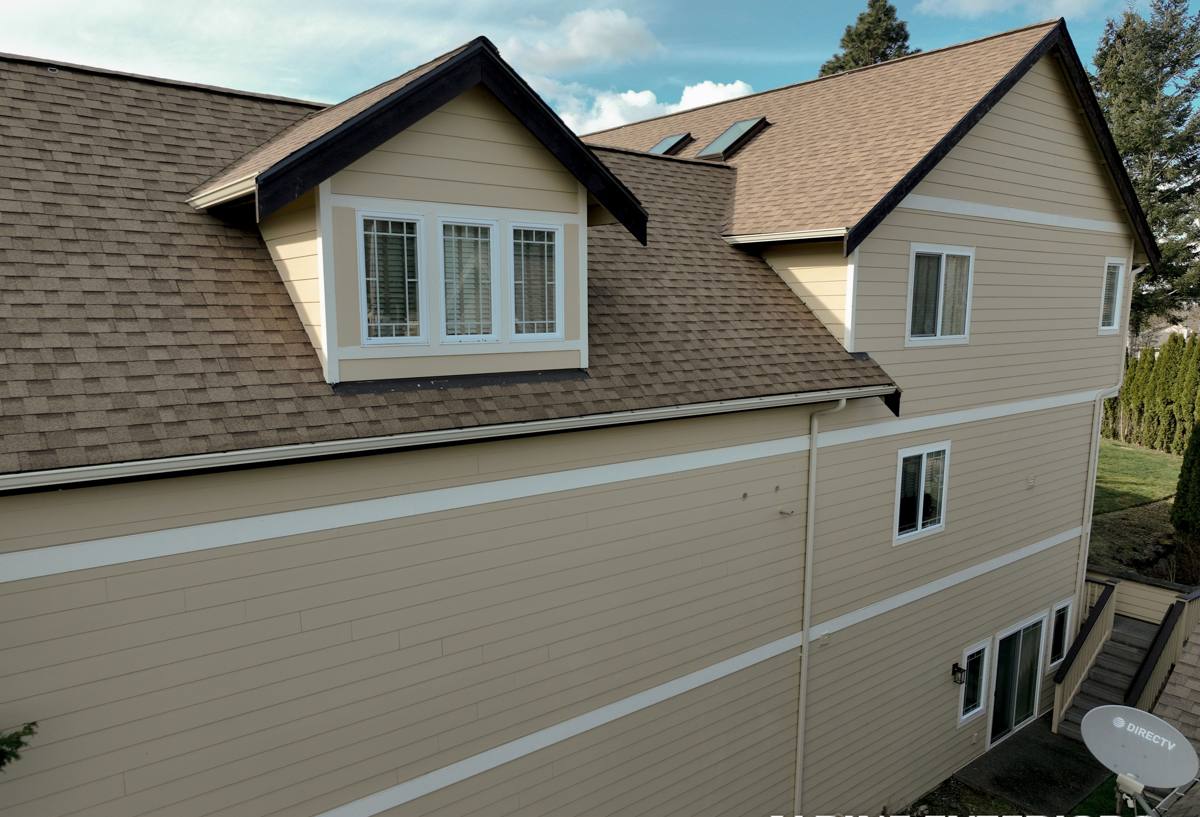
What Whatcom County Weather Actually Does to a Wall
Custer sits close enough to the Strait of Georgia and Drayton Harbor that salt-laden air is a normal part of the local climate, not an occasional event. Combine that with the long, low-intensity rain season that defines this part of the Pacific Northwest and you get a wall assembly that spends a large share of the year damp, followed by a moss season that keeps north-facing and shaded elevations wet even longer than the open sides of the house.
None of that is exotic weather. It's just persistent. The siding on a Custer home isn't dealing with occasional storms so much as it's dealing with months of low-grade moisture exposure, wind-driven rain hitting horizontal seams, and organic growth that thrives in shade and damp. Materials that perform fine in a drier climate, or even in a rainier climate without the salt component, don't always perform the same way here.
What We've Learned Installing in Salt Air and Rain
Two things matter more than anything else in this climate: how a material handles sustained moisture contact, and how it handles the fasteners and trim details that hold it to the wall. Salt air accelerates corrosion at every metal touchpoint — fasteners, flashing, trim screws — and driving rain finds every gap in a lap or J-channel that isn't sealed exactly right. A siding product that's forgiving of minor installation imperfections in a mild climate can become a moisture trap here, because the wall doesn't get enough dry time between rain events to shed what got in.
That's the lens we use when we evaluate any siding product before we'll put it on a house: not "does this look good on day one" but "what does this wall look like in year twelve after a dozen wet winters and a few marine wind events."
Why We Don't Install Everything We're Asked About
We get asked to quote other products regularly, and we're happy to explain, product by product, why we've chosen not to install them — not because they're bad materials in every application, but because they're not the right fit for what this coastline does to a house.
Vinyl Siding
Vinyl is inexpensive and low-maintenance in the sense that it doesn't need painting. But it's a thin, hollow-backed product that expands and contracts significantly with temperature swings, which means every panel is intentionally installed loose rather than fastened tight — a detail a lot of homeowners don't realize until a panel rattles or blows off in a windstorm. It also has no real fire resistance, softens and warps under sustained heat or reflected sunlight from low-E windows, and its finish is baked into the plastic itself, so once it fades or chalks there's no refinishing it — only replacement. In a coastal wind zone like this one, we don't think it's the right long-term investment.
LP SmartSide
LP SmartSide is engineered wood strand siding — wood fiber bonded with resin and coated with a wax-based moisture barrier. It's lighter and easier to handle than fiber cement, and it holds paint well when new. The trade-off is that it's still wood at its core, and wood strand products depend entirely on that factory coating and on perfect field sealing of every cut edge, seam, and fastener penetration to keep moisture out. In a climate with this much sustained dampness, a compromised seal at even one joint can let moisture into the substrate, and because it's an engineered wood product, sustained moisture intrusion leads to swelling and deterioration in a way fiber cement simply doesn't experience.
Primed Wood and Cedar
Cedar is a legitimate, attractive material with a long regional history here, and we're not going to tell you it doesn't have its place. But real wood siding is a maintenance commitment — repainting or restaining on a cycle, caulking joints as they open up, and watching for rot at end grain and ground contact. In a moss-prone, high-moisture area like Custer, that maintenance cycle tends to run shorter than homeowners expect, and the labor cost of staying on top of it adds up over the life of the siding.
Other Fiber Cement Brands (Cemplank, Allura, etc.)
This one surprises people. Other fiber cement brands are a similar material category to Hardie — cement, sand, and cellulose fiber — and in principle they can perform reasonably well. Where we've drawn the line is the factory finish system and the manufacturer's climate engineering behind the product line, plus the transferable warranty backing it. We'd rather standardize on one system we know inside and out, with one warranty structure and one finish process we trust, than juggle multiple fiber cement brands with different specs, different touch-up paint, and different warranty terms.
What James Hardie Gets Right
James Hardie fiber cement is non-combustible, dimensionally stable across temperature and humidity swings, and doesn't feed moss or fungal growth the way wood-based products can. For this specific climate, Hardie also builds region-specific product lines — engineered for high-moisture, high-humidity zones like ours — rather than selling one generic panel everywhere in the country.
The other piece is the ColorPlus factory finish: baked-on, multi-coat color applied under controlled conditions rather than field-painted on site. Field-applied paint depends on weather conditions the day it's sprayed and the skill of whoever's holding the sprayer. A factory finish is consistent by design, and it comes with a longer, product-backed finish warranty than field paint typically gets.
How the Materials Actually Compare
| Material | Moisture behavior | Fire resistance | Typical finish | Maintenance load |
|---|---|---|---|---|
| James Hardie fiber cement | Dimensionally stable, doesn't swell or rot | Non-combustible | Factory ColorPlus finish | Low |
| Vinyl | Sheds water but traps moisture behind it if compromised | Softens/melts under heat | Color molded into plastic, fades over time | Low, but not repairable |
| LP SmartSide | Depends on intact factory coating and sealed cuts | Combustible (wood-based) | Factory primer/finish | Moderate — seam and edge upkeep |
| Cedar / primed wood | Absorbs and releases moisture; prone to rot at end grain | Combustible | Field-applied paint/stain | High — recurring repaint/restain cycle |
| Other fiber cement brands | Similar base material to Hardie | Non-combustible | Varies by manufacturer | Low, varies by finish warranty |
What Correct Installation Actually Involves
Even the right material fails if it's installed wrong, and fiber cement is less forgiving of shortcuts than people assume. This is what we hold every job to, and it's worth knowing so you can ask any contractor the same questions:
- Proper clearance between the bottom of the siding and grade, decks, and roof lines so water has somewhere to go
- Correct fastener type, spacing, and depth — over-driven nails crack the board and void warranty coverage
- Flashing installed at every window, door, and horizontal transition before the siding goes on, not caulked over afterward
- Butt joints and seams sealed with a compatible, paintable sealant rated for the product
- A drainage plane (weather-resistant barrier and, where called for, a rainscreen gap) behind the siding, not siding fastened directly to sheathing
- Field cuts and touch-up handled with the manufacturer's specified paint system to protect the factory finish's warranty coverage
A homeowner can't inspect most of this once the wall is closed up, which is exactly why we treat it as non-negotiable rather than optional.
The Honest Trade-offs of Choosing Hardie
We're not going to pretend our standard is free of downsides. Fiber cement costs more upfront than vinyl and typically more than LP SmartSide. It's heavier, which means installation takes more labor and more careful handling than lighter products. Cutting it produces silica dust, so it has to be cut with the right tools and dust controls — that's a job-site discipline issue, not a product flaw, but it's part of why installation quality varies so much between crews. And because it's a rigid material, it requires accurate layout and control joints to handle expansion — done wrong, that shows up as cracking down the line.
We think those trade-offs are worth it for what you get in return: a wall that isn't fighting the climate here, a finish that doesn't need repainting on a short cycle, and a warranty structure that's actually meaningful because the material and the finish are backed by the same manufacturer.
What This Means If You're Getting Quotes
If you're collecting bids for a siding replacement in Custer or elsewhere in Whatcom County, it's reasonable to ask any contractor — us included — why they're recommending a particular product for your specific site conditions: how exposed the house is to wind and salt air, how much shade and moss risk it has, and what the manufacturer's warranty actually requires for it to stay valid. Those answers will tell you more about a contractor's standards than any brochure will.
If you'd like to talk through your home's specific exposure and get a straightforward estimate, we're happy to take a look and walk you through what we'd recommend and why — no pressure, no obligation. The form below is the easiest way to get started.