 Custer
 Why Ferndale Roofs Wear Differently Than Roofs Inland
Ferndale sits close enough to the water that salt-laden air is a real factor in how a roof ages, not just a talking point. Combine that with Whatcom County's driving rain — the kind that comes in sideways during a winter blow — and a moss season that can run eight or nine months out of the year, and you get a roofing environment that's tougher on materials than most manufacturers' warranty testing accounts for. Metal fasteners corrode faster near the coast. Asphalt shingles that would last two decades in a dry climate lose granules faster here because they rarely get a chance to fully dry out between rain events. And moss doesn't just sit on top of a roof looking bad — it holds moisture against the shingle or shake surface and works its way under tabs and around flashing over time.
None of this means Ferndale homes need exotic materials or constant babysitting. It means a roof replacement here has to be specified and installed with this climate in mind from the start — right underlayment, right ventilation, right fastener choices, right attention to the details that keep moss from getting a foothold in the first place. A roof that's "fine" in a drier part of the state can fail early here if it was built to a generic spec.
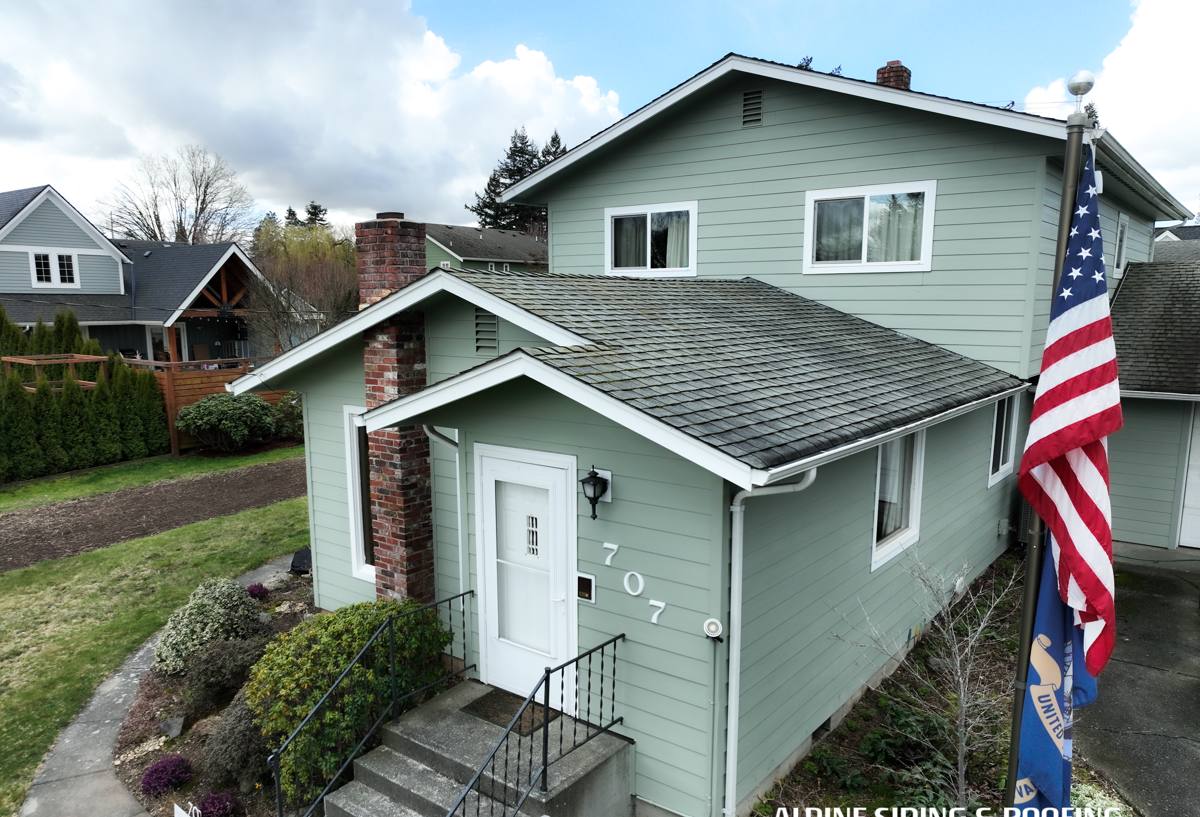
Signs a Ferndale Roof Needs Replacement, Not Just Repair
Not every roof problem calls for a full tear-off. But there are signs that tell us repair is just delaying the inevitable, especially on older roofs in this area:
- Granule loss heavy enough that you can see bare, shiny patches on asphalt shingles, or granules collecting in gutters and downspouts
- Shingles that are cupping, curling at the edges, or cracking when you walk the roof
- Moss growth that's established in the shingle mat itself, not just sitting on the surface — this usually means moisture has already been working underneath
- Soft spots in the roof deck, visible from the attic as sagging or discoloration around nail points
- Repeated leaks in different spots each winter rather than one isolated failure point
- A roof that's 20+ years old (asphalt) or 25-30+ years old (cedar) and has never had a full underlayment replacement
If a roof is showing two or more of these at once, patch repairs tend to become a cycle — you fix one leak and another shows up the next storm. At that point a full replacement is usually the more honest recommendation, even though it's the bigger job.
What a Correct Roof Replacement Actually Involves
It Starts Below the Shingles
The part homeowners see — the new shingles or panels — is the least important factor in how long a roof lasts in this climate. What matters more is what's underneath: the underlayment, the flashing, and the deck itself. In a high-moisture, moss-prone area like Ferndale, we treat underlayment as the primary water barrier and the visible roofing material as the second line of defense, not the other way around.
Ventilation Isn't Optional Here
A roof deck that can't breathe traps moisture from the inside of the house against the underside of the sheathing. In a marine climate with long wet stretches, that trapped moisture leads to rot, mold, and premature shingle failure from underneath — problems you won't see until they're expensive. Balanced intake and exhaust ventilation is part of every replacement we do, not an upsell.
Flashing Details Are Where Roofs Actually Leak
Almost every roof leak we've traced back to its source starts at a flashing point — around chimneys, skylights, valleys, or where a roof plane meets a wall — not in the open field of shingles. Salt air accelerates corrosion on cheaper flashing metals, so material choice and installation care at these transition points matter more here than in a drier, inland climate.
Choosing a Roofing Material for This Climate
There's no single "best" roofing material — the right choice depends on budget, how the home is used, and how much long-term maintenance a homeowner wants to take on. Here's how the common options actually perform in Ferndale and Whatcom County conditions:
| Material | Performance in Salt Air / Driving Rain | Moss Resistance | Typical Lifespan Here |
|---|---|---|---|
| Architectural asphalt shingles | Good with proper underlayment; mid-grade fasteners hold up well | Moderate — needs periodic cleaning or zinc/copper strips | 20-25 years |
| Standing seam metal | Very good if fasteners and flashing are corrosion-rated for coastal exposure | Excellent — moss struggles to grip a smooth metal surface | 40-50+ years |
| Cedar shake | Requires more upkeep in constant damp; needs breathable underlayment | Poor without regular treatment and cleaning | 25-30 years with maintenance |
| Synthetic/composite shingles | Good; less prone to granule loss than asphalt | Moderate to good depending on product | 30-40 years |
We'll walk through these trade-offs honestly during an estimate. Cedar, for example, can look great and has real appeal, but in a climate this wet it demands more upkeep than a lot of homeowners want to sign up for — that's a maintenance-burden conversation, not a knock on the product itself. Metal costs more up front but often makes the most sense for anyone who wants to stop thinking about their roof for several decades.
Our Roof Replacement Process
Every roof replacement we do in the Ferndale area follows the same basic sequence, adjusted for the specific home:
- Inspection and assessment — we get on the roof and in the attic, not just a look from the ground, to check deck condition, ventilation, and the extent of any existing moisture damage
- Written estimate — material options, scope, and a clear price, with the trade-offs explained rather than just a number
- Tear-off — full removal of the old roofing material so the deck can actually be inspected and repaired, not covered over
- Deck repair — any soft or rotted sheathing gets replaced before anything new goes down; this is where skipping corners shows up years later
- Underlayment and flashing installation — sized and specified for this climate's rain and moisture load
- Ventilation check and correction — intake and exhaust balanced for the specific attic and roof geometry
- Roofing material installation — following manufacturer specs plus the coastal-climate adjustments we've learned matter here
- Final walkthrough — cleanup, magnetic sweep for nails, and a review of the finished work with the homeowner
What Drives the Cost of a Roof Replacement
Every roof is priced individually after inspection, but the main factors that move the number are consistent:
| Factor | Why It Matters |
|---|---|
| Roof size and pitch | More surface area and steeper slopes mean more material and labor time |
| Deck condition | Rotted or soft sheathing found during tear-off requires repair before new roofing goes on |
| Material choice | Asphalt, metal, cedar, and composite carry very different material costs |
| Number of penetrations | Chimneys, skylights, and vents each add flashing work and labor |
| Layers to remove | Homes with multiple existing layers take longer to tear off and haul away |
| Access and site conditions | Tree cover, roof height, and staging space affect labor time and disposal logistics |
We'd rather give a broad, honest range during the estimate walk-through than a number pulled out of thin air online — every one of these factors can shift the price meaningfully, and the only way to price it accurately is to actually look at the roof.
Keeping a New Roof Ahead of the Moss
A correctly installed roof replacement dramatically cuts moss problems compared to an older roof, but it doesn't eliminate the need for basic maintenance in a climate this wet. A few habits go a long way toward protecting the investment:
- Keep overhanging branches trimmed back so the roof gets more sun and airflow, which slows moss and algae growth
- Clean gutters at least twice a year — clogged gutters hold water against the roof edge, which is exactly where moss likes to start
- Have the roof looked at after major windstorms, which are common in this area in fall and winter, to catch lifted shingles or flashing early
- Avoid pressure washing shingles directly, which can strip granules and shorten the roof's life — softer wash methods or manual moss removal are safer
- If moss does appear, address it while it's still on the surface rather than letting it establish in the shingle mat
Why It Matters That We Already Work in Ferndale
A roofing crew that's replaced roofs throughout Whatcom County knows which flashing details fail first in this climate, which underlayment products actually hold up to a full wet season, and how local wind patterns tend to find weak points on a roof. That's not something a crew driving in from outside the area picks up on the fly. It also means we're not guessing at permitting requirements or disposal logistics for the area — we've already done the legwork.
Local presence matters after the job is done, too. If a question comes up during the first winter after a new roof goes on, we're not far away, and we're not disappearing after the invoice is paid.
Get a Straight Answer About Your Roof
If your Ferndale roof is showing its age — heavy moss, granule loss, or leaks that keep coming back — it's worth getting an honest, on-the-roof assessment before deciding between repair and replacement. We offer free, no-pressure estimates and will tell you plainly what we see, what it will take to fix it right, and what it will cost. Fill out the form below to get started.