 Custer
 Siding for a Peninsula Most Contractors Don't Bother With
Point Roberts sits in a strange spot on the map. It's part of Whatcom County and part of Washington State, but you can't drive there without crossing into Canada first and back out again near Tsawwassen. That geography keeps a lot of contractors away, or turns a simple siding job into a scheduling headache when a crew based two hours south has to plan around border crossings, ferry-adjacent logistics, and getting materials staged on time. We're based in Custer, close enough that Point Roberts is a normal part of our service area rather than a special trip.
That proximity matters more than it sounds like it should. Siding work depends on timing — flashing goes on before it rains, caulking cures in a dry window, deliveries need to land the same day as the crew. A contractor who has to factor in an international border crossing every time they need a forgotten tool or an extra box of trim is going to make different decisions than one who can be there in under an hour. We plan Point Roberts jobs the same way we plan any Whatcom County job, because we treat it as one.
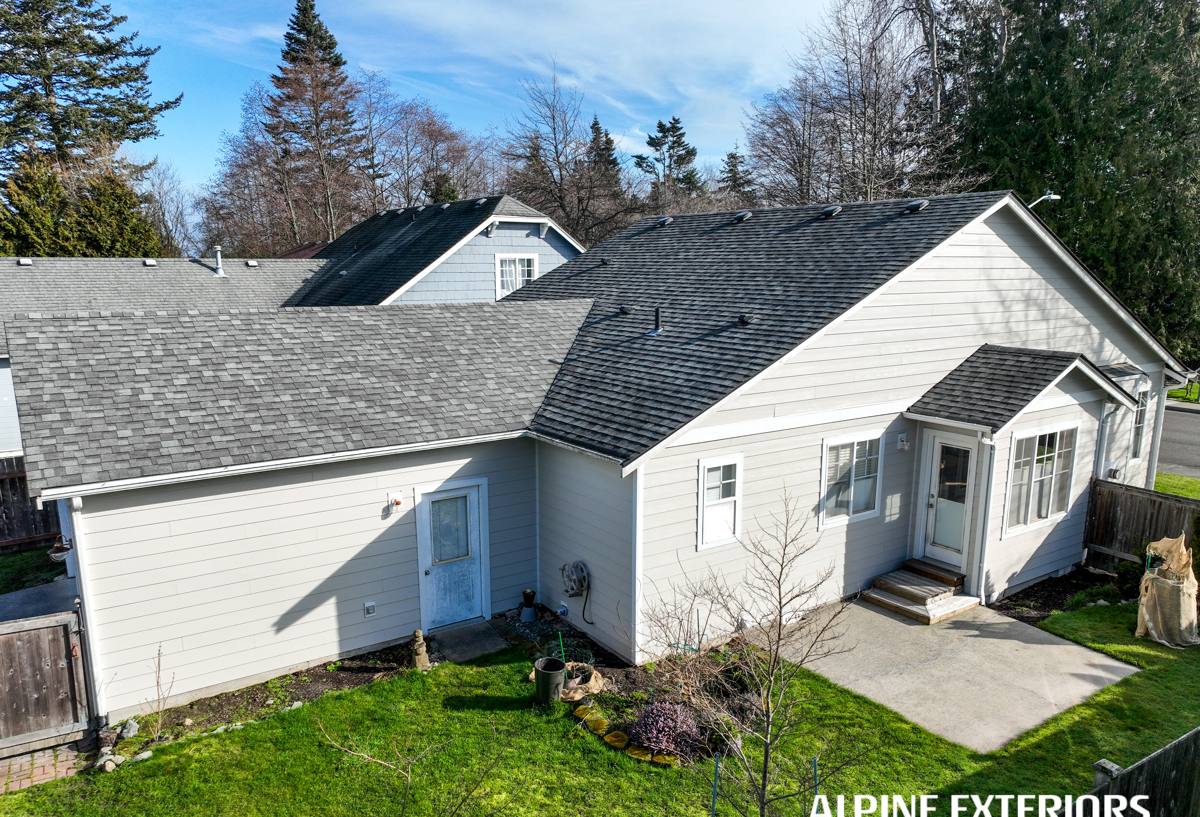
What the Climate Actually Does to Siding Out There
Point Roberts is exposed water on three sides — the Strait of Georgia and Boundary Bay wrap around it — which means homes there get a heavier dose of marine weather than sites further inland around Custer or Ferndale. Three things show up again and again on siding in that kind of exposure:
Salt-Laden Air
Airborne salt doesn't just affect metal fasteners and flashing, though it does accelerate corrosion there too. It also settles into porous or poorly sealed siding surfaces, holding moisture against the material longer than plain rain would. Over years, that combination is hard on paint films, caulk joints, and any wood-based product that depends on a factory or field-applied coating to keep water out.
Driving, Wind-Driven Rain
A low, exposed peninsula gets rain that doesn't fall straight down — it gets pushed sideways into wall assemblies, especially on the water-facing sides of a house. That kind of exposure punishes weak laps, poorly sealed butt joints, and any siding system that relies on surface paint alone to shed water rather than a product engineered for the coast.
A Long Moss and Mildew Season
Cool, damp, and shaded conditions for much of the year give moss, algae, and mildew a long runway on north-facing walls and anywhere tree cover blocks sun and airflow. Siding that stays damp for extended stretches is siding that's working harder, and cheaper coatings tend to show green and black staining faster than a factory-cured finish does.
Why We Standardized on One Siding Product
We install James Hardie fiber cement siding. That's it — we don't install vinyl, LP SmartSide, Cemplank, Allura, primed spruce, or cedar siding. That's not because those products can't be installed correctly by someone, or because they don't have their own fans. It's because after years of doing exterior work in this climate, we decided we didn't want to keep telling homeowners "it depends on how well it's maintained" as an answer to how their siding will hold up.
Vinyl is inexpensive and low-maintenance in mild weather, but it can warp or become brittle over time and it isn't built to take an impact or hold paint if you ever want a different color. Wood species like cedar and primed spruce look great fresh off the truck, but they need real upkeep — recoating, caulk checks, moisture monitoring — to avoid rot in a climate that stays wet as long as this one does. LP SmartSide, Cemplank, and Allura are all reasonable engineered or fiber cement products, but we made a call to build our whole install process, warranty conversations, and crew training around a single system rather than spread ourselves across five product lines with different installation rules and different failure points.
James Hardie fiber cement is non-combustible, dimensionally stable, and comes factory-finished with ColorPlus technology rather than depending on a field-applied paint job to hold up against salt air and UV. It also has product lines specifically engineered for different moisture and temperature zones, which matters directly for a place like Point Roberts.
Hardie's Climate-Engineered Lines and Point Roberts
James Hardie makes siding in different formulations depending on regional climate demands — commonly referred to as HZ5 and HZ10 zones, with HZ5 built for wetter, more variable coastal and northern climates like ours. The point isn't a marketing label; it's that the fiber cement mix and finish are matched to the moisture cycling a home actually experiences, rather than using one generic formulation everywhere in the country.
For a peninsula home taking wind-driven rain and long damp stretches, that engineering shows up in day-to-day performance: less swelling and shrinking across seasons, a factory finish that's cured for UV and moisture exposure rather than applied on-site, and a product that doesn't rely on the homeowner catching every hairline crack in a field-applied coat before water gets behind it.
ColorPlus Finish vs. Field Painting
ColorPlus is baked on and cured in a controlled factory environment before the boards ever reach the site, which gives a more consistent, harder finish than most site-applied paint jobs achieve. It also comes with its own finish warranty, separate from the substrate warranty on the siding itself — worth understanding both of, since they cover different things.
How a Point Roberts Project Actually Runs
- Walkthrough and assessment — we look at current siding condition, moisture staining, trim and flashing condition, and which elevations take the worst weather.
- Scope and product selection — lap width, texture, and color are chosen based on the home's style and exposure, all within James Hardie's product line.
- Scheduling around weather and logistics — because we're a short drive from Point Roberts rather than a long haul, we can plan tighter weather windows instead of padding the schedule for travel uncertainty.
- Tear-off and prep — old siding comes off, sheathing and moisture barrier get inspected, and any rot or hidden damage gets addressed before new material goes up.
- Installation to manufacturer spec — correct fastener placement, clearances, and flashing details matter more in high-exposure coastal sites than almost anywhere else we work.
- Final inspection and cleanup — walk the whole exterior, check caulking and trim, and confirm everything matches the agreed scope.
What Correct Installation Looks Like — and Why It's Non-Negotiable Here
Fiber cement siding is only as good as its installation. Hardie's own specifications call for specific fastener types and spacing, minimum clearances from grade, decks, and roof lines, and proper flashing and caulking at every joint and penetration. In a lower-exposure inland climate, small installation shortcuts might take years to show up as a problem. On a wind-exposed peninsula site, they show up faster — a gapped joint or under-flashed window is an invitation for wind-driven rain to find its way behind the cladding.
This is a big part of why we don't subcontract siding out to whoever's available and why we don't spread across five different products: our crew installs the same system, the same way, on every job, and that consistency is what backs up the warranty conversation with a homeowner.
Cost Factors for a Point Roberts Siding Project
| Factor | Why It Moves the Price |
|---|---|
| Home size and elevation exposure | Water-facing walls often need extra flashing and detailing attention, which adds labor |
| Tear-off vs. new construction | Removing old siding, inspecting sheathing, and addressing hidden rot adds time versus a bare-wall install |
| Siding profile and texture | Lap width, shingle-style panels, and specialty trim all price differently within the Hardie line |
| Trim and accessory scope | Fascia, soffit, corner boards, and window trim are often replaced or upgraded alongside siding |
| Access and staging | Material delivery and equipment staging on a peninsula site can take more planning than a mainland lot |
Beyond Siding: The Whole Exterior
Siding rarely fails on its own — a leaking roof, a failing window seal, or a rotting deck ledger can all send moisture into a wall assembly regardless of how good the cladding is. We handle roofing, windows, and decks alongside siding for exactly that reason. Coordinating those trades under one crew means flashing details at rooflines and window openings get handled consistently instead of becoming a hand-off point between separate contractors who never talk to each other.
For a Point Roberts home, that coordination also cuts down on the number of separate visits and separate scheduling conversations a homeowner has to manage across an international border commute.
Signs It's Time to Look at Your Exterior
- Soft spots, bubbling, or visible warping in siding, especially on water-facing walls
- Persistent green or black staining that returns quickly after cleaning
- Caulk or trim joints that have cracked, gapped, or pulled away
- Interior signs of moisture — peeling paint, musty smell, or staining near exterior walls
- Roofing, window, or deck issues that haven't been addressed and could be feeding moisture into the wall
- Siding that's original to a home built more than 20-25 years ago
Why a Local Crew Is Worth Insisting On
A siding job isn't a one-day transaction — it involves a walkthrough, a scope conversation, a delivery, an install window, and a follow-up if anything needs adjustment. Every one of those steps is easier when the contractor is genuinely local rather than treating Point Roberts as an occasional out-of-the-way stop. Being based in Custer means Whatcom County weather patterns, coastal exposure, and the practical logistics of getting a crew and materials to a border-locked peninsula are things we plan around routinely, not something we're guessing at for the first time on your project.
If your Point Roberts home is due for new siding, or you're not sure whether what you're seeing is cosmetic or something more serious, we're happy to take a look. Reach out for a free, no-pressure estimate — there's a form below to get started.