 Custer
 What Primed Spruce Siding Actually Is
Primed spruce siding is solid wood lap siding, usually finger-jointed spruce or pine boards, milled to a bevel profile and coated with a factory primer before it ships. It's been a staple of Pacific Northwest home building for decades, and for good reason — it's real wood, it's workable with standard carpentry tools, and it's usually cheaper up front than cedar. A lot of homes around Custer and throughout Whatcom County were built with it, especially before fiber cement became widely available.
We get asked to quote replacement siding jobs where primed spruce is the existing product, and we get asked why we don't offer it as an option for new installs or full re-sides. This page is our honest answer.
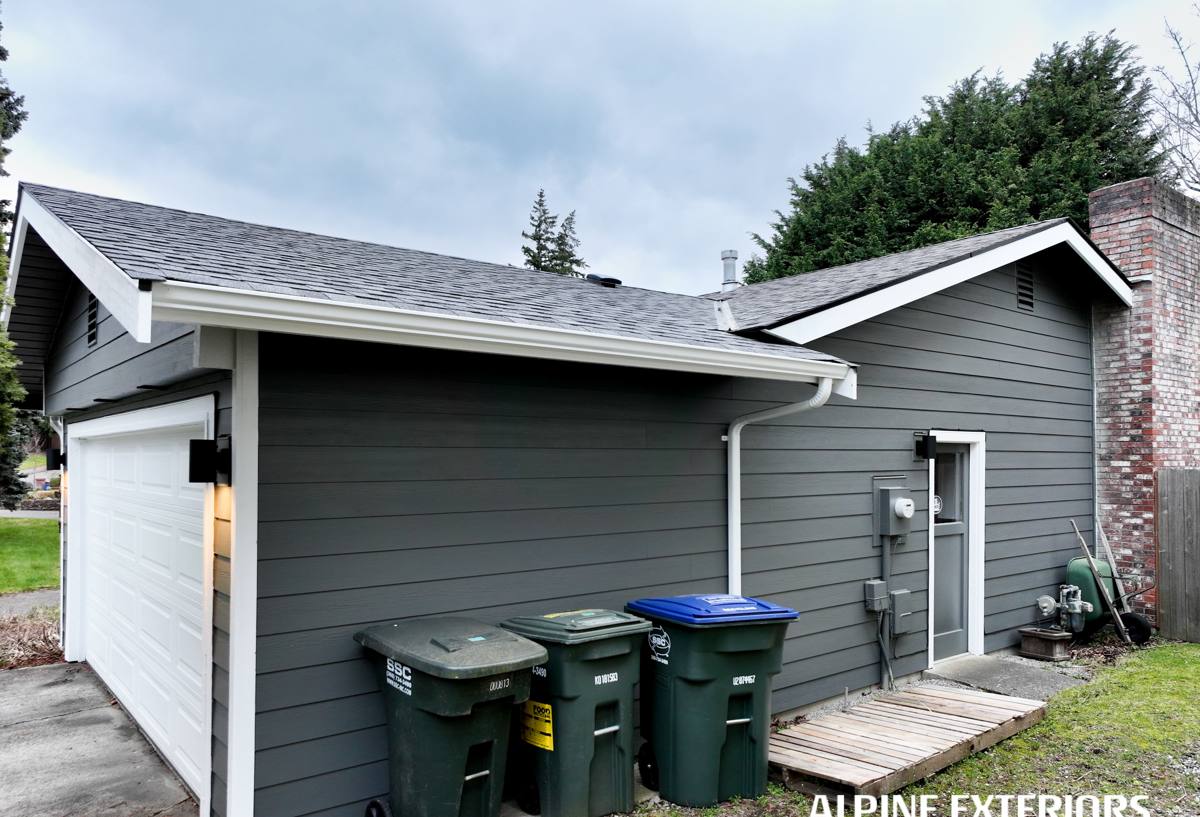
What Primed Spruce Gets Right
We're not going to pretend this product has no merit. Primed spruce has real advantages that explain why it was standard for so long:
- It's genuine solid wood, which some homeowners simply prefer over any manufactured product
- It's easy to cut, nail, and fit on site with basic tools — no special blades or fasteners required
- Upfront material cost is typically lower than cedar and can be lower than fiber cement
- It takes paint well when properly prepped, and repairs (patching a section, replacing a board) are straightforward
Where it runs into trouble isn't the wood itself — it's what happens to that wood once it's hanging on a wall in a climate like ours.
The Moisture Problem in Whatcom County's Climate
Custer sits close enough to the Strait of Georgia and Puget Sound that salt-laden air is a real factor on exterior materials, and Whatcom County gets a long stretch of driving rain and low-angle winter sun that keeps north- and west-facing walls damp for weeks at a time. Add in the moss season that runs from fall through spring, and you have a climate that's genuinely tough on any wood product that relies on a surface coating to stay dry.
Factory priming is a base coat, not a moisture barrier. It's designed to give a paint finish something to bond to — it isn't formulated to seal wood against long-term water exposure. Once that primer and topcoat start to break down (from UV, from standing moisture, from age), the bare wood underneath is directly exposed to rain, salt air, and the kind of persistent dampness that this area sees more of than drier inland climates.
Spruce is also a softer, more dimensionally active wood than cedar. It swells when it absorbs moisture and shrinks as it dries, cycle after cycle. That movement is what eventually cracks paint films, opens up nail holes, and creates the hairline gaps where water gets behind the board instead of running off it.
Where Failure Actually Starts
In our experience, primed spruce doesn't fail evenly across a wall — it fails at specific weak points first:
- Butt joints where two boards meet end to end, especially if the end grain wasn't field-primed before installation
- Nail penetrations, which create a tiny entry point for water once the paint film around them cracks
- Bottom edges of each board, where water sheds off the course above and sits longest
- Shaded, damp elevations — north-facing walls and areas under eaves or tree cover — where moss and mildew get a foothold and hold moisture against the wood
Installation Sensitivity: Where Corners Get Cut
A lot of primed spruce's real-world problems trace back to installation shortcuts rather than the material itself. Manufacturers of primed wood siding typically specify back-priming (coating the reverse side of every board before it goes up) and field-priming every cut end. In practice, on a lot of job sites, back-priming gets skipped because it's slow and doesn't show — the front face looks primed and finished either way.
The problem is that the back of the board and every cut end are exactly where bare, unprotected wood meets the wall assembly and the weather that gets behind the cladding. Skip the back-priming and you've built a slow leak into the wall from day one, one that won't show up as a visible problem for a few years.
This is a big part of why we made the call we did. We don't want to be in the position of installing a product correctly only to have its long-term performance depend on whether every single board was back-primed and every cut end was sealed before it went up — on every job, every time, with no way for the homeowner to verify it after the fact.
The Maintenance Cycle You're Signing Up For
Even installed correctly, painted wood siding has a maintenance clock that starts running the day it goes up. Paint film breaks down under UV and moisture cycling, and once it does, the wood underneath is exposed again. In a wetter coastal climate, that cycle runs faster than it would in a dry inland region.
| Factor | Primed Spruce Siding | James Hardie Fiber Cement |
|---|---|---|
| Repaint cycle | Every 5-8 years typically, sooner on sun/rain-exposed walls | ColorPlus factory finish holds color for decades; field paint not required |
| Moisture behavior | Absorbs, swells, shrinks; rot risk at joints/ends if coating fails | Fiber cement doesn't rot; engineered to shed moisture |
| Pest vulnerability | Susceptible to carpenter ants, woodpeckers, wood-boring insects | Non-organic material, not a food source or nesting target |
| Fire rating | Combustible | Non-combustible core material |
| Coastal/salt air performance | Coating breakdown accelerated by salt exposure | Purpose-engineered HZ product lines for moisture and climate exposure |
| Warranty | Typically limited to material defects, not finish or moisture performance | Strong transferable product warranty backing the finish and substrate |
Moss, Algae, and the Long Wet Season
Moss doesn't just grow on roofs. On shaded or north-facing walls in Custer and the surrounding area, painted wood siding gives moss and algae something to hold onto — a slightly porous, slightly textured painted surface that stays damp for days after a storm. Once moss establishes on a wall, it holds moisture against the surface continuously, which is exactly the condition that accelerates paint failure and, eventually, wood decay underneath.
Keeping painted wood siding moss-free means periodic washing and treatment, which itself carries risk — pressure washing painted wood too aggressively can strip or crack the coating and push water into seams that were otherwise intact.
What Happens When It's Ignored
The failure mode we see most often on older primed spruce homes isn't a dramatic collapse — it's slow, hidden rot. A board looks fine from ten feet away, painted and intact, while moisture has been working behind the coating at a joint or nail hole for a couple of seasons. By the time it's visibly soft or the paint is visibly cracked and peeling, there's often already rot in the sheathing or framing behind it, which turns a siding job into a structural repair job.
Signs it's time to have primed wood siding inspected:
- Paint that's peeling, alligatoring, or bubbling rather than just fading
- Soft spots when you press on the board, especially near the bottom edge or at joints
- Visible cracks running along the board, particularly near nail lines
- Persistent moss, algae, or dark staining that keeps coming back after cleaning
- Gaps opening up at butt joints or around trim where caulking has failed
- A musty smell or visible staining on interior walls that back onto exterior siding
Why We Standardized on James Hardie Instead
We made the decision to install only James Hardie fiber cement siding because it removes the two biggest risk factors we've just walked through: a coating that has to be maintained to keep water out, and a substrate that rots when that coating eventually fails. Hardie's fiber cement core isn't organic material, so it isn't a food source for pests and it doesn't decay the way wood does. The ColorPlus factory finish is baked on under controlled conditions rather than field-applied, which gives it a color life measured in decades rather than years, and Hardie's HZ product lines are specifically engineered for different moisture and climate zones — relevant in a region where salt air and driving rain are part of the deal.
It's also a non-combustible material, which matters to a lot of homeowners regardless of climate. And because installation quality is the other half of long-term performance, we install it to Hardie's published specifications every time, which is also what keeps the manufacturer's transferable warranty intact for the homeowner.
None of this means primed spruce is a bad product when it's installed correctly and maintained on schedule. It means we've decided, after years of doing this work in Custer and the rest of Whatcom County, that we'd rather put a material on your home that doesn't put that much of its long-term performance in the hands of a repaint schedule.
If you're weighing a re-side, or you've got existing wood siding that's showing some of the signs above, we're happy to take a look and give you a straight, no-pressure read on what we'd recommend for your home. Reach out for a free estimate using the form below.