 Custer
 Two Very Different Materials, One Regional Climate
If you're re-siding a home in Custer, you've almost certainly narrowed it down to two finalists: vinyl siding and James Hardie fiber cement. Both are popular, both are available from plenty of contractors in Whatcom County, and both will make your house look good the day they go up. The differences show up years later, and they show up specifically because of where you live — a few miles off the Salish Sea, exposed to salt-laden wind, long wet winters, and a moss season that can run from October into May. This page lays out how each material actually performs here, not in a showroom or a national brochure.
We'll say upfront: this company installs James Hardie exclusively. We used to offer vinyl, and we don't anymore. That's not because vinyl is a scam or a bad product in the abstract — it isn't. It's because after years of installing and repairing both, we concluded fiber cement holds up better against this specific coastline climate, and we'd rather stand behind one material we trust completely than split our warranty and craftsmanship across two.
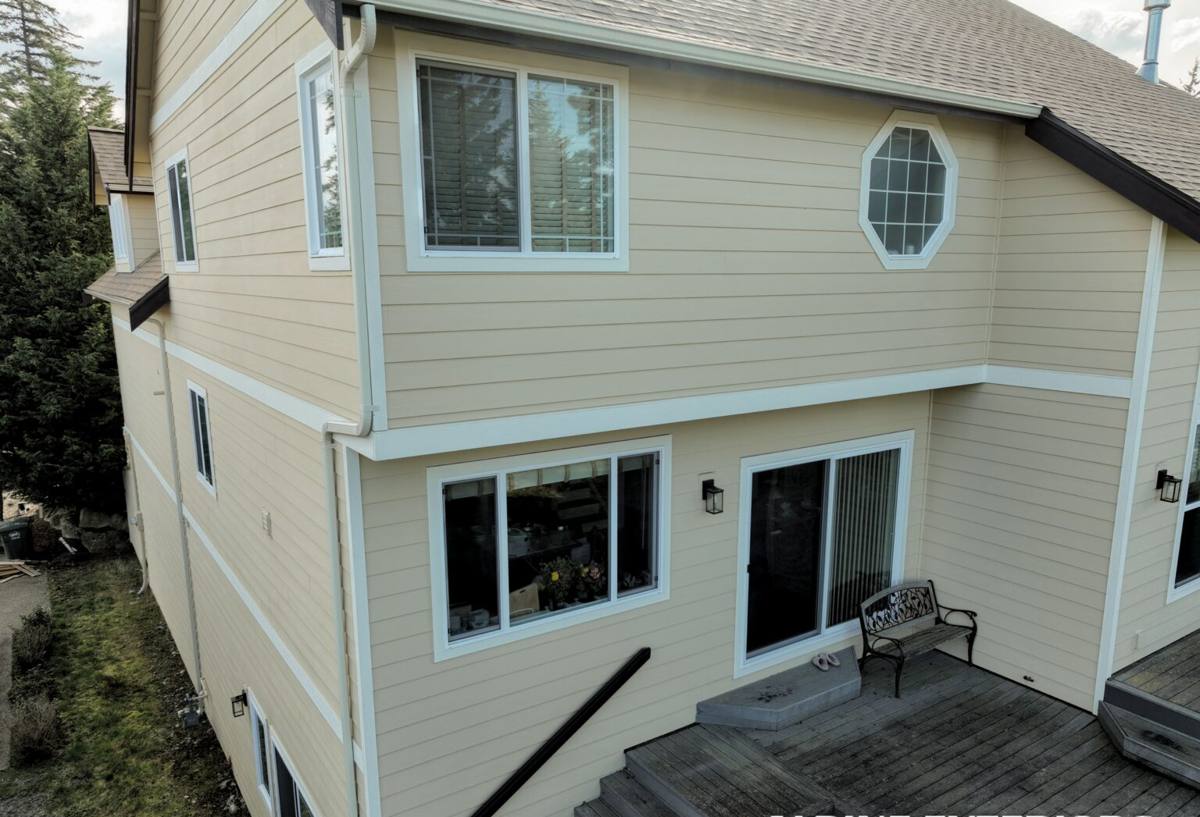
What Vinyl Siding Gets Right
Vinyl earned its market share honestly. It's lightweight, relatively inexpensive to purchase, and fast to install, which keeps labor costs down. It never needs painting, it doesn't rot, and a huge number of licensed contractors across Washington are comfortable installing it. For a budget-driven project, or a home that will change hands again soon, vinyl can make financial sense. None of that is in dispute.
The trade-offs matter more in a place like Custer than they would in a drier, milder inland climate, and that's where the comparison gets interesting.
Where Vinyl Struggles in Whatcom County Conditions
- Salt air and wind exposure: Vinyl is a thin, flexible plastic panel. Sustained coastal wind loads can work at the fastening system over time, and panels installed too tight (a common mistake) can buckle with temperature swings.
- Impact and brittleness: Vinyl gets brittle in cold weather and can crack from hail, thrown debris, or even an errant ladder — not rare during our wet-season storms.
- Color life: Vinyl color is baked into the plastic, but UV and salt air exposure will fade darker colors over the years, and there's no practical way to refinish it — a faded panel means a new panel, if you can even still match the color line.
- Moss and mildew: Vinyl doesn't rot, but its overlapping seams and channels give moss and algae plenty of places to take hold in our long damp season, especially on north-facing walls that don't get sun exposure.
- Heat distortion: Reflected heat from a nearby window or dark-colored surface can warp vinyl panels — an underappreciated risk on homes with energy-efficient glass.
What James Hardie Fiber Cement Does Differently
James Hardie siding is manufactured from cement, sand, and cellulose fiber, cured into a dense, rigid board. It's a completely different category of material from vinyl — closer in behavior to masonry than to plastic. That density is what drives most of the practical differences homeowners notice.
Built for Wet, Salty, Wind-Driven Climates
Hardie's HZ5 product line is specifically engineered for climates with heavy moisture exposure — which is exactly what Custer gets between the marine air off the water and our driving winter rain. The board itself doesn't absorb water the way wood does, doesn't rot, and won't support the kind of moss growth that clings to vinyl channels and wood grain. It's also non-combustible, which matters increasingly for insurance underwriting even on the wet side of the state.
ColorPlus Factory Finish
Rather than site-painting or relying on baked-in plastic color, Hardie's ColorPlus finish is a multi-coat, kiln-baked finish applied under factory-controlled conditions before the boards ever reach the job site. It resists fading and chalking far better than field-applied paint, and touch-up products are made to match the exact color line, so repairs don't turn into a full repaint.
Side-by-Side Comparison
| Factor | Vinyl Siding | James Hardie Fiber Cement |
|---|---|---|
| Material composition | PVC plastic panel | Cement, sand, cellulose fiber |
| Combustibility | Combustible plastic | Non-combustible |
| Moisture behavior | Won't rot, but seams trap moss/algae | Engineered HZ5 line resists moisture intrusion |
| Impact resistance | Can crack, especially in cold weather | Dense board resists impact damage |
| Color stability | Baked-in color fades with UV/salt over years | Factory ColorPlus finish, matched touch-up available |
| Wind performance | Can buckle or blow off if under-fastened | Heavier, rigid board holds fastening line |
| Repair/replace approach | Panel swap, color match gets harder over time | Board replacement with matched factory finish |
| Typical warranty | Varies widely by manufacturer/product tier | Long-term limited warranty, transferable to a new owner |
Installation Sensitivity: Where Both Products Actually Fail
Here's something that doesn't get said enough: most siding failures, on either product, come from installation mistakes rather than the material itself. Vinyl needs to "float" on its fasteners to allow for expansion and contraction — nail it too tight and it will buckle. Hardie has its own installation requirements: correct fastener type and spacing, proper clearance from grade and roof lines, and factory-specified caulking and flashing details at every joint and penetration. A poorly installed Hardie job can trap moisture behind the board just as easily as a poorly installed vinyl job can let wind get behind a panel.
This is a big part of why we only install one product. Certification, crew training, and warranty accountability all get diluted when a crew is jumping between material systems. We'd rather our installers know one system cold — every flashing detail, every fastening spec, every manufacturer requirement — than be competent-but-not-expert across two.
Cost Considerations, Honestly
Vinyl siding generally costs less upfront than James Hardie fiber cement, both in material and labor, and that gap is real — we won't pretend otherwise. What we ask homeowners to weigh is cost over the ownership period, not just at signing:
- Repainting/refinishing: Vinyl never needs painting, but faded panels usually need full replacement rather than a refresh; Hardie's ColorPlus finish is warrantied against fading for a long service life.
- Moss and mildew maintenance: Both need periodic soft-washing in our climate, but vinyl's overlapping profile gives algae more places to establish.
- Storm/impact damage: Replacing a cracked vinyl panel is cheap; the harder cost is when the exact color is discontinued and a wall ends up mismatched.
- Resale and appraisal: Fiber cement is generally viewed as a higher-end, longer-life exterior material, which can matter at resale in Whatcom County's market.
- Warranty structure: Compare what's actually covered — material only, or material and labor — and whether it transfers to a future buyer.
What This Looks Like on a Custer Home
Custer sits close enough to the water that salt-laden wind is a real factor on window and door trim, fasteners, and any exposed metal, not just the siding face. Combine that with our extended wet season and the moss growth that comes with it, and you've got a climate that rewards a dense, factory-finished, moisture-engineered product over a thin, seam-heavy plastic one. We see the difference most clearly on north- and west-facing walls — the ones that get the worst of the wind-driven rain and the least drying sun — where vinyl seams collect grime and moss fastest and Hardie's tighter, heavier board sheds water and resists buildup.
Questions to Ask Before You Decide
- What warranty does the manufacturer offer, and does it cover labor or just material?
- Is the warranty transferable if you sell the home?
- Has the installer been factory-trained or certified on this specific product?
- What flashing and moisture-barrier details will be used at windows, doors, and trim?
- How will the color hold up in direct salt-air and UV exposure over 10-20 years?
- What's the realistic maintenance schedule — soft-washing, caulking checks, inspections?
Why We Standardized on James Hardie
We made the call to install James Hardie exclusively because it's the product we've seen perform best against this exact coastline climate: non-combustible, engineered for high-moisture regions, finished at the factory rather than in the field, and backed by a strong transferable warranty. It costs more upfront than vinyl, and we tell every homeowner that plainly. What we're not willing to do is install two different systems and be halfway good at both. One material, done right, every time.
If you're weighing vinyl against fiber cement for a home in Custer, we're happy to walk your specific house — wall by wall, exposure by exposure — and give you a straight answer, not a sales pitch. Reach out for a free, no-pressure estimate using the form below.