 Custer
 Siding That Understands Sandy Point
Sandy Point sits right up against the water, and that changes what a house needs from its exterior. Homes here aren't just dealing with ordinary Pacific Northwest rain — they're taking on salt-laden air off the Strait, near-constant wind exposure, and long stretches of shade and dampness that keep surfaces wet far longer than homes even a few miles inland in Custer. If you own a place in Sandy Point, you already know your siding, trim, and paint don't last as long as they would somewhere drier and more sheltered. That's not bad luck — it's the environment doing exactly what marine environments do.
We work throughout Whatcom County, and Sandy Point is one of the areas where we're the most particular about material choice, because the margin for error is smaller here than almost anywhere else we build. What holds up fine in a sheltered inland neighborhood can fail early on a waterfront lot exposed to salt spray and wind-driven rain. That's the lens we bring to every siding, roofing, window, and deck project in this community.
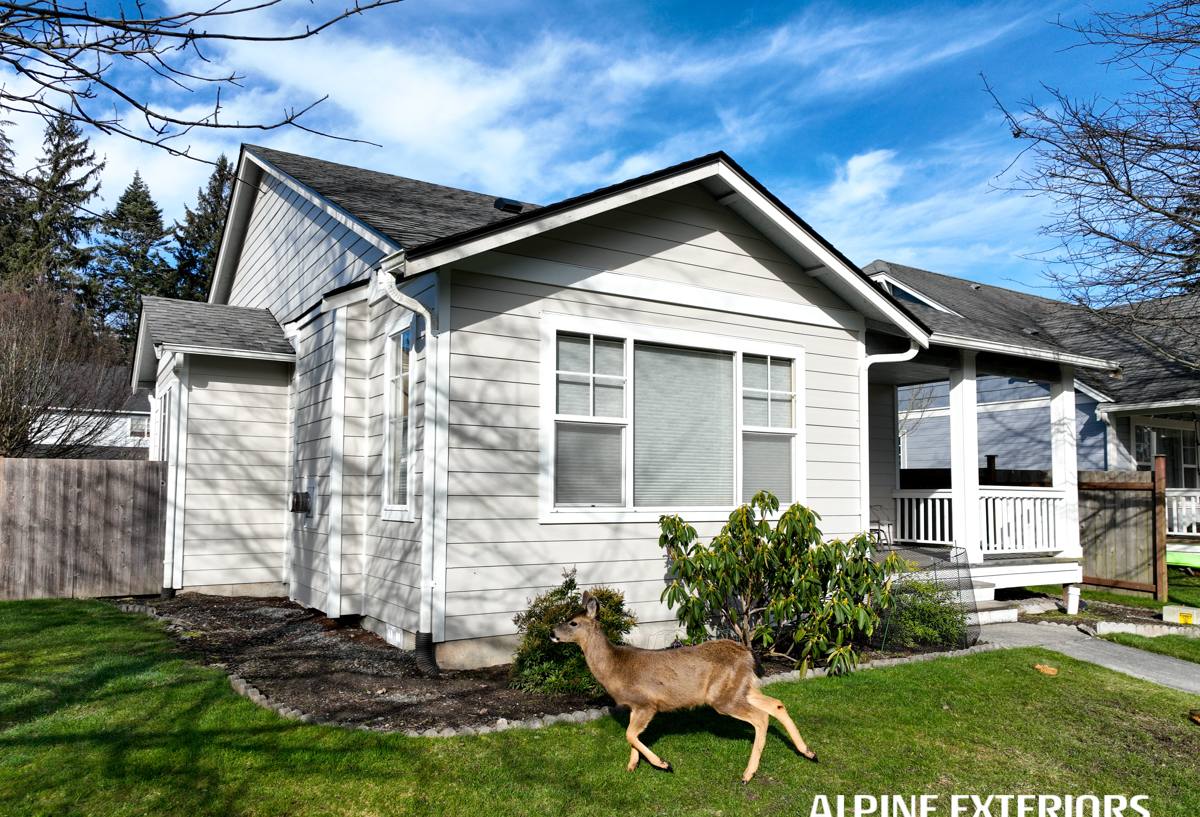
What Salt Air Actually Does to a House
Airborne salt is corrosive and hygroscopic — it draws moisture out of the air and holds it against whatever surface it lands on. On a home near the water, that means fasteners, flashing, trim, and siding surfaces stay damp longer than they would in a dry inland climate, even on days it isn't raining.
- Untreated or poorly coated metal fasteners and flashing corrode faster near salt water
- Wood-based siding products absorb the salt-carried moisture and swell, which accelerates paint failure and rot at joints
- Painted surfaces chalk and fade faster under the combined load of salt exposure and UV
- Caulked seams and butt joints take more abuse and need to be detailed correctly the first time
None of this means a house near Sandy Point is doomed to constant repairs. It means the materials and fastening details matter more here than they do in a typical subdivision, and it's worth being honest about that upfront rather than finding out ten years in.
Driving Rain and Wind: The Other Half of the Equation
Whatcom County gets a lot of rain in general, but waterfront and near-waterfront lots like Sandy Point catch more wind-driven rain than sheltered inland sites. Wind-driven rain doesn't just fall on a wall — it gets pushed sideways into laps, seams, and penetrations around windows and doors. Over years, that's where poor installation details show up first: hairline gaps at butt joints, under-flashed window heads, or siding installed too close to grade or a deck surface.
This is really an installation issue as much as a material issue. A high-quality siding product installed with the wrong clearances or flashing will still let water in eventually. That's why we treat flashing details, kick-out flashing at roof-to-wall intersections, and proper clearances above decks, roofs, and grade as non-negotiable on every job — not an upgrade, just how it's done correctly.
Where Water Problems Usually Start
- Missing or undersized kick-out flashing where a roofline meets a sidewall
- Siding installed with insufficient clearance above roofing, decking, or soil
- Poorly sealed or unsealed butt joints between siding boards
- Window and door flashing that relies on caulk alone instead of proper layered flashing
Moss, Algae, and the Long Wet Season
Sandy Point's tree cover and proximity to the water mean a lot of shaded, damp wall area, especially on north-facing elevations. That combination — moisture plus shade plus a long wet season that stretches from fall through spring — is exactly what moss and algae need to take hold. On some siding materials, that growth doesn't just look bad; it holds moisture directly against the surface and can accelerate deterioration underneath.
The factory finish on the siding matters a lot here. A dense, factory-cured finish sheds water and resists the kind of surface breakdown that gives algae and moss something to grip onto, compared to field-applied paint on a more porous substrate, which weathers and roughens faster and becomes more hospitable to growth over time.
Why We Only Install James Hardie Fiber Cement
We get asked why we don't offer LP SmartSide, vinyl, or the other fiber cement brands like Cemplank or Allura. It's a fair question, especially since some of those products are less expensive up front. Here's the honest answer, specific to a place like Sandy Point:
- Vinyl expands and contracts with temperature swings and can warp or become brittle at the seams over time, and it's not a great match for a coastal environment where wind loads and driving rain test every seam and lap.
- Engineered wood siding (like LP SmartSide) is a wood-strand product. It performs well when installed and maintained correctly, but any wood-based siding is more vulnerable to sustained moisture exposure at cut edges and joints than fiber cement is — and Sandy Point gives siding more sustained moisture exposure than most sites.
- Other fiber cement brands (Cemplank, Allura) are legitimate fiber cement products, and we don't claim otherwise. We've simply standardized our crews, our warranty relationship, and our finish specification around one manufacturer so we can guarantee consistent results.
- Primed spruce or cedar can look beautiful, but both require an ongoing maintenance commitment — refinishing, caulking, monitoring for rot — that's a tougher ask on a salt-air waterfront home than it is inland.
James Hardie fiber cement is non-combustible, dimensionally stable across our temperature swings, and its ColorPlus factory finish is baked on under controlled conditions rather than applied on site — which matters directly for the salt exposure and fading issues described above. Hardie also builds climate-engineered HZ product lines specifically for wetter regions like ours, and backs installations with a strong transferable warranty when installed to their specification. For a house that's going to sit near salt water for the next several decades, that combination is what we're willing to put our name behind.
How the Main Siding Options Compare in a Sandy Point Setting
| Factor | Vinyl | Engineered Wood | James Hardie Fiber Cement |
|---|---|---|---|
| Salt air / moisture resistance | Moderate; seams and fasteners are the weak point | Good if maintained; edges/joints are moisture-sensitive | Strong; cement composition doesn't rot or swell |
| Fire resistance | Combustible | Combustible | Non-combustible |
| Finish durability | Color molded in, can fade/chalk | Field or factory paint, needs upkeep | Factory-cured ColorPlus finish |
| Maintenance in a wet, shaded climate | Low, but limited repair options | Moderate; caulk and paint checks needed | Low; periodic cleaning and caulk checks |
| Typical warranty structure | Varies by brand | Varies by brand | Long-term, transferable when installed to spec |
How We Approach a Siding Job on a Waterfront or Near-Waterfront Property
Every Sandy Point project starts with a walk-around that looks specifically at exposure — which elevations catch the worst of the wind-driven rain, where moss has already established itself, where old flashing or trim is showing corrosion. That tells us where to spend extra attention during installation, not just where to hang siding.
- Assess existing siding, trim, flashing, and any moisture or rot damage, especially at grade, decks, and roof intersections
- Confirm proper water-resistive barrier and flashing details before any siding goes on
- Install James Hardie panels or lap siding to manufacturer fastening and clearance specifications, adjusted for our exposure conditions
- Detail all penetrations — vents, hose bibs, light fixtures, window and door trim — with proper flashing and sealant, not caulk alone
- Final walkthrough covering care and what to watch for given the site's specific exposure
Siding Rarely Stands Alone Out Here
Because we also handle roofing, windows, and decks, we regularly find that a Sandy Point siding call turns up related issues — a roof-to-wall intersection missing kick-out flashing, a window that's been letting moisture into the wall cavity, or a deck ledger board that's trapping water against the house. Fixing siding without addressing the exposure that caused the damage in the first place just resets the clock on the same problem. We'll flag what we see and give you a straight answer on what actually needs attention versus what can wait.
What to Ask Before Hiring Anyone to Work on a Coastal Home
- Do they carry current Washington contractor licensing and insurance, and will they show you proof without being asked twice?
- Do they have experience specifically with waterfront or near-waterfront exposure, not just general residential siding?
- Will they explain their flashing and clearance details in writing, not just verbally?
- Are they installing to the manufacturer's actual specification, including fastener type and spacing appropriate for a marine environment?
- Do they offer a manufacturer-backed warranty that's transferable if you sell the home?
Cost Factors Specific to This Area
Pricing on any Sandy Point exterior project depends on the same core factors as anywhere — square footage, number of stories, trim complexity, and existing damage — but a few things tend to show up more often here than elsewhere in Custer:
| Cost Factor | Why It Comes Up in Sandy Point |
|---|---|
| Existing moisture or rot repair | Longer wet exposure and salt air accelerate hidden damage at joints and penetrations |
| Additional flashing work | Wind-driven rain requires more attention at roof-to-wall and deck-to-wall intersections |
| Access and staging | Waterfront lots can have tighter access, slopes, or seasonal road conditions |
| Trim and fastener upgrades | Corrosion-resistant fasteners and trim details cost more but last longer near salt water |
We give straightforward, itemized estimates so you can see exactly what's being priced and why — no vague allowances buried in a single number.
Why a Local Crew Matters Here
Sandy Point isn't a generic subdivision, and it doesn't get treated like one. A crew that mostly works dry, sheltered inland lots can miss the details that matter on a site that takes direct salt spray and wind-driven rain for months at a time. Working across Whatcom County, including this stretch of coastline near Custer, means we've seen what fails here and why, and we build accordingly from the first flashing detail to the last piece of trim.
If you're planning siding work, a roof, new windows, or a deck for a Sandy Point property, we're happy to walk the site with you and give you a straightforward, no-pressure estimate. Use the form below to get started.