 Custer
 Two Products Cut From the Same Cloth
Homeowners in Custer sometimes come to us with a quote in hand for Cemplank fiber cement siding, usually because a distributor or a competing contractor priced it out as a Hardie alternative. It's a fair question to ask why we'd say no to a job. So let's be upfront about something: Cemplank is not a cheap knockoff or a vinyl product wearing a fiber cement label. It's made from the same basic recipe as James Hardie siding — Portland cement, sand, and cellulose fiber, cured into a dense, non-combustible board. Structurally, the two products are close cousins.
Our decision to install only James Hardie isn't about bad-mouthing a competing product. It's about what we've learned installing and servicing siding on homes along the Whatcom County coastline for years, and where the differences between fiber cement brands actually show up — not on install day, but five, ten, and twenty years later.
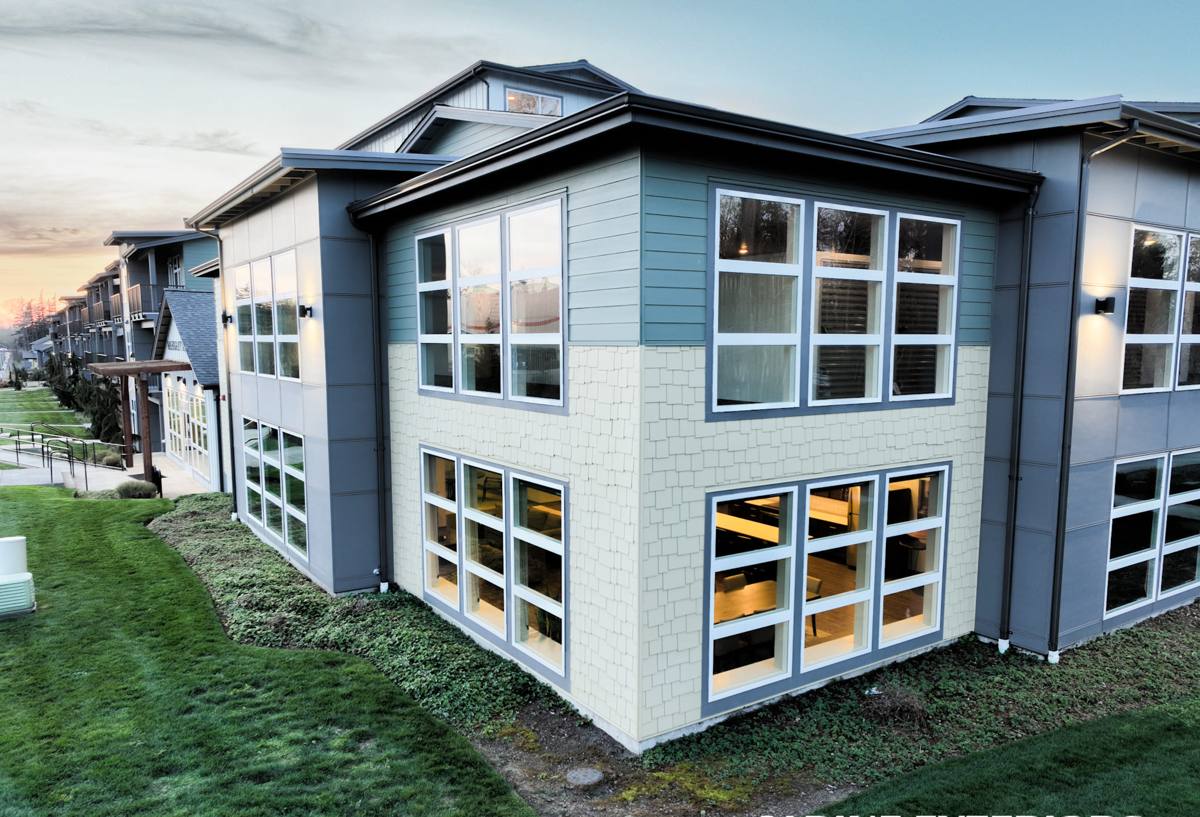
What Cemplank Gets Right
Credit where it's due: fiber cement as a category solved a real problem. It doesn't rot like untreated wood, it doesn't dent like vinyl, and it stands up to fire and pests better than almost anything else on the market. Cemplank boards are dimensionally stable, take paint and factory finishes reasonably well, and are typically priced a notch below Hardie's product line, which makes it an understandable pick for a budget-conscious job.
If your only question were "is this better than vinyl or bare wood," the honest answer is yes. That's not where the real comparison lives, though. The real comparison is Cemplank against James Hardie, brand to brand, in a marine climate that's harder on exterior materials than most of the country ever deals with.
Why Custer's Climate Changes the Calculus
Custer sits right up against Puget Sound and Semiahmoo Bay, which means every board on a home here deals with salt-laden air, wind-driven rain coming in sideways off the water, and a moss and algae season that runs most of the year in the shade of our conifers. None of that is unique to one street or one subdivision — it's the baseline condition for exterior materials anywhere in this part of Whatcom County.
Fiber cement handles moisture better than wood, full stop. But "handles moisture better than wood" is a low bar. The question that actually matters for a 30- or 40-year siding investment is how the factory finish resists salt exposure, how the board itself behaves through hundreds of wet-dry cycles a year, and how forgiving the product is when installation isn't perfect. That's where brand differences stop being marketing and start being real.
Salt Air and Fasteners
Salt exposure is hard on more than the siding face — it's hard on every fastener, flashing detail, and trim piece around it. A siding system that's engineered as a complete package, with matched trim, corner treatments, and fastening guidance built for coastal exposure, holds up more predictably than a board-only product where the trim, caulking, and finish come from different places.
Driving Rain and Joint Design
Wind-driven rain finds every gap in a siding job. The boards themselves matter less here than the water-management details behind them — rain-screen gaps, flashing at joints and penetrations, and how the manufacturer specifies those details for high-exposure zones. This is less about which fiber cement brand is "stronger" and more about which one gives installers a complete, climate-specific system to follow instead of generic instructions.
The Finish System Is the Real Difference
This is the heart of it. James Hardie's ColorPlus finish is baked on at the factory in a controlled process, formulated specifically to resist fading, chipping, and moisture intrusion at the finish layer — the layer that's actually exposed to salt air and UV every single day. Cemplank offers factory-finished and primed options too, but the finish technology, color-match consistency, and touch-up system aren't the same product, because they're not the same company's formulation.
Why does that matter more here than in, say, Spokane? Because a finish that's marginal in a dry climate becomes a visible problem in a wet, salty one much faster. Chalking, color drift, and finish failure show up as callbacks years before the board itself would ever fail structurally. When we stand behind a job for the long haul, we want the finish layer to be the last thing that gives us trouble, not the first.
Climate-Engineered Product Lines
One thing that's genuinely unique to James Hardie is its HardieZone system — siding formulated differently for different climate zones (HZ5 versus HZ10) based on moisture exposure and freeze-thaw patterns across the country. It's a straightforward acknowledgment that siding engineered for Arizona shouldn't be identical to siding engineered for a wet coastal zone like ours. We spec HZ5 product for Custer jobs specifically because it's built for exactly the moisture cycling this area produces.
We're not aware of a directly equivalent, region-specific engineering system on the Cemplank side. That doesn't mean their product fails here — plenty of Cemplank installations exist in wet climates — but it does mean the manufacturer isn't explicitly building and warrantying a version of the product for our specific conditions the way Hardie does.
Availability, Training, and Field Support
The other piece that doesn't show up on a spec sheet is what happens after installation — when a homeowner needs a repair, a color match, or a warranty claim five years down the road.
| Factor | James Hardie | Cemplank |
|---|---|---|
| Regional distributor stock | Consistently stocked by multiple Whatcom County suppliers | Narrower, distributor-dependent availability |
| Contractor certification program | Formal certified installer network with ongoing training | No comparable manufacturer-run certification program |
| Climate-specific engineering | HardieZone HZ5/HZ10 system | Not offered as a distinct product line |
| Factory finish system | ColorPlus baked-on finish with matched touch-up | Factory-finished and primed options vary by order |
| Brand recognition with appraisers/insurers | Widely recognized in the Pacific Northwest | Less consistently recognized |
When a fastener corrodes or a trim piece needs replacing on a fifteen-year-old job, being able to walk into a local supplier and match the product on the shelf — rather than special-order something from a distributor two states away — is the difference between a same-week repair and a months-long headache for the homeowner.
Warranty Structure and Long-Term Value
Both brands offer manufacturer warranties, and we'd encourage any homeowner to read the fine print on either one rather than take a salesperson's word for it. What we've found consistently is that James Hardie's warranty coverage — on both the substrate and the factory finish — is longer, better documented, and more straightforward to act on than what we've seen from smaller-volume fiber cement brands. A warranty is only worth what it's worth when you actually need to use it, and that's a track record built over decades, not a line item on a brochure.
There's also a practical resale angle. Appraisers, home inspectors, and buyers in this region increasingly recognize "Hardie board" by name, which isn't true to the same degree for every fiber cement brand. That recognition can matter when a home eventually goes on the market.
What We Actually Install and Why
We standardized on James Hardie because it lets us offer one consistent, climate-matched system — siding, trim, soffit, and finish — backed by a manufacturer with training programs, regional supply, and a warranty we can stand behind without hedging. Here's what we walk through with every Custer homeowner comparing fiber cement options:
- Ask whether the product is engineered for your specific climate zone, or a one-size-fits-all formulation
- Ask how the factory finish is applied and what the finish-specific warranty actually covers
- Ask how easily a color-matched repair panel can be sourced five or ten years from now
- Ask whether the installing contractor has manufacturer certification, or is just familiar with the product
- Ask what the warranty covers if the finish fails before the board does
- Compare quotes on total installed system cost, not just price per board
None of this means Cemplank is a scam or a bad product in general terms. It means that for a coastal Whatcom County home dealing with salt air, driving rain, and a long moss season, we've concluded the finish system, climate engineering, and long-term support behind James Hardie give homeowners a better outcome over the life of the siding — and that's the standard we've chosen to build our business on.
If you're weighing siding options for a home in Custer or anywhere else in Whatcom County, we're happy to walk your property, look at your exposure, and give you a straight answer about what we'd install and why. Reach out for a free, no-pressure estimate using the form below.