 Custer
 Why Custer Homes Fight a Different Battle Than Most
If you've owned a home in Custer for more than a winter or two, you already know the exterior of your house works harder here than it would almost anywhere else in the state. You're close enough to the Salish Sea to pick up salt-laden air, close enough to the Cascades' rain shadow gap to catch driving rain off the water, and far enough north that moss and algae have a long, cool, damp season to establish themselves on anything that stays wet. None of that is dramatic on its own. It's the combination, repeated year after year, that wears siding down.
Most siding failures we see in Whatcom County aren't sudden. They're slow — moisture getting into a material that wasn't built to handle repeated wetting and drying, then rot or delamination showing up two, five, or ten years later, usually at the worst possible spot to catch early.
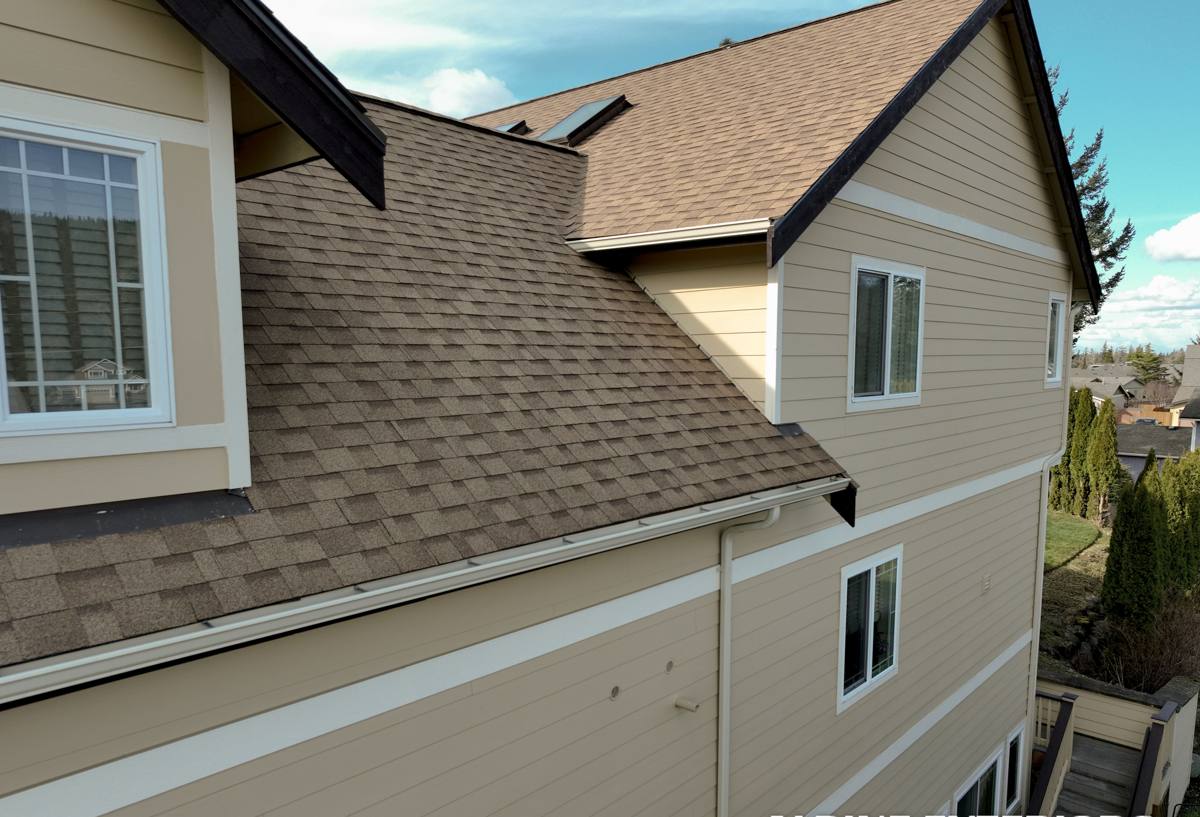
How Moisture Actually Gets Into Siding
Siding doesn't have to be flooded to fail. In this climate, the damage usually comes from a handful of predictable entry points:
- Butt joints and seams — where two pieces of siding meet, caulk or sealant is doing the work. When it shrinks, cracks, or is applied inconsistently, water gets behind the material instead of running off it.
- Bottom edges — the lowest few inches of any siding board sit closest to splashback, sprinkler overspray, and standing moisture near grade. This is almost always where rot starts first.
- Fastener penetrations — every nail or screw is a tiny hole. Over-driven fasteners, wrong fastener spacing, or the wrong fastener type all create paths for water to track inward.
- Panel edges around windows and trim — flashing detail work matters more than the siding material itself at these transitions.
- Capillary draw — some materials will pull moisture upward through the fibers of the board itself, even without an obvious opening, if the surface coating is compromised.
Salt air makes all of this worse. Airborne salt is hygroscopic — it holds onto moisture rather than letting a surface dry quickly between rain events. A board that would dry out in a day in a drier inland climate can stay damp noticeably longer here, especially on north- and west-facing walls that see less direct sun.
Moss and Algae Aren't Just Cosmetic
A lot of homeowners treat green or black staining on siding as a look problem to power-wash away. It's worth understanding what's actually happening: moss and algae need sustained moisture to grow, which means any surface hosting visible growth is a surface that's staying wet longer than it should. That's a moisture-retention problem first and an appearance problem second. Left alone through several wet seasons, that retained moisture is exactly what accelerates rot in moisture-sensitive materials underneath a failing paint or coating layer.
Why Some Siding Materials Handle This Better Than Others
Not all siding responds to moisture the same way, and this is the core of why we made the choice we did as a company. We install James Hardie fiber cement exclusively — we don't install LP SmartSide, vinyl, Cemplank, Allura, primed spruce, or cedar. That's not a marketing position; it's a standard we settled on after weighing how each material category actually behaves over 15-20 years in a wet, salt-influenced climate like this one.
| Material | Moisture behavior in this climate | Long-term maintenance reality |
|---|---|---|
| Wood-based composite (LP SmartSide) | Engineered wood strand core; edges and cut ends need diligent sealing or moisture can wick in over time | Manufacturer requires specific caulking and paint maintenance to preserve warranty coverage |
| Vinyl | Doesn't absorb water itself, but doesn't manage bulk water behind the panel either — relies entirely on drainage plane and house wrap doing their job | Low upkeep on the material, but hides moisture problems behind it until they're advanced |
| Cemplank / Allura (other fiber cements) | Similar base chemistry to Hardie, but factory finish systems and climate-specific product engineering vary by manufacturer | Warranty and finish performance depend heavily on the specific product line and installer familiarity |
| Primed spruce / cedar | Natural wood — attractive, but inherently moisture-permeable; primed spruce especially needs a finish coat promptly and ongoing recoating | Requires the most active maintenance cycle of any option: recoating, caulk renewal, and inspection |
| James Hardie fiber cement (HZ5/HZ10 lines) | Engineered specifically for climate zones with sustained moisture exposure; dimensionally stable, doesn't swell or wick the way wood-based products can | ColorPlus factory finish is baked on and warranted separately from the substrate — no recoating cycle in normal use |
To be fair to the products we don't install: none of them are junk. LP SmartSide holds paint well and is a real cost-effective option. Vinyl is genuinely low-maintenance where it's appropriate. Cedar and primed spruce give a natural look plenty of homeowners want. The trade-offs are real, though, and in a climate that gives siding fewer dry days per year than most of the country, we decided we didn't want to be the contractor telling a Custer homeowner five years later that their siding needs recoating, resealing, or panel replacement because the material simply asks for more upkeep than most people realize going in.
What Correct Installation Prevents (and What It Can't)
It's worth being honest that no siding material is moisture-proof if it's installed wrong. Good material choice and good installation are two separate things, and both matter:
- Proper starter strip and clearance from grade so the bottom edge isn't sitting in splashback
- Correct fastener type, spacing, and drive depth per the manufacturer's climate-specific installation instructions
- Weather-resistive barrier and flashing integrated correctly at every window, door, and penetration — not just tucked behind the siding
- Rain screen or drainage gap detailing where the wall assembly calls for it, so incidental moisture has somewhere to go
- Factory-cut and factory-primed or factory-finished edges used wherever possible, with field cuts sealed per spec
Even the best-engineered fiber cement will underperform if any of the above is skipped. This is why we treat installation detail work as equally important as the material decision — a Hardie board installed with the wrong flashing detail can still let water in behind it.
Reading the Warning Signs Before They Become Repairs
Because rot develops slowly, catching it early is almost always cheaper and less invasive than catching it late. A few things worth checking on your own exterior a couple of times a year, especially heading into and out of our wet season:
- Soft spots — press gently on siding near the bottom edge and around windows. Any give or sponginess is a sign moisture has already gotten in.
- Paint or finish that's bubbling, peeling, or chalking unevenly — a coating failing in one localized spot, rather than uniformly with age, usually points to a moisture source, not just sun exposure.
- Persistent dark streaking or green growth in the same spots every year — a sign that area isn't drying between rain events.
- Visible gaps at seams or trim where caulk has shrunk away from the joint.
- Warping or waviness visible from a distance, especially on wood-based products.
None of these mean the whole wall needs replacing. Caught early, most are a repair, not a project. Caught late, after a few more wet seasons working on the same weak point, they usually aren't.
What This Means for a Custer Property Specifically
Location on your lot matters more here than in a drier climate. Walls facing the water or open to prevailing weather take the brunt of driving rain and salt exposure; north-facing walls that don't get much sun dry the slowest and tend to hold onto moss the longest. If you're planning any siding work — a repair, a partial replacement, or a full re-side — it's worth having a contractor look at your home wall by wall rather than assuming uniform wear. In our experience across Whatcom County, the exposed and shaded sides of a house are frequently years ahead of the sheltered, sun-facing sides in terms of moisture-related wear, even on the same home with the same siding installed the same year.
When Repair Makes Sense vs. When Replacement Does
Homeowners often ask us to give a straight answer on this, so here's the honest version:
- Localized soft spots or damage limited to a small area, on siding that's otherwise sound, is usually a repair — cut out the damaged section, address the moisture source, patch correctly.
- Recurring problems at the same seams or trim details across multiple areas of the house often point to a systemic installation issue, which repair alone won't fix — the underlying flashing or drainage detail needs correcting.
- Widespread softness, warping, or finish failure across most of the exterior, especially on a wood-based or composite product past the 15-20 year mark, is usually a sign the material has reached the end of what it can reasonably give back in repairs.
We'll always tell you honestly which category your situation falls into rather than defaulting to a full re-side recommendation.
A Straightforward Maintenance Checklist
Whatever siding is currently on your home, a short annual routine goes a long way in this climate:
- Rinse siding (low-pressure, not a pressure washer aimed directly at seams) once or twice a year to clear salt residue, pollen, and early moss growth
- Trim back vegetation and tree branches so walls get airflow and sun exposure to dry out between rain events
- Re-caulk any joints where sealant has visibly shrunk, cracked, or separated
- Check and clear gutters and downspouts before the wet season so overflow isn't running down the wall
- Confirm sprinkler heads and irrigation aren't spraying directly onto siding
- Walk the exterior after any major windstorm to check for loose panels, trim, or flashing
Get an Honest Look at Your Siding
If you're noticing soft spots, staining that won't rinse off, or siding that's due for its next maintenance cycle, we're happy to take a look and give you a straight answer about what you're dealing with — no pressure, no upsell script. Reach out for a free estimate and we'll walk your home's exterior with you.