 Custer
 Why Cherry Point Siding Wears Out Faster Than You'd Expect
Cherry Point sits right where the Strait of Georgia meets Whatcom County's shoreline, and that location is exactly why siding here fails on a different timeline than siding fifteen miles inland. Homes out on the point take a steady diet of salt-laden air, wind-driven rain that hits walls sideways instead of falling straight down, and a moss season that can run eight or nine months out of the year in a wet stretch. None of those things show up overnight. They show up as a slow, cumulative breakdown that most homeowners don't notice until paint is peeling, boards are soft at the bottom edge, or a contractor pulls a piece of trim off and finds rot underneath that's been building for years.
Salt air is corrosive to more than metal. It accelerates the breakdown of paint film and caulk, which are the first line of defense on most siding materials. Once that film starts chalking and cracking, whatever's underneath — wood fiber, OSB substrate, even some engineered products — starts absorbing moisture every time it rains. And on Cherry Point, it rains sideways often enough that "protected" wall areas under eaves don't stay protected the way they would on a home a few miles inland.
Moss is the third factor, and it's the one most homeowners underestimate. Moss doesn't just grow on roofs. It colonizes north-facing siding, the undersides of window trim, and anywhere air doesn't move freely — and it holds moisture against the wall surface for weeks at a time. On materials that aren't built to shrug off sustained dampness, that's a slow rot sentence.
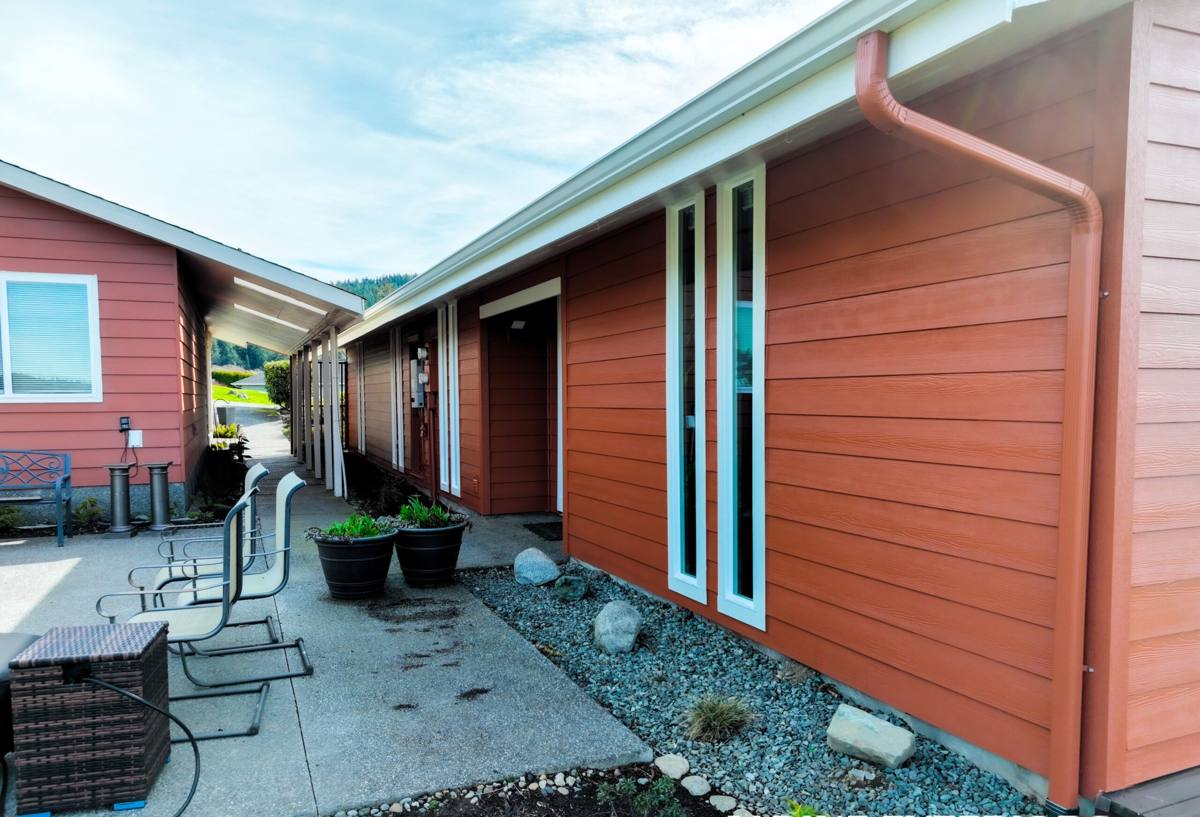
What "Correct" Actually Means for a Cherry Point Replacement
A siding replacement job done right out here isn't just swapping old boards for new ones. It's addressing the conditions that wore out the old siding in the first place, so the new siding doesn't follow the same path. That means:
- Full tear-off to bare sheathing so we can actually see what's happening underneath — not just re-siding over hidden rot
- Repair or replacement of any damaged sheathing and framing before a single new board goes up
- A correctly lapped, code-compliant weather-resistive barrier (house wrap) installed shingle-style so water sheds outward, not inward
- Proper flashing at every window, door, deck ledger, and roof-to-wall intersection — these are the spots where driving rain finds its way in
- Rainscreen or drainage gap detailing where the wall assembly calls for it, so any moisture that does get behind the siding has somewhere to go besides sitting against the wood
- A siding material that's actually engineered to handle sustained moisture and salt exposure, not one that merely tolerates it in a dry climate
Skip any of those steps and you can end up with siding that looks great for two or three years and starts failing at year six — which is exactly the pattern we see on a lot of tear-offs out here.
Why We Don't Cut the Tear-Off Corner
It's tempting, and cheaper, to side over existing material. Some contractors will offer it. On Cherry Point specifically, we don't recommend it, because the whole point of a replacement is fixing what salt air, rain, and moss have already been doing to the wall assembly. Covering that up without inspecting it just delays the discovery of a bigger problem — and often makes that problem worse by trapping moisture that was previously able to dry out.
Why We Only Install James Hardie Fiber Cement
We standardized on James Hardie fiber cement siding for every job we do, and in an environment like Cherry Point that decision matters more than usual. Fiber cement is non-combustible, dimensionally stable, and doesn't absorb and swell with moisture the way wood-based products can. That combination is exactly what a salt-air, high-rain coastal exposure calls for.
James Hardie also makes climate-engineered product lines — its HZ5 line, for example, is formulated for wetter, harsher climates like the Pacific Northwest coast, as opposed to the HZ10 formulation built for hot, dry regions. We spec the version that matches Whatcom County's actual weather, not a one-size-fits-all product.
The factory-applied ColorPlus finish is another piece of this. It's baked on and warranted separately from the substrate, which means the paint layer — the thing salt air degrades fastest — is engineered and tested for exactly this kind of exposure, rather than being job-site paint applied over primed material and left to weather on its own.
What We Don't Install, and Why
We get asked fairly often about vinyl, LP SmartSide, and primed wood siding, since all three are common around Whatcom County and all three cost less upfront than fiber cement. Here's our honest read on each, specific to a Cherry Point exposure:
- Vinyl holds up fine in mild climates, but it becomes brittle in cold snaps and can warp or bow under sustained heat and direct sun exposure on south-facing walls. It also can't be repainted to refresh its color, which matters when salt air dulls a finish over time.
- LP SmartSide (engineered wood) performs well when installation and caulking are perfect and stay perfect, but it's a wood-fiber product at its core — sustained moisture exposure at seams, cuts, and butt joints is its real vulnerability, and that's precisely the failure mode driving rain and moss create.
- Primed wood or cedar looks great and has real character, but it demands a repainting and caulking maintenance cycle that's shorter out here than almost anywhere else in the county, simply because the paint film takes more abuse from salt air and UV.
None of these are bad products in the abstract — they're just not what we're willing to warranty our labor against on a site with this exposure profile. Fiber cement is.
Material Comparison for a Coastal Whatcom County Exposure
| Material | Moisture Behavior | Salt Air / UV Durability | Maintenance Cycle |
|---|---|---|---|
| James Hardie Fiber Cement | Dimensionally stable, doesn't swell or rot | Factory ColorPlus finish engineered for harsh coastal exposure | Occasional wash; repaint only if ever desired, not required |
| Vinyl | Doesn't absorb water, but can warp/bow with heat cycling | Fades and chalks over time; can't be refinished | Low, but limited lifespan in full sun/wind exposure |
| LP SmartSide | Wood-fiber core vulnerable at seams and cuts | Requires perfect, ongoing caulk maintenance | Regular caulk/paint inspection, especially at joints |
| Primed Wood / Cedar | Absorbs moisture readily if finish fails | Paint film breaks down faster under salt air and UV | Repaint every few years; most maintenance-intensive option |
Our Process on Cherry Point Jobs
- On-site assessment — we walk the exterior, check for existing moisture damage, and look at exposure direction (which walls take the worst of the wind and rain)
- Tear-off and inspection — old siding comes off, sheathing gets inspected, and any rot or damage gets documented and repaired before moving forward
- Weather barrier and flashing — house wrap, window and door flashing, and any drainage plane detailing goes in per code and per the specific exposure of that wall
- Hardie installation — installed to James Hardie's fastening, clearance, and caulking specifications, which is what keeps the manufacturer's warranty valid
- Final detail pass — trim, caulking at penetrations, and a walk-through so you know what was done and why
Why It Matters That We Already Work This Area
A crew that's already worked Cherry Point and the surrounding Custer shoreline knows which walls on a given lot typically take the worst weather, knows the Whatcom County permitting process for exterior work, and isn't guessing at material specs for the first time on your house. That familiarity shows up in fewer surprises mid-job and a tear-off crew that already knows what kind of hidden damage to expect from this specific stretch of coastline — because they've seen it before, on the house next door or down the road.
Cost Factors for a Cherry Point Replacement
Every home is different, but the factors that move the price on a coastal replacement here are fairly consistent:
| Factor | Why It Matters Here |
|---|---|
| Extent of hidden moisture damage | Salt air and driving rain accelerate rot behind old siding; more repair work means more cost |
| Wall exposure | Walls facing prevailing wind and rain often need more flashing detail and sometimes a drainage gap |
| Home size and complexity | More corners, windows, and roof-to-wall intersections mean more flashing and labor time |
| Siding profile and color | ColorPlus finishes and certain plank profiles carry different material costs |
| Site access | Waterfront and point-adjacent lots sometimes have tighter access for staging material |
What to Check Before Hiring Anyone for This Job
- Are they doing a full tear-off, or offering to side over existing material?
- Will they inspect and repair sheathing before installing new siding, and is that written into the estimate?
- Do they install to the manufacturer's fastening and clearance specs (this is what keeps a Hardie warranty valid)?
- Have they worked on homes in this specific exposure — coastal Whatcom County, not just "the general area"?
- Is the warranty transferable if you sell the home?
- Are they licensed and insured for exterior work in Washington State?
If a bid doesn't mention tear-off, flashing detail, or moisture inspection at all, that's usually a sign the estimate was built around speed rather than around what a coastal exposure actually requires.
Maintenance After Installation
One of the practical advantages of fiber cement in a moss-prone, salt-air environment is how little ongoing maintenance it asks for. A periodic rinse to keep moss and salt residue from building up, an annual check of caulking at trim and penetrations, and that's most of it. There's no repainting cycle to plan around and no seams that need re-caulking every couple of years just to keep water out — which, on a point exposed to wind and rain the way Cherry Point is, is worth more than it might sound like on paper.
If your siding is showing its age — chalking paint, soft spots near the bottom of walls, or moss that keeps coming back no matter how often you clean it — we're happy to take a look and give you a straight answer on what's going on and what it would take to fix it right. Reach out for a free, no-pressure estimate and we'll walk your home's exterior with you.