 Custer
 What Sumas Roofs Are Up Against
Sumas sits at the north edge of Whatcom County, close enough to the Salish Sea and the Fraser Valley that the weather here isn't like a roof's weather fifty miles inland. Homes take a steady combination of moist marine air, wind-driven rain, and long stretches of shade and dampness that keep moss active most of the year. A roof that's correctly built for this stretch of Whatcom County is doing a different job than a roof built for a dry inland climate, and it shows up in the materials, the flashing details, and how often a roof needs attention.
Salt Air and Slow Corrosion
The marine air that moves through this part of Washington carries salt and moisture that settle on metal flashing, fasteners, and vents year-round. It's a slow process, not a dramatic one, but it's constant. Fasteners and flashing that aren't rated for this kind of exposure corrode faster than homeowners expect, and once flashing starts to go, water finds its way in long before a homeowner notices a stain on the ceiling.
Driving Rain and Wind
Whatcom County storms don't just drop rain straight down — wind pushes it sideways, up under shingle edges, and into any gap in the flashing around chimneys, skylights, and roof-to-wall transitions. A roof system that relies on shingles alone to keep water out, without proper underlayment and flashing behind them, is a roof that's going to leak eventually. It's just a matter of which storm finds the weak spot first.
A Long Moss Season
Between the shade from mature trees common on Sumas lots and the near-constant dampness for much of the year, moss has a long growing season here. Moss doesn't just look bad — it holds water against the shingle surface, works its way under tabs, and lifts material as it grows. A roof that isn't detailed to shed water and dry out between rains will host moss faster and lose shingle life to it.
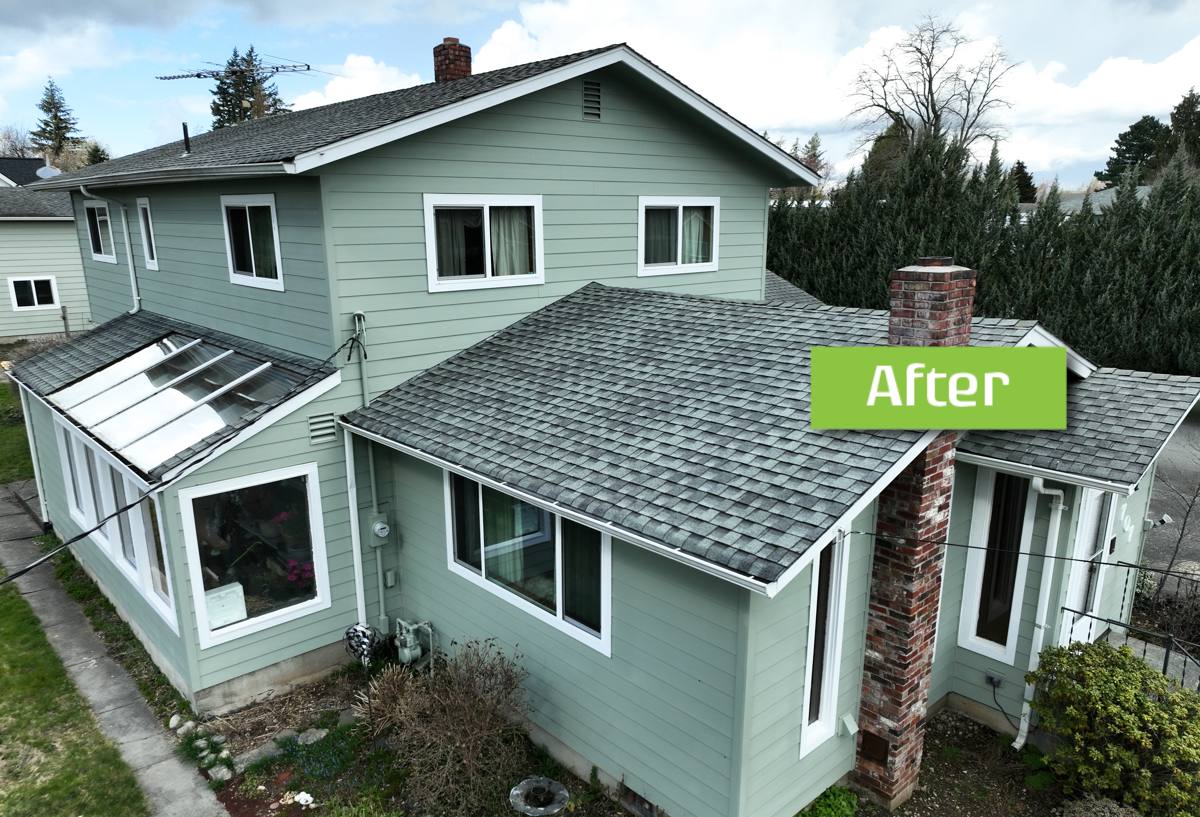
Signs a Sumas Roof Needs Replacement, Not Another Patch
Not every roof problem calls for full replacement, but there's a point where patching stops making sense — where the cost of repeated repairs, and the risk of a repair failing to catch a hidden problem, outweighs the cost of starting fresh. Here's what we look for:
- Granules collecting in gutters or at downspout outlets, showing the shingle surface is wearing thin
- Shingles that are curling, cupping, or cracking, especially on south- and west-facing slopes
- Moss mats thick enough to lift shingle edges rather than just sitting on the surface
- Soft or spongy spots when walking the roof, which usually means the decking underneath has taken on moisture
- Daylight visible through the roof deck from inside the attic
- Water stains on interior ceilings or attic framing, even faint or old-looking ones
- A roof at or past 20–25 years old (typical asphalt shingle lifespan) with more than one layer of repairs already done
- Rising frequency of repair calls for the same general area of the roof
If two or three of these are present at once, it's usually more cost-effective over time to replace than to keep chasing individual repairs.
What a Correct Roof Replacement Actually Involves
Tear-Off and Deck Inspection
A proper replacement starts with a full tear-off down to the deck — not a layover on top of old shingles. That's the only way to actually see the condition of the decking, catch soft or rotted sheathing before it's covered back up, and confirm the roof is starting from a solid, dry base. Any damaged decking gets replaced before anything else goes down.
Underlayment and Ice-and-Water Barrier
Given how much wind-driven rain this area sees, underlayment choice matters more here than it would somewhere drier. A synthetic underlayment holds up better than old-style felt paper under prolonged damp conditions, and self-adhered ice-and-water membrane belongs at eaves, valleys, and any roof-to-wall transition where wind-driven water is most likely to find a way in.
Flashing Details
Flashing is where most roof leaks actually start, not in the field of the shingles themselves. Chimneys, skylights, vent pipes, and any place a roof plane meets a wall need flashing that's installed correctly and made of a material that can handle the salt-laden air without corroding out in a few years. This is the detail work that separates a roof that lasts from one that leaks within five years.
Ventilation
Proper intake and exhaust ventilation keeps the attic dry and temperature-balanced, which protects the new decking and shingles from the inside and reduces the moisture that helps moss and mildew take hold. A replacement is the right time to correct ventilation that was never adequate to begin with — it's far more disruptive to fix afterward.
Picking the Right Material for Whatcom County Weather
There's no single "best" roofing material for every home — it depends on budget, roof pitch, and how much maintenance a homeowner wants to take on. Here's how the common options hold up under Sumas conditions:
| Material | Typical Lifespan | Moss & Moisture Behavior | Relative Upfront Cost |
|---|---|---|---|
| Asphalt composition shingle | 20–30 years | Susceptible to moss without maintenance; wide range of quality tiers | $ |
| Architectural / laminate shingle | 25–35 years | Better shedding profile than basic 3-tab; still needs moss upkeep | $$ |
| Standing seam metal | 40–60 years | Sheds water and moss well; needs coastal-rated fasteners and finish | $$$ |
| Synthetic/composite shake | 30–50 years | Resists moisture absorption better than wood shake; consistent appearance | $$$ |
For most Sumas homes, a quality architectural shingle with correct underlayment and flashing is the practical middle ground — real durability without the cost jump of metal. Homes with steeper pitches, heavy tree cover, or owners planning to stay long-term often see the value in metal instead, where the higher upfront cost is offset by decades less maintenance.
How We Handle a Roof Replacement in Sumas
- On-site inspection of the current roof, decking, attic ventilation, and flashing points, with photos and a written scope
- A clear estimate that breaks out material, labor, and any decking repair as a separate line item so there are no surprises
- Scheduling around realistic weather windows — we don't tear off a roof and leave it exposed to a Whatcom County storm system
- Full tear-off, deck inspection, and replacement of any compromised sheathing
- Installation of underlayment, ice-and-water barrier at vulnerable areas, new flashing, and the chosen roofing material
- Ventilation check and correction where the existing setup was inadequate
- Full site cleanup, including a magnetic sweep for stray fasteners
- Final walkthrough with the homeowner and warranty paperwork handed over in writing
What Affects the Cost of a Sumas Roof Replacement
| Factor | Why It Moves the Price |
|---|---|
| Roof size and pitch | More square footage and steeper pitches mean more material and more labor time/safety setup |
| Number of existing layers | Tear-off and disposal cost more when a roof has two or more layers to remove |
| Decking condition | Rotted or soft sheathing found during tear-off has to be replaced before the new roof goes on |
| Material choice | Asphalt, architectural shingle, and metal sit at different price tiers, as shown above |
| Ventilation upgrades | Adding or correcting intake/exhaust venting is easiest and most cost-effective during a full replacement |
| Site access | Steep driveways, limited staging area, or difficult roof access can add setup time |
We walk through these factors on-site before writing an estimate, so a homeowner knows exactly what's driving the number rather than getting a flat quote that doesn't match the actual roof.
Why Hiring a Crew That Already Works in Sumas Matters
A roof replacement done right depends on more than just installing shingles correctly — it depends on knowing the conditions the roof has to survive. A crew that already works throughout Whatcom County knows which flashing materials hold up against the marine air, how aggressive the moss growth gets on shaded lots, and how to read a weather window well enough to keep a torn-off roof from sitting exposed. Working out of Custer, we're not driving in from out of the area to learn these conditions on a homeowner's roof — we already build for them.
Familiarity with Whatcom County permitting and inspection requirements also keeps a project moving instead of stalling on paperwork. That's a small thing until it isn't — a permit delay in the middle of a wet season can leave a roof exposed longer than it should be.
Keeping a New Roof Performing Through Moss Season
A correctly installed roof still benefits from some upkeep, especially in a climate with this much sustained moisture. A few habits go a long way toward protecting the investment:
- Keep gutters and downspouts clear so water has somewhere to go during heavy rain
- Trim back tree limbs that shade the roof and keep it damp longer than it needs to be
- Treat moss growth early with a roof-safe treatment rather than letting mats build up over a season
- Have the roof looked at after major windstorms, since lifted flashing or shingles aren't always visible from the ground
- Schedule a periodic inspection every couple of years even if nothing seems wrong — small issues are cheap to fix early and expensive to ignore
If you're weighing a roof replacement for a home in Sumas or anywhere else in Whatcom County, we're happy to take a look and give you a straightforward, no-pressure estimate. There's a form below — reach out and we'll get a time on the calendar.