 Custer
 Why Point Roberts Windows Take More Punishment Than Most
Point Roberts sits on its own peninsula at the southern tip of the Tsawwassen headland, surrounded on three sides by the Strait of Georgia and Boundary Bay. That location is what makes the place special, and it's also what makes window replacement here a different job than it is a few miles inland. Homes get near-constant exposure to salt-laden marine air, wind-driven rain off the water, and the long, damp moss season that Whatcom County is known for. None of that is dramatic on any single day, but it adds up year after year on the same window frames, sills, and seals.
Salt air is corrosive to unprotected metal hardware and fasteners, and it accelerates the breakdown of some finishes faster than manufacturers' standard warranty testing accounts for. Driving rain finds any weak point in flashing or sealant and pushes water sideways and upward, not just down, which is why a window that would be fine in a sheltered inland yard can fail early on a Point Roberts home facing open water. And moss and algae growth on north-facing walls and sills holds moisture against wood and trim for months at a time, which is exactly the condition that rots frames and breeds mold if a window isn't detailed correctly. A custom window job out here has to account for all three at once.
What "Custom" Actually Means for a Window Job
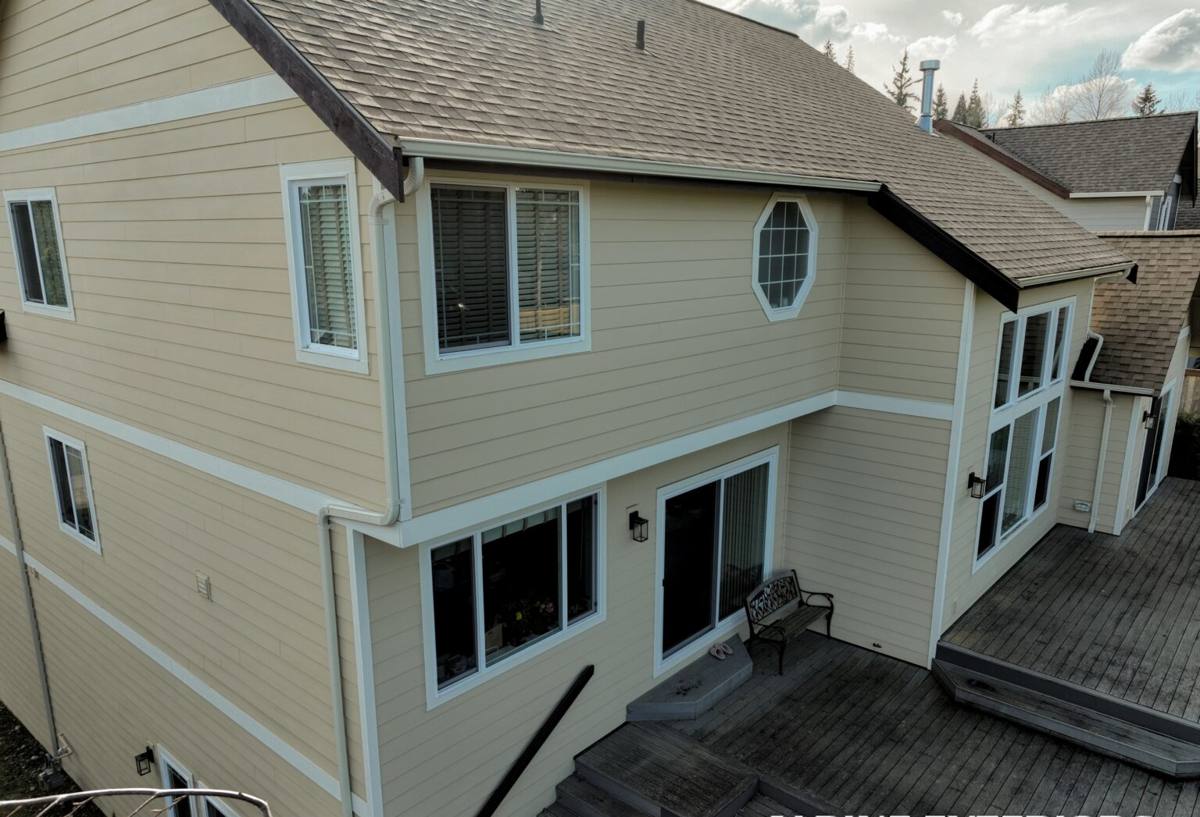
"Custom windows" doesn't just mean an odd shape or an unusual size, though that's part of it — a lot of homes in this area have additions, older framing, or settled openings that stock sizes don't fit cleanly. It also means matching the right window construction, glass package, and installation method to the specific wall, orientation, and exposure of each opening on your house. A window facing the water on the west or north side needs different attention than one tucked under an eave on a sheltered side.
Retrofit (Pocket) Replacement
When the existing frame is square, solid, and free of rot, we can often install a new window inside the old frame. This is faster, less disruptive to your siding and interior trim, and usually less expensive. It only works if the old frame is genuinely sound — we won't recommend it just because it's the cheaper option if we find soft wood or old water damage once we open things up.
Full-Frame Replacement
If there's rot, the frame is out of square, or we're changing the size or style of the opening, the job goes to full-frame. This means pulling the window and trim down to the rough opening, inspecting and repairing the framing and sheathing underneath, and rebuilding the flashing and moisture barrier from scratch. It costs more and takes longer, but on a home with real water exposure — which describes a lot of Point Roberts properties — it's often the only way to actually fix the underlying problem instead of covering it up.
Choosing the Right Frame Material for a Salt-Air Environment
Frame material matters more here than it does in a drier, inland climate. Every material has trade-offs, and the right choice depends on your budget, the window's exposure, and how much upkeep you're willing to do.
| Material | Behavior in Salt Air / Moisture | Maintenance | Best For |
|---|---|---|---|
| Vinyl | Doesn't corrode or rot; welded corners resist water intrusion well | Low — occasional cleaning | Most Point Roberts homes, budget-conscious replacements |
| Fiberglass | Very stable, resists moisture and salt exposure with minimal expansion/contraction | Low | Exposed, water-facing walls where long-term stability matters |
| Wood-clad (composite exterior) | Good if the cladding is fully intact; any breach exposes wood to rot and moss growth | Moderate to high | Homeowners prioritizing interior wood appearance, sheltered exposures only |
| Aluminum | Prone to corrosion and pitting in direct salt air unless properly coated; also conducts cold and can condensate | Moderate | Limited use here — we generally steer clients away from it on exposed walls |
We're not tied to one material for every job. What we won't do is put a wood-clad or bare aluminum window on a wall that takes direct salt spray and driving rain without being upfront about the added maintenance and risk. That's a judgment call we make with you, not a sales pitch.
Glass Packages: What Actually Matters Here
Beyond the frame, the glass package affects comfort, condensation, and energy bills. In a marine climate like this one, condensation resistance is often as important as insulation value, because damp indoor air meeting a cold pane of glass is a common source of window sill moisture and, eventually, mold or rot at the sill.
- Low-E coatings reduce heat loss and help manage solar gain without noticeably darkening the glass
- Gas-filled sealed units (typically argon) improve insulation between panes and reduce interior condensation risk
- Double-pane is standard and performs well for most Point Roberts homes when paired with a good frame and correct installation
- Triple-pane adds cost and weight but can be worth it on north- or west-facing rooms that take the brunt of wind and cold off the water
Glass quality alone won't save a window with poor flashing or a bad seal at the frame. We treat the glass package as one part of the system, not the whole solution.
Flashing, Sealing, and Moisture Management — The Part That Actually Prevents Failure
This is the step that separates a window that lasts decades from one that starts leaking in a few years, and it's also the step that's easiest to rush. Proper installation in a driving-rain environment means:
- Inspecting and repairing the rough opening and sheathing before the new window goes in — not covering up existing damage
- Installing sill flashing that sheds water outward, not just a bead of caulk at the bottom
- Layering house wrap and flashing tape so water is always directed over the layer below it, following correct shingle-lap order
- Sealing the interior air barrier separately from the exterior water barrier — these serve different jobs and shouldn't be combined into one caulk line
- Using fasteners and hardware rated for coastal or high-moisture exposure, not standard interior-grade hardware
A window that looks correctly installed from the outside can still fail here if these layers are done out of order or skipped. It's not a visible difference on install day — it shows up two or three wet seasons later as a soft spot at the sill or staining on interior trim.
Our Installation Process
We keep the process straightforward and try to minimize the time your home is open to the weather, which matters more here than in a drier climate:
- On-site assessment — we look at each opening individually, check for existing rot or moisture damage, and note exposure direction
- Measurement and material selection — custom sizing where needed, frame and glass package matched to that specific opening's exposure
- Removal and inspection — old window comes out, framing and sheathing get inspected and repaired as needed before anything new goes in
- Flashing and installation — new window set, shimmed level and plumb, flashed and sealed in the correct layered order
- Interior and exterior finish work — trim, sealant, and touch-up so the job looks finished inside and out
- Final walkthrough — we check operation, seals, and answer questions before we consider the job done
Signs Your Current Windows Are Already Failing
A lot of Point Roberts homeowners live with window problems for years before calling anyone, mostly because the signs are gradual. Worth checking for:
- Fogging or haze between the panes of a double- or triple-pane window (the seal has failed and can't be repaired, only replaced)
- Noticeable drafts at the frame edges even when the window is fully closed and latched
- Windows that are difficult to open, close, or latch — often a sign the frame has shifted or swollen
- Soft or discolored wood at the sill, especially on north-facing or water-facing walls
- Moss or dark staining building up on the sill or lower frame
- Condensation forming on the inside of the glass or frame regularly, not just on the coldest mornings
- A noticeable jump in heating costs without another clear explanation
Any one of these on its own isn't necessarily urgent. Several together, especially on the same wall, usually mean it's worth having someone look before it turns into a framing repair.
Living With Windows in a Marine, Moss-Prone Climate
Even a well-installed window needs some upkeep here. Rinsing salt residue off exterior frames and hardware periodically helps slow corrosion and finish wear, especially on walls facing open water. Keeping gutters and nearby vegetation clear reduces the moisture and shade that let moss establish on sills and trim. And it's worth doing a quick visual check of caulking and sealant at the frame edges once a year — sealant is a wear item everywhere, but it wears faster under Whatcom County's rain and salt exposure than it does in a lot of the country. Catching a cracked bead of caulk early is a five-minute fix; ignoring it for a couple of wet seasons can turn into a sill repair.
Why Hiring a Crew That Already Works in Point Roberts Matters
Point Roberts is a peninsula exclave — reaching it by land means crossing an international border, which affects scheduling, material delivery, and how a crew plans a job day. A contractor who doesn't already work this area regularly may not account for that in their timeline or pricing, and that can turn into delays or surprises partway through your project. We already know how to plan logistics for this specific area, which means fewer surprises for you.
Just as important is familiarity with how homes here actually weather. A crew that mostly works drier, inland neighborhoods may default to standard techniques that hold up fine there but aren't built for direct salt air and driving rain. Getting the flashing detail, frame material, and hardware choice right for this specific exposure isn't guesswork when you've already done it on other homes nearby.
If you're weighing whether your current windows need attention, or you're ready to plan a custom replacement for a Point Roberts home, we're happy to take a look and give you an honest read on what's needed — no pressure, no upsell. Use the form below to request a free estimate.