 Custer
 Building a Deck That Actually Holds Up in Nooksack
Nooksack sits close enough to the water and the lowland river valleys around Custer that decks here take a beating most homeowners don't fully appreciate until a few winters go by. It's not one big storm that causes the damage — it's the steady combination of salt-laden air blowing in off the Strait, driving rain that comes in sideways more often than straight down, and a moss season that can stretch from October into May. A deck built with generic, big-box specs might look fine for the first year or two. The problems show up in year three, four, or five: soft spots near the ledger board, corroded fasteners, slick green decking, and railings that start to wobble because the posts were never really protected from standing water.
This page is about deck building specifically for homes in and around Nooksack — what the climate demands, what a correctly built deck involves, and how we approach the work so it's still solid a decade from now.
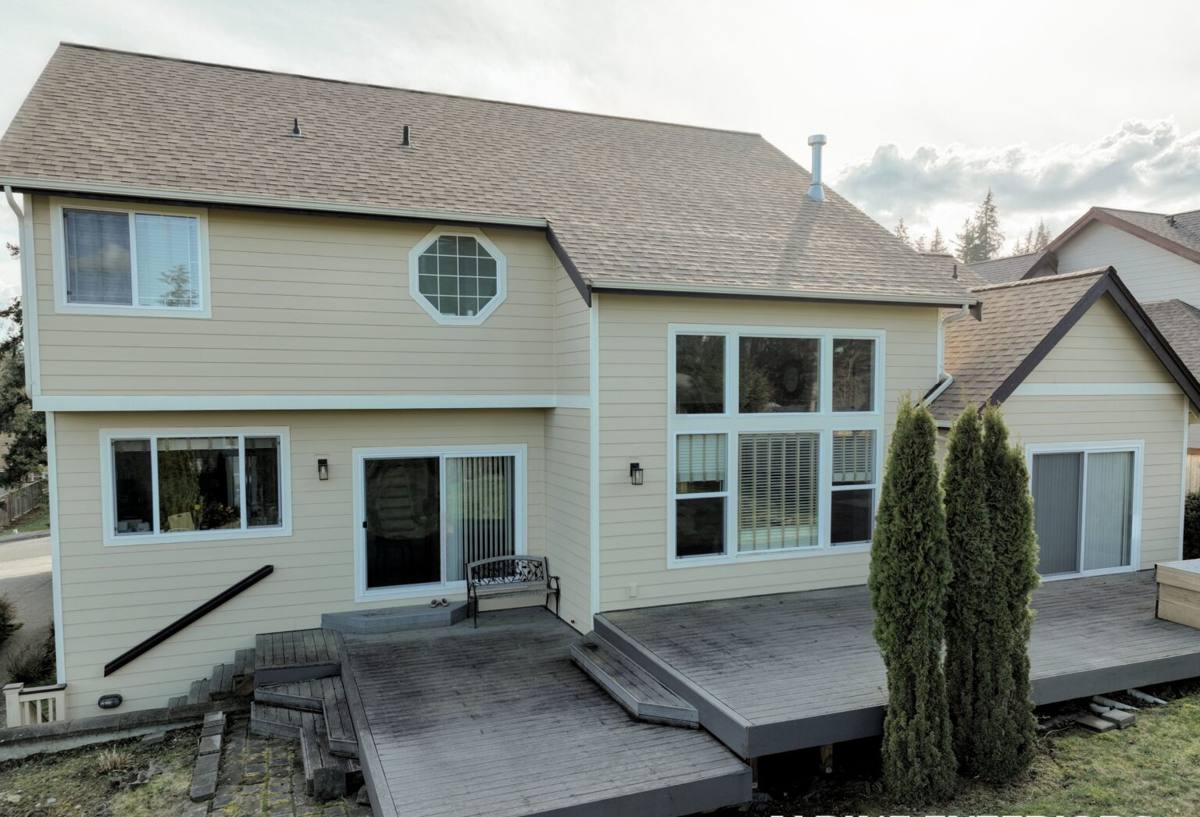
What Whatcom County's Climate Actually Does to a Deck
Salt Air and Corrosion
Being this close to Puget Sound and the Strait of Georgia means a fine mist of salt is in the air more often than most people realize, even miles inland. Salt air accelerates corrosion on anything metal — fasteners, joist hangers, structural screws, railing hardware. A deck fastened with standard interior-grade or even generic exterior screws will show rust streaks and weakened connections years before a deck built with fasteners rated for coastal exposure.
Driving Rain and Water Intrusion
Rain in this part of Whatcom County doesn't always fall straight down. Wind-driven rain gets pushed up under railings, into ledger connections, and behind fascia boards if those areas aren't properly flashed. Once water gets behind a ledger board or into end-grain cuts that weren't sealed, rot starts from the inside where you can't see it until a board is already soft.
Moss Season
Moss and algae growth is a near year-round concern on shaded or north-facing decks in this area, and it gets worse through the long wet stretch from fall through spring. Beyond being unsightly, a mossy deck surface is a genuine slip hazard, and moss holds moisture against the decking material, which shortens its life whether it's wood or composite.
What a Correctly Built Nooksack Deck Requires
A deck built for this specific climate isn't about upgrading everything to the most expensive option — it's about getting a handful of details right that generic construction often skips.
- Ledger board flashing that actually sheds water away from the house, not just a bead of caulk
- Structural fasteners and joist hangers rated for coastal or treated-lumber exposure, not standard interior hardware
- Post bases that keep wood posts off the ground or off concrete, so water doesn't wick up into end grain
- Proper drainage slope on the decking surface so water sheds instead of pooling
- Gapping between deck boards sized correctly for the material, so wood or composite can expand, contract, and drain
- Railing posts anchored in a way that resists both wind load and the slow loosening that comes from repeated wet-dry cycles
Skip any one of these and the deck may still look fine on installation day. The failures in this climate are almost always slow — a loose railing post two years in, a soft ledger connection five years in, hardware bleeding rust stains into the decking.
Decking Material Options for This Climate
There's no single "correct" decking material for every home in Nooksack — it depends on budget, how much maintenance you want to do, and how much shade the deck gets. Here's how the common options actually perform under local conditions.
| Material | Moisture Behavior | Moss/Algae Resistance | Maintenance |
|---|---|---|---|
| Pressure-treated wood | Good rot resistance if sealed regularly; end cuts need attention | Low — needs periodic cleaning and treatment | Annual cleaning, re-sealing every 1-3 years |
| Cedar | Naturally decay-resistant, but softer and can cup if not maintained | Moderate — still needs cleaning in shaded areas | Regular sealing to keep appearance and prevent splintering |
| Composite decking | Doesn't rot, minimal water absorption | Better than wood, but can still grow surface algae in constant shade | Occasional washing, no sealing or staining |
| PVC/capped composite | Fully sealed surface, best moisture performance | Best of the group, easiest to keep clean | Lowest — periodic rinse-off is usually enough |
For decks that sit in mostly shade — which describes a lot of tree-lined lots around Nooksack — we generally steer homeowners away from untreated or lightly-treated wood as a standalone choice, not because the wood itself is bad, but because the maintenance schedule needed to keep it safe and good-looking in constant damp shade is more than most people want to keep up with. That's a maintenance-burden tradeoff, not a knock on wood as a material — it's a great choice for sunnier, better-ventilated deck locations.
Framing and Structure: Where the Real Work Happens
Ledger Attachment
The ledger board — where the deck attaches to the house — is the single most common failure point on older decks in wet climates. We flash it so water is directed out and away from the house band joist, not just sealed with caulk that will eventually crack and let water track in behind the siding.
Footings and Post Bases
Given how saturated the ground gets here for months at a time, footings need to be set below frost depth and sized for the soil conditions on your specific lot. Post bases that hold the post above grade — rather than embedding wood directly in concrete — keep end grain from sitting in standing water through the wet season.
Fasteners and Hardware
Every joist hanger, structural screw, and bolt on a deck in this area should be rated for the exposure it's actually going to see — coastal-grade or stainless where it matters most, particularly anywhere near ground contact or where two dissimilar materials meet.
Railings, Stairs, and the Details That Get Skipped
Railings take a lot of abuse from wind and repeated wet-dry cycling, and post connections are one of the first things to loosen on a poorly built deck. Stair stringers need the same rot-resistant treatment and hardware as the main frame, since they're often more exposed to direct rain than the deck surface itself, especially on open, uncovered stairs. Fascia and skirting details matter too — closed-in skirting that doesn't allow airflow can trap moisture underneath the deck and create a damp, moss-prone environment that's hard to fix after the fact.
Our Process for Nooksack Deck Projects
We approach every deck build or replacement in this area the same structured way:
- On-site assessment — we look at drainage, sun exposure, existing structure (if replacing a deck), and how the house's siding and roofline affect where water lands on the deck area.
- Material and design conversation — we walk through the honest tradeoffs between wood, composite, and PVC decking based on your budget and how much upkeep you want to do.
- Permitting — deck projects in Whatcom County typically require permits depending on size and height; we handle that process as part of the job.
- Framing and structural work — ledger flashing, footings, joist layout, and hardware selection done to hold up to local conditions, not just code minimums.
- Decking, railing, and finish work — proper board spacing, railing anchoring, and stair details.
- Final walkthrough — we go over basic maintenance specific to your deck's material and sun exposure so you know what upkeep actually looks like.
Living With Moss Season: What Maintenance Actually Looks Like
No deck in this part of Whatcom County is fully maintenance-free, even the low-upkeep materials. What changes by material is how much and how often:
- Wood decks generally need a yearly cleaning and a re-seal or stain every one to three years, more often on shaded sections
- Composite and PVC decking mainly need periodic washing to keep surface algae from taking hold, especially in shaded corners
- Gutters and downspouts near the deck should be checked so overflow isn't dumping extra water directly onto the deck surface or framing
- Any skirting or under-deck area should get occasional airflow checks — a fully closed-in space with no ventilation is where moisture and moss problems tend to start
Why Hire a Crew That Already Works in Nooksack
A deck built to a generic national spec sheet isn't wrong, exactly — it's just not built for this specific combination of salt air, sideways rain, and long wet shoulder seasons. Crews who work regularly in Custer and the surrounding Whatcom County communities have already seen which details fail here and which hold up, because we've been called back to fix the ones that didn't. That experience shapes which fasteners we use, how we flash a ledger board, and which materials we recommend for a shaded, low-airflow lot versus a sunny, open one. It's the difference between a deck that needs real repair work in year four and one that's still solid well past year ten.
If you're planning a new deck or need to replace one that's showing its age, we're happy to take a look and give you a straightforward, no-pressure estimate. There's a form below — tell us a bit about your project and we'll go from there.