 Custer
 Window Replacement in Marietta: Building for Direct Marine Exposure
Marietta sits low and close to the water on the flats near Bellingham Bay, in the part of Whatcom County where the land barely rises above the tideline before it meets the Nooksack River delta and Lummi Bay. That geography matters more for window performance than most homeowners expect. Properties here don't just get occasional marine influence carried in on a storm — they sit close enough to open water and tidal flats to take salt-laden air, wind, and driving rain more directly and more often than homes set back a few miles inland. Over years, that exposure works on window frames, hardware, glazing seals, and the wood trim around older openings in ways a drier or more sheltered site never has to deal with.
We replace and repair windows on homes throughout this stretch of Whatcom County, and Marietta is one of the areas where we pay the closest attention to frame material, hardware grade, and flashing detail, because the margin for error is smaller here. A window installed the way it would be in a sheltered inland neighborhood often doesn't hold up the same way on a low, open, water-adjacent lot.
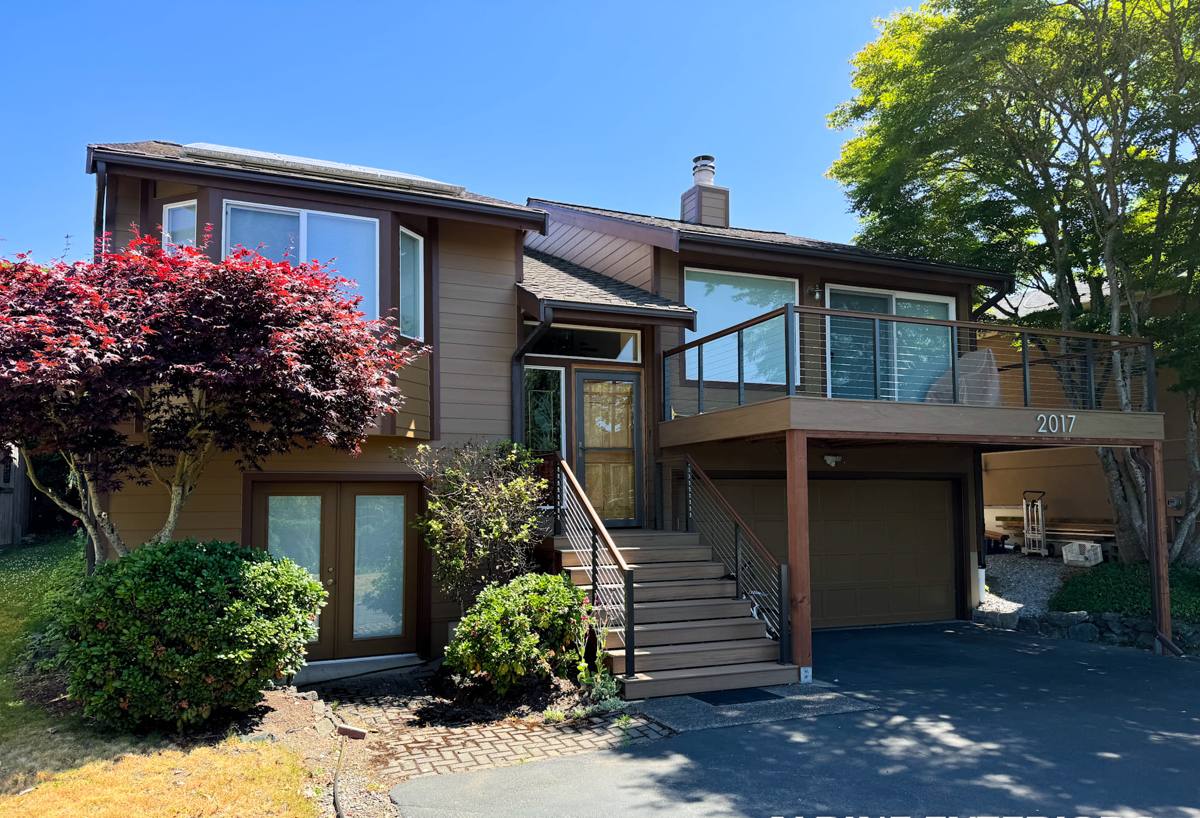
What Marietta's Environment Does to Windows
Direct Salt Air Exposure
Salt-laden air moving off Bellingham Bay and the surrounding tidal flats reaches Marietta more consistently than it does communities set further back from the water. That salt content accelerates corrosion on window hardware, fasteners, and lower-grade frame components. Locks, cranks, and hinges that would last decades in a dry climate can start binding, pitting, or failing years ahead of schedule when they're rated for general use rather than marine-grade exposure.
Driving Rain Off Open Water
Low, open terrain near the water doesn't give storms much to slow down before they reach a house. Rain here often comes in sideways rather than straight down, which pushes water into seams and gaps around window openings that would stay dry in calmer conditions. That's a flashing and installation problem as much as it is a window problem — the unit itself can be well made and still leak if the flashing underneath it wasn't lapped and sealed correctly.
A Long Moss and Mildew Season
The combination of mild temperatures, near-constant humidity, and limited direct sun on shaded or north-facing elevations gives moss and mildew a long growth window across most of the year in this part of Whatcom County. Window sills, trim, and the wood framing around older single-pane windows are common places it establishes first, especially anywhere water lingers instead of draining away cleanly.
Condensation From Humid, Water-Adjacent Air
Homes this close to open water tend to carry more ambient humidity indoors than homes further inland, which shows up as condensation on window glass and, in older units, moisture trapped between panes. That's usually a sign of a failed seal rather than something a homeowner can fix by wiping the glass — once a double-pane seal is gone, the fog comes back no matter how often it's cleaned.
Signs a Marietta Home Needs Window Replacement
- Persistent fog or moisture between panes that returns after cleaning
- Hardware that's stiff, pitted, or has stopped locking and unlocking smoothly
- Cold drafts around the frame even with the window fully latched
- Soft, discolored, or visibly rotted wood trim or sill material
- Visible gaps or daylight where the frame meets the siding
- Paint or finish failing noticeably faster on window trim than on the rest of the exterior
- Moss or dark staining building up on sills and window trim year over year
What a Correct Window Replacement Job Actually Involves
Careful Removal and an Honest Look at What's Underneath
Pulling the old window is also the point where we find out what's really going on with the rough opening — whether the framing underneath is sound, whether there's existing rot or water staining, and whether the previous installation's flashing was done correctly in the first place. On homes this close to the water, we often find that the visible window problem (fog, drafts, stiff hardware) is only part of the story, and the framing behind it needs attention too.
Flashing and Weather Barrier Integration
This is the step that determines whether a new window actually performs in Marietta's conditions. Flashing has to lap correctly with the weather-resistive barrier and siding around it, directing water out and away from the opening rather than letting it collect behind the frame. Caulk has a role here, but it's a supplement to proper flashing, not a substitute for it — caulk alone breaks down under sustained wind-driven rain and needs to be reapplied, while correctly lapped flashing keeps working long after the caulk line has started to crack.
Sealing, Shimming, and Insulation
A window that's shimmed unevenly or insulated poorly around the frame will draft and can trap moisture inside the wall cavity even if the exterior flashing is done right. We shim for square and level, insulate the gap between the frame and rough opening without overpacking it, and seal the interior side so conditioned air isn't leaking out around the unit.
Choosing Window Materials for a Water-Adjacent Site
We install vinyl and fiberglass window systems and talk homeowners through the real trade-offs rather than defaulting to one option. For a property this close to open water, hardware grade and frame material matter as much as the glazing package.
| Factor | Vinyl | Fiberglass |
|---|---|---|
| Cost | Generally lower upfront cost | Generally higher upfront cost |
| Corrosion resistance | Frame doesn't corrode; hardware grade still matters | Frame doesn't corrode; hardware grade still matters |
| Dimensional stability | Can expand and contract more with temperature swings | More stable across temperature swings |
| Color options | Limited, typically not paintable | Can often be painted for custom color |
| Best fit | Budget-conscious replacements where color flexibility isn't a priority | Homeowners wanting a specific finish or maximum long-term stability |
- Hardware grade: Corrosion-resistant locks, cranks, and hinges are worth specifying on any Marietta property given the direct salt air exposure.
- Glazing package: Double or triple-pane options with low-E coatings help with both energy performance and reducing interior condensation during humid, water-adjacent conditions.
- Frame material: Both vinyl and fiberglass resist rot in a way uncladded wood frames don't, which matters given how much moisture this site sees over a year.
- Warranty structure: A manufacturer's product warranty and our installation warranty are two separate things, and we're upfront about what each one actually covers.
How We Handle a Marietta Window Replacement Project
We start on site, checking the condition of existing frames, hardware, seals, and how the current flashing ties into the siding at each opening. That tells us which windows are genuine replacement candidates versus which ones might still have life left with a repair. From there we give a straightforward, written scope before any work starts — what's being replaced, what the flashing and sealing detail will look like, and how product and installation warranties are separated. Flashing and drainage detailing are standard on every window we install here, not an upgrade.
Because we also handle siding and roofing, the same crew doing the window flashing understands how it needs to tie into the siding and drainage plane around it. That matters on a site like Marietta, where a window installed without attention to the surrounding wall assembly can look fine for a season or two and still be letting water into the wall behind it.
Why a Crew That Already Works Marietta Matters
A contractor who works this specific stretch of Whatcom County regularly already knows how exposed a low, water-adjacent site like Marietta is compared to a sheltered inland lot a few miles away. That shows up in decisions that aren't obvious from a sales brochure — how much lap a flashing detail gets, whether hardware gets specified for marine-grade exposure or general use, whether the crew treats caulk as a sealant supplement or as the whole plan. Those decisions are what separate a window installation that holds up for decades from one that starts leaking within a few wet seasons.
A Checklist Before Hiring for Window Work in Marietta
- Ask how they handle flashing integration with the existing siding, not just which window brand they sell
- Confirm current Washington contractor licensing and active liability insurance
- Ask specifically whether hardware is rated for marine or coastal exposure, given the site's proximity to open water
- Get a written scope that separates the manufacturer's product warranty from the contractor's installation warranty
- Ask about lead times, since custom-sized window orders can take several weeks to arrive before installation starts
If windows on your Marietta property are fogging, drafting, sticking, or just showing their age, we're happy to take a look and give you a straight answer on repair versus replacement. Reach out below for a free, no-pressure estimate.