 Custer
 Point Roberts Puts Siding Through a Different Kind of Test
Point Roberts sits on its own peninsula, surrounded on three sides by the Strait of Georgia and cut off from the rest of Whatcom County by the Canadian border. That geography is exactly why siding fails faster here than it does twenty miles inland. Homes take direct salt-laden wind off the water, driving rain that comes in sideways more often than straight down, and a shoulder-season fog and drizzle pattern that keeps exterior walls damp for weeks at a stretch. Add the moss and algae growth that thrives in that dampness, and you've got a climate that's genuinely harder on a house's skin than most manufacturers' spec sheets assume.
None of this means Point Roberts homes need something exotic. It means the siding, the installation details, and the maintenance plan all need to be matched to marine exposure instead of generic Pacific Northwest conditions. That's the gap we see most often when we're called out to look at failing siding on this peninsula — the material or the install (or both) were specified for an easier climate than the one actually in front of the house.
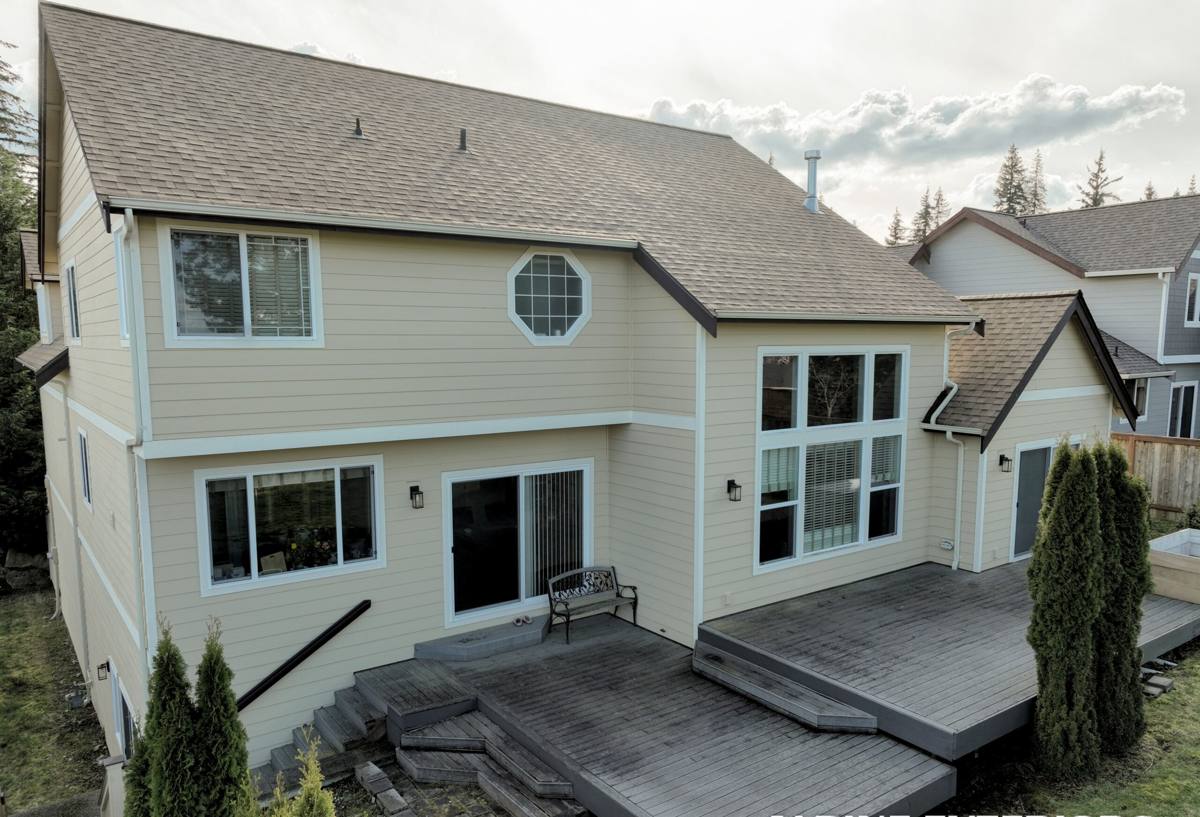
What Salt Air and Moss Actually Do to a Wall
Salt Air
Airborne salt is corrosive to fasteners, flashing, and any metal trim components, and it accelerates the breakdown of paint films and coatings that aren't formulated to resist it. Siding that looks fine after year one can start chalking, fading unevenly, or losing adhesion at the seams by year five in a salt-exposed spot, well ahead of what the same product would show a few miles inland.
Driving Rain
Wind-driven rain doesn't just wet the surface of a wall — it finds every lap, seam, and penetration and tries to push water behind the cladding. If the water-resistive barrier, flashing, and drainage plane behind the siding aren't detailed correctly, that moisture gets trapped against the sheathing where nobody sees it until there's rot, mold, or a soft spot in the wall.
Moss and Algae Season
Whatcom County's wet season runs long, and north- or west-facing walls that stay shaded and damp for extended stretches are prime real estate for moss and algae growth. Beyond the cosmetic issue, sustained moisture sitting on a wall surface shortens the life of whatever finish is on it and gives water more time to find its way into any weak points in the cladding.
Why We Only Install James Hardie Fiber Cement Here
We standardized this company on James Hardie fiber cement siding, and we don't install LP SmartSide, vinyl, Cemplank, Allura, primed spruce, or cedar. That's not a marketing position — it's a decision based on what holds up on this coastline without turning into a maintenance project for the homeowner.
- Non-combustible material that doesn't rely on a wood-based core, which matters for long-term durability in a wet, salt-exposed environment where moisture intrusion is the enemy.
- ColorPlus factory finish — baked on in a controlled facility rather than field-applied, which gives it better adhesion and fade resistance against salt air and UV than most job-site paint jobs.
- HardieZone engineering — Hardie makes climate-specific product formulations for exactly this kind of exposure, rather than a one-size-fits-all board.
- A warranty structure built around correct installation — which pushes us to detail flashing, gaps, and fastening the way the manufacturer actually specifies, not just "close enough."
Vinyl can crack and fade faster under UV and temperature swings, and its seams give wind-driven rain more opportunities to get behind the panel. Cedar and primed spruce are wood — beautiful, but they need real upkeep to resist rot and moss in a climate this damp, and that upkeep cost compounds over the life of the siding. LP SmartSide, Cemplank, and Allura are reasonable products in the right hands, but we made a call years ago to put our installation expertise behind one system we can install to spec every time, and stand behind. On this stretch of coastline, that system is James Hardie.
What a Correct Installation Looks Like on This Peninsula
Fiber cement siding is only as good as the wall assembly behind it. For Point Roberts homes specifically, a correct job includes:
Drainage Plane and Rainscreen Gap
A properly lapped water-resistive barrier with a drainage gap behind the siding gives any moisture that does get past the cladding a path to escape instead of sitting against the sheathing. In a driving-rain environment, this detail matters more than the siding itself.
Flashing at Every Penetration
Windows, doors, hose bibs, light fixtures, and deck ledgers are all places where water tries to get behind the wall. Each one needs flashing that sheds water outward, not just caulk covering a gap — caulk fails, flashing doesn't.
Fastener and Trim Choices
Corrosion-resistant fasteners and trim hardware matter more here than a few miles inland. We spec fastening and accessory materials with the salt exposure in mind rather than defaulting to whatever's standard for an unexposed site.
Correct Gaps and Clearances
Hardie's install spec calls for specific gaps at trim, penetrations, and ground clearance so the board can handle moisture and movement without trapping water. Skipping these gaps to save time is the single most common cause of premature siding problems we see on re-inspections.
Why a Crew That Already Works Point Roberts Matters
Point Roberts is a U.S. exclave — the only road access is through Canada, and materials, crew scheduling, and site logistics all need to account for that before a project starts. A contractor unfamiliar with the peninsula can lose real time and money figuring this out mid-job, and that cost usually lands on the homeowner's timeline or bid. Our crew is based in Custer and already routes material deliveries and scheduling around that border crossing, so a Point Roberts job runs on the same timeline as any other job in our service area — not a special-case project that gets bumped around.
Knowing the peninsula also means knowing which walls take the worst of the wind and salt exposure on a typical lot orientation here, which shapes where we pay the closest attention to flashing and drainage detail during the tear-off and install.
Cost Factors for a Point Roberts Fiber Cement Project
Every home is different, but these are the variables that move a Point Roberts siding estimate up or down:
| Factor | Why It Matters Here |
|---|---|
| Existing siding removal | Tear-off of failing vinyl, cedar, or damaged fiber cement adds labor and may expose sheathing damage from past moisture intrusion |
| Sheathing/framing repair | Salt air and driving rain conditions mean a higher chance of finding soft sheathing behind older siding that needs replacing before new siding goes on |
| Home size and wall complexity | More corners, dormers, and penetrations mean more flashing detail, which is where correct installation matters most in this climate |
| Siding profile and trim package | Lap width, trim style, and accessory choices affect material cost and installation time |
| Access and staging | Border-crossing logistics for material delivery and site access factor into scheduling, though we plan around this as a standard part of doing business on the peninsula |
Our Process, Start to Finish
- On-site assessment — we walk the exterior, check for existing moisture damage, and note wind/salt exposure by wall orientation.
- Written estimate — a clear scope covering tear-off, repair allowances if needed, material selection, and installation timeline.
- Material staging — Hardie boards and accessories ordered and scheduled around Point Roberts delivery logistics so the crew isn't waiting on materials mid-job.
- Tear-off and wall prep — removal of old siding, inspection and repair of sheathing, correct installation of the water-resistive barrier and drainage plane.
- Installation to Hardie spec — proper gaps, flashing, and fastening detail at every penetration and trim line.
- Final walkthrough — we go over the finished work with the homeowner before calling the job done.
Maintaining Fiber Cement Siding in a Marine Climate
James Hardie siding with a ColorPlus finish needs less upkeep than wood or vinyl, but "less" isn't "none" — especially with this much salt air and moss pressure. A simple annual routine keeps it performing the way it's designed to:
- Rinse the exterior with a garden hose (not a pressure washer aimed directly at seams) once or twice a year to clear salt residue and organic buildup
- Check caulking at trim and penetrations annually and re-caulk any cracked or separated joints promptly
- Trim back vegetation and clear gutters so water and debris don't sit against the siding
- Look for early moss or algae growth on shaded walls and clean it off before it spreads
- Have any impact damage or chipped finish repaired quickly — an exposed edge is where moisture problems start
Get a Straight Answer on Your Point Roberts Home
If your siding is showing its age — fading, soft spots, moss you can't keep ahead of, or trim that's pulling away — it's worth having someone who knows this peninsula's conditions take a look before you decide what to replace it with. We'll give you a straightforward, no-pressure estimate and an honest read on what your home actually needs. Use the form below to get started.