 Custer
 Siding That Has to Work Against Salt Air, Not Just Look Good
Blaine sits close enough to the water that homes here deal with a version of weather most inland Whatcom County houses never see: salt-laden air off the Strait of Georgia, wind-driven rain that gets pushed sideways into wall assemblies, and a moss season that runs long and wet from fall through spring. Siding in Blaine isn't just a finish material — it's the first line of defense against three things working on it at once: corrosion, moisture intrusion, and biological growth. A product and installation that would be fine in a drier part of the state can fall short here.
We install James Hardie fiber cement siding exclusively, and Blaine is one of the areas where that decision matters most. Hardie's fiber cement composition doesn't rot, doesn't feed moss the way wood-based products can, and holds its factory finish through repeated wet-dry cycling in a way that other common siding materials struggle to match over the same number of years.
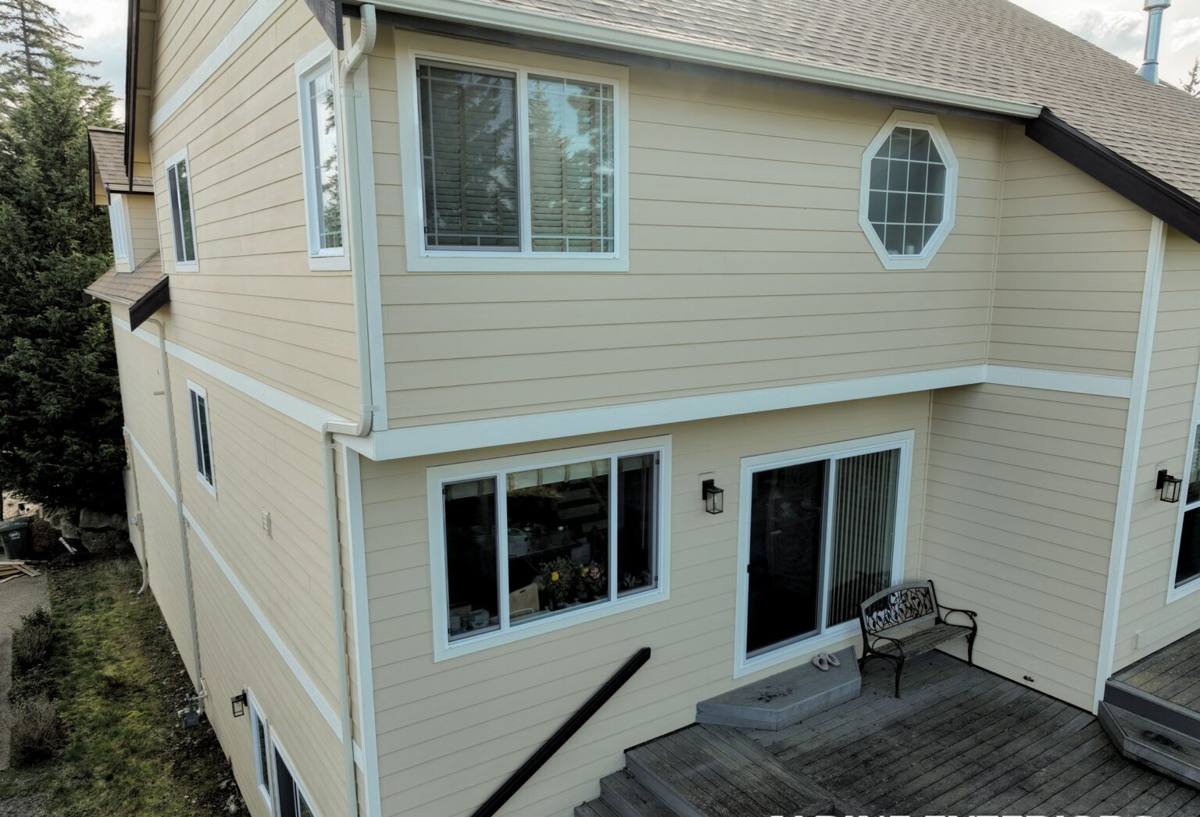
What Blaine's Climate Actually Does to a House
Salt Air and Fasteners
Airborne salt accelerates corrosion on anything metal — fasteners, flashing, trim connectors. On a coastal property, the fastener schedule and fastener material matter as much as the siding panel itself. We use corrosion-resistant fasteners appropriate for James Hardie's coastal/near-water installation requirements, not whatever happened to be on the truck.
Driving Rain and Wall Assembly
Wind off the water doesn't just fall as rain — it drives horizontally into walls, especially on west- and south-facing elevations. That means water management behind the siding (weather-resistant barrier, proper flashing at windows and penetrations, correct lap and gap details) carries more weight in Blaine than it would on a sheltered inland lot. Siding that looks identical from the street can perform very differently depending on what's happening behind it.
Moss and Prolonged Moisture
Whatcom County's wet season is long, and shaded, north-facing walls in Blaine can stay damp for weeks at a stretch. Moss and algae need organic material and sustained moisture to establish. Fiber cement doesn't give moss the same foothold that wood, wood composite, or some vinyl surfaces can, and Hardie's factory-applied ColorPlus finish resists the staining that comes with prolonged dampness better than field-applied paint.
Why James Hardie Specifically for This Job
We don't install LP SmartSide, vinyl, Cemplank, Allura, primed spruce, or cedar. That's not a marketing position — it's a standard we hold because of jobs like this one. In a coastal, high-moisture environment, the trade-offs on those alternative products (moisture sensitivity at cut edges, UV and heat distortion, shorter finish life, higher long-term maintenance) show up faster and more visibly than they would in a milder climate. James Hardie's fiber cement is non-combustible, dimensionally stable in wet-dry cycling, and available in HZ10 formulation engineered specifically for wetter, more humid climate zones like ours.
| Climate Stress in Blaine | What It Does to Ordinary Siding | How Hardie Fiber Cement Responds |
|---|---|---|
| Salt air / coastal wind | Accelerated fastener corrosion, surface pitting on some metals | Non-metallic panel body; paired with corrosion-resistant fastener specs |
| Wind-driven rain | Water intrusion at laps, seams, and cut edges on moisture-sensitive materials | Dense fiber cement composition resists water absorption; proper install adds correct water management |
| Long moss/algae season | Surface staining, biological growth on wood or wood-composite products | Factory ColorPlus finish resists staining; material doesn't feed organic growth |
| UV and temperature swings | Fading, warping, or heat distortion on some composite and vinyl products | Stable fiber cement panel with baked-on finish rated for extended UV exposure |
What a Correct James Hardie Install Looks Like Here
The product is only half the equation. A Hardie job installed to spec performs completely differently than the same product installed loosely, and in Blaine's climate that gap shows up sooner. Correct installation on a coastal Blaine home includes:
- Weather-resistant barrier installed and lapped correctly before any siding goes up
- Flashing at every window, door, and penetration, directing water out and away from the wall assembly
- Proper clearance at grade, decks, and roof lines so siding never sits in standing water or constant splash-back
- Correct fastener type, spacing, and embedment per James Hardie's fastening requirements for the panel and climate zone
- Caulked and sealed joints at trim and butt seams, using sealants rated for the exposure
- Proper gapping at panel ends and around penetrations to allow for expansion without trapping moisture
- Field-touch-up of any cut edges with Hardie-approved products to maintain the factory seal
Skipping any one of these doesn't usually cause an immediate problem — it shows up two, five, or eight years later as a moisture issue, a corrosion stain, or premature finish failure. That's the real cost of a rushed install, and it's a cost that's harder to hide in a coastal climate.
Our Process for Blaine Homes
1. On-Site Assessment
We look at the home's exposure — which walls take the worst of the wind-driven rain, which sides stay shaded and damp, and what condition the existing siding, trim, and water management are in. Blaine properties near the water often need different detailing on their windward elevations than on sheltered sides of the same house.
2. Product and Line Selection
We walk through James Hardie's product lines and ColorPlus color options based on the home's style, HOA or neighborhood expectations where relevant, and the specific exposure conditions on that lot.
3. Tear-Off and Prep
Old siding comes off, and we inspect sheathing and framing underneath for any moisture damage before it's covered up again. This is the point where hidden problems get caught and fixed, not sealed in.
4. Water Management First
Weather-resistant barrier and flashing go in before a single piece of siding is hung. This step is what actually protects the house — the siding is the visible layer on top of it.
5. Installation to Manufacturer Spec
Panels, fasteners, gapping, and sealants are installed per James Hardie's published requirements for our climate zone — not shortcuts, not "close enough."
6. Final Walkthrough
We review the finished work with the homeowner, including basic care guidance specific to a coastal Whatcom County property.
Why a Crew That Already Works Blaine Matters
A contractor who only occasionally works this close to the water can miss details that are second nature to a crew that installs here regularly — which walls need extra attention to flashing, how much clearance to leave at grade given local drainage patterns, or which fastener specs actually hold up against salt exposure over time. Familiarity with Blaine's specific conditions isn't a nice-to-have; it directly affects how long the job lasts before it needs attention again.
It also matters for smaller, practical reasons: knowing realistic weather windows for exterior work in this part of Whatcom County, understanding typical lot layouts and setbacks in the area, and having already worked through the kind of moisture and moss issues that show up on older Blaine homes.
Maintenance Expectations After Installation
One advantage of fiber cement in a climate like this is how little ongoing maintenance it asks for compared to wood-based alternatives. That said, no siding is fully maintenance-free. A short annual routine keeps a Hardie install performing the way it should:
- Rinse the exterior once or twice a year to clear salt residue and organic debris, especially on walls facing prevailing wind
- Check caulking at trim and joints periodically and re-seal if it's cracked or pulling away
- Keep gutters and downspouts clear so water isn't sheeting down the wall face
- Trim back vegetation that keeps a wall section shaded and damp longer than the rest of the house
- Address any touch-up paint needs promptly at cut edges or minor scuffs to keep the seal intact
Cost Factors Specific to a Blaine Project
| Factor | Why It Affects the Job |
|---|---|
| Home size and elevation complexity | More corners, windows, and roof lines mean more flashing and trim detail work |
| Existing wall condition | Sheathing repair from prior moisture damage adds scope beyond the siding itself |
| Exposure level | Fully wind- and salt-exposed elevations may warrant upgraded fastener and sealant specs |
| Panel/product line selection | Lap siding, panel systems, and trim packages carry different material costs |
| Color and finish | Standard ColorPlus colors versus custom finish options affect material pricing |
We'll walk through these factors on-site and give a straightforward estimate before any work starts — no guessing games, no pressure.
If your Blaine home's siding is showing moss staining, chalky or peeling paint, or you're just planning ahead for a coastal-durable replacement, we're happy to come take a look and talk through what your home actually needs. Fill out the form below for a free, no-pressure estimate.