 Custer
 Bellingham's Climate Is Hard on Decks
A deck in Bellingham lives a harder life than a deck almost anywhere inland. You've got salt-laden air rolling off Bellingham Bay, long stretches of driving rain that come in sideways off the water, and a moss season that can run from October clear through May in a wet year. None of that is dramatic on its own, but stacked together, year after year, it's exactly the combination that ages decking boards, corrodes fasteners, and rots framing faster than most homeowners expect.
We're not describing a hypothetical. It's the same pattern we see on repair calls throughout Bellingham and the rest of Whatcom County: a deck that looked fine from the yard has soft spots, rusted hardware, or a ledger board connection that's been quietly failing underneath the surface. Deck repair here isn't just about swapping a cracked board — it's about understanding how this specific climate attacks a structure and fixing the actual cause, not just the symptom.
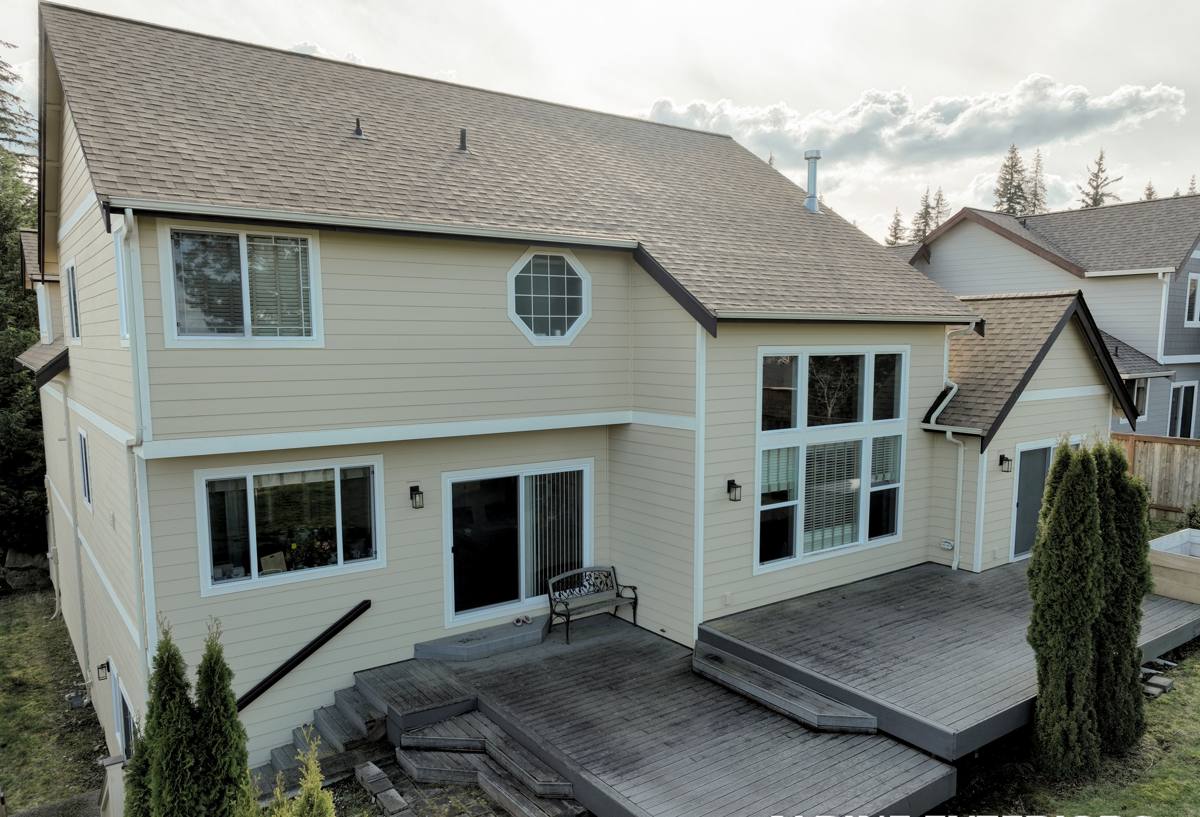
Signs Your Bellingham Deck Needs Repair
Surface-Level Wear
Some problems are easy to spot if you know what to look for:
- Graying, splintering, or soft/spongy spots in decking boards
- Moss or algae film that stays damp for days after rain
- Fasteners that are rust-streaked, popped up, or spinning loosely in their holes
- Gaps opening up between boards, or boards that have cupped or crowned
- Peeling or bubbling on stained or painted deck surfaces
Structural Red Flags
These matter more, because they affect safety, not just appearance:
- Noticeable bounce, sway, or flex when you walk across the deck
- A railing that moves or feels loose when you lean on it
- Stairs that feel unstable or have visibly sagging stringers
- Discoloration or soft wood where the deck's ledger board attaches to the house
- Gaps or rust stains at joist hangers, visible from underneath
If you're seeing anything from that second list, it's worth getting a look sooner rather than later. Structural issues in a wet climate like ours don't stay small — they compound.
What's Actually Going Wrong Underneath
Most of the deck damage we deal with in Bellingham traces back to one of a handful of causes:
Moss Holding Moisture Against Wood
Moss doesn't just look bad. It acts like a wet sponge sitting directly on your decking boards, keeping the wood saturated long after the rain has stopped. In a drier climate that moisture would evaporate off in a day or two. Here, with our overcast stretches and short winter daylight, a mossy deck surface can stay damp for the better part of a week — which is more than enough time for rot to take hold in untreated or unsealed wood.
Corroding Fasteners and Hardware
Salt air is genuinely corrosive to metal, and it doesn't take direct ocean exposure — just proximity to the bay is enough over years. Standard fasteners and joist hangers that aren't rated for this environment will rust, weaken, and eventually fail well before the wood around them gives out. A deck can look structurally sound while the hardware holding it together is quietly failing.
Ledger Board and Flashing Failures
The ledger board — where the deck attaches to the house — is the single most common point of serious structural failure on decks in our region. If flashing was installed incorrectly, or wasn't installed at all, driving rain gets forced behind the ledger and soaks into the rim joist and framing where nobody sees it happen. This is a slow failure that can go undetected for years, which is exactly why it's dangerous.
UV and Wet-Dry Cycling
Bellingham doesn't get brutal summer heat, but decking still goes through repeated cycles of soaking rain followed by drying, which stresses wood fibers and breaks down finishes over time. It's a slower process than in harsher climates, but it's constant, and it adds up.
Repair or Replace? How We Make the Call
Not every deck problem means starting over, and not every deck is worth patching. We look at the framing first, because that's what determines everything else. If the structural bones are sound and the damage is limited to the surface, repair is usually the honest recommendation. If the ledger connection, joists, or posts are compromised, patching around that is a short-term fix at best.
| Factor | Favors Repair | Favors Replacement |
|---|---|---|
| Framing & ledger condition | Solid, dry, no rot at connections | Soft wood, rust staining, or movement at ledger |
| Extent of damage | Isolated boards, railing sections, or stairs | Widespread rot or damage across multiple structural members |
| Age of the deck | Newer deck, one or two problem areas | Original structure is decades old and near end of life |
| Fastener condition | Hardware still sound, isolated corrosion | Widespread rust on joist hangers and structural fasteners |
| Cost comparison | Repair cost is a small fraction of rebuild cost | Repairs would need to be repeated soon after, or approach rebuild cost |
As a rough guide, straightforward repairs — a handful of boards, a railing section, re-securing hardware — typically run from a few hundred dollars into the low thousands. Structural repairs involving framing or the ledger connection cost more because of the labor involved in opening up and properly rebuilding that area. We'll always walk you through exactly what we're finding and why, so the repair-versus-replace decision is yours to make with real information, not a sales pitch.
Our Deck Repair Process
- Full inspection, top and bottom. We check the deck surface, but just as important, we get underneath and look at the framing, ledger connection, and hardware where the real problems usually hide.
- Honest assessment. We tell you what's cosmetic, what's structural, and what can wait versus what shouldn't.
- Address the cause, not just the symptom. If moss and moisture caused the damage, we won't just swap boards and leave the same conditions in place — we'll talk through drainage, spacing, and airflow fixes where they're needed.
- Correct the framing and connections first. Any structural work — ledger flashing, joist hangers, posts — gets done before cosmetic repairs, because there's no point in new boards over a weak frame.
- Match materials appropriately. New boards, railings, or hardware are chosen to hold up in our climate, not just to match what's there.
- Final walkthrough. We check the deck is solid, level, and safe before we call the job done.
Materials That Hold Up Here
What we use for a repair depends on what's already on your deck and what you want going forward, but a few standards guide our recommendations in this climate:
- Fasteners and hardware: We favor stainless steel or heavy hot-dip galvanized fasteners and connectors for anything exposed to moisture or salt air, since standard coated fasteners corrode faster here than in drier inland areas.
- Flashing: Proper ledger flashing is non-negotiable on any repair that touches the house connection — it's the cheapest insurance against the most expensive failure.
- Pressure-treated lumber: Still a solid, economical choice for framing and even decking, provided it's properly sealed and maintained on a regular schedule.
- Composite decking: A reasonable option for homeowners who want to reduce the moss, staining, and refinishing burden that comes with wood decking in a wet climate — the trade-off is a higher upfront material cost and the need for correct spacing and ventilation underneath to avoid trapping moisture.
We'll talk through the honest trade-offs of each option for your specific deck rather than pushing one material across the board. The right call depends on your budget, how much maintenance you want to do, and what's already in place.
Homeowner Deck Maintenance Checklist
Between repairs — or after one — a little seasonal attention goes a long way in this climate:
- Sweep debris and standing leaves off the deck surface regularly, especially in fall
- Treat or brush off moss buildup before it has a chance to hold moisture against the boards
- Check railings and stairs for movement a couple of times a year
- Look underneath the deck once or twice a year for rust staining, soft wood, or gaps at the ledger
- Reseal or restain wood decking on the schedule recommended for the product, not just when it looks bad
- Keep gutters and downspouts near the deck clear so water isn't dumping directly onto or under it
Why a Crew That Already Works in Bellingham Matters
Deck repair isn't a one-size-fits-all trade. A crew that mostly works in dry inland climates is going to make different assumptions than one that works Bellingham and the rest of Whatcom County regularly. We know what a ledger connection looks like after a decade of coastal rain versus after a decade somewhere drier. We know moss isn't just a cosmetic nuisance here — it's a moisture problem with a cosmetic symptom. That local, repeated experience is what lets us diagnose a deck problem accurately the first time instead of guessing and hoping.
If your deck has soft spots, corroded hardware, moss that won't quit, or just doesn't feel as solid as it used to, we're happy to come take an honest look. Reach out for a free, no-pressure estimate using the form below, and we'll tell you straight what your deck needs.