 Custer
 Why Siding Fails Faster in Meridian Than Most Places
Meridian sits in the part of Whatcom County where three things stack up against a house at the same time: salt-laden air moving in off the water, long stretches of driving rain that hit siding sideways rather than falling straight down, and a moss season that can run most of the year in shaded, north-facing spots. Any one of these will shorten the life of a mediocre siding job. Together, they expose weak installation work fast — usually within the first two or three winters, not the first ten years.
Salt air accelerates corrosion on fasteners, flashing, and trim. Wind-driven rain finds every gap in a butt joint, a missing kick-out flashing, or a caulk line that was never really needed if the job had been detailed correctly. And moss doesn't just sit on the surface — it holds moisture against the cladding, which matters enormously depending on what that cladding is made of. This page is about one specific answer to that problem: James Hardie fiber cement siding, installed correctly, for homes in the Meridian area.
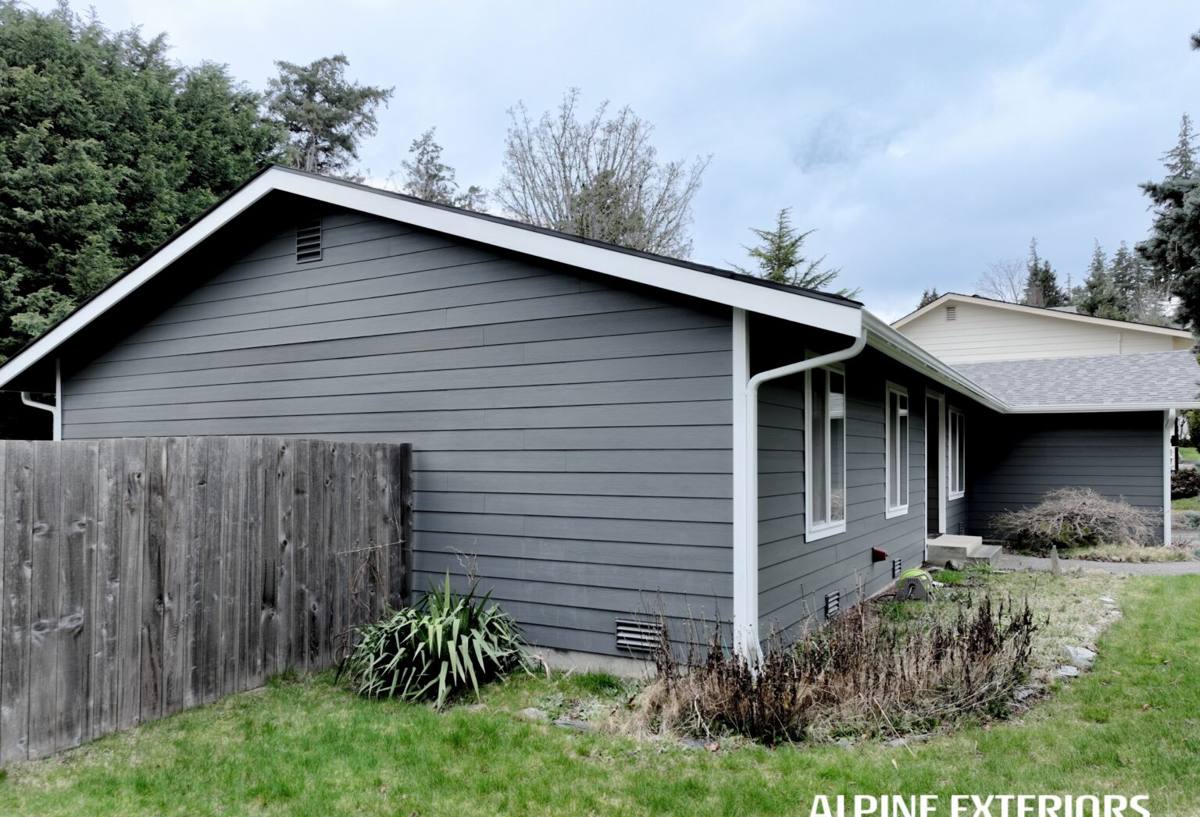
What This Climate Actually Requires From Siding
Moisture that doesn't get a foothold
Fiber cement doesn't absorb water the way wood-based products do, and it doesn't degrade the way vinyl can under repeated freeze-thaw and UV cycling near the coast. That matters here specifically because Whatcom County homes get long soaking rain events, not quick summer downpours — the siding stays wet for hours or days at a time during the wet season.
A finish that holds color despite salt exposure
Salt air is hard on paint. Field-applied finishes chalk, fade, and peel faster near the water than they do inland. James Hardie's ColorPlus finish is baked on at the factory in multiple coats, which is a meaningfully different product than site-painted siding — it's part of why we standardized on it rather than treating paint as an afterthought.
A material that doesn't feed moss and mildew
Moss needs organic material and a damp surface to colonize. Fiber cement gives it neither the food source nor the softness that wood-based sidings offer. That doesn't mean a Meridian home won't ever get moss or algae streaking on the surface — it will, especially on shaded elevations — but it means the siding underneath isn't being eaten by it.
James Hardie's Climate-Specific Product Lines
James Hardie engineers its products by climate zone, and that's not marketing — it changes the formulation. HZ5 products are built for freeze-prone regions; HZ10 products are engineered for climates like ours, with an emphasis on moisture and moderate-temperature performance rather than hard freeze cycling. Getting this specification right for a Meridian home is a basic part of doing the job correctly, not an upgrade.
| Consideration | What it means for a Meridian home |
|---|---|
| Climate zone (HZ10) | Matched to Pacific Northwest moisture exposure rather than inland freeze-thaw cycling |
| ColorPlus factory finish | Multi-coat, baked-on finish that resists fading from salt air and UV better than field-applied paint |
| Non-combustible core | Doesn't ignite or feed a fire the way wood-based sidings can — a factor insurers increasingly weigh |
| Product profile (lap, shingle, panel) | Lap siding is the common choice; shingle or panel accents can be used for architectural detail without changing the underlying material |
What a Correct Installation Actually Involves
Fiber cement siding is only as good as the installation behind it. James Hardie publishes detailed installation specifications, and most of the siding failures we get called out to inspect trace back to someone skipping a step in those specs, not a flaw in the material itself.
Below the siding
- A weather-resistive barrier installed and lapped correctly, shingle-style, so water sheds outward
- Flashing at every window, door, and roofline intersection — not caulk substituting for flashing
- Kick-out flashing wherever a roofline meets a wall, so runoff is directed away from the wall assembly instead of behind the siding
- Sheathing checked for existing rot or moisture damage before anything new goes up
The siding itself
- Correct minimum gaps at butt joints and around penetrations, per manufacturer spec, not siding installed tight and hoping caulk holds forever
- Fasteners set to the proper depth — overdriven nails crack the board's edge and create a moisture entry point that shows up as a stain line within a year or two
- Clearance maintained between the bottom of the siding and grade, decks, and roof lines so the board isn't sitting in standing water or snow
- Field-cut edges primed and sealed, since factory finish only protects the face and factory edges until a cut is made
Our Process for a Meridian Job
We walk the exterior first and look at exposure by elevation — the side of the house that takes the weather off the water is treated differently in planning than a sheltered side, even though the material is the same. We check existing sheathing condition once old siding comes off, because that's the only real chance to catch hidden rot before it's sealed behind new cladding. Flashing details get built out before a single course of Hardie goes up. Then the siding is installed to James Hardie's published fastening and clearance specs, not "close enough" versions of them, and we do a final walk to check gaps, caulk lines, and trim before calling the job done.
None of that is unusual for a properly run siding job anywhere. What's different in Meridian is that we're not guessing at wind exposure or rain patterns from a spec sheet — we've built and repaired siding on homes with the same salt air and moss conditions close by, so the flashing and clearance decisions are based on what actually happens to a wall here over a winter, not just what a manual says in the abstract.
Why Local Experience on This Specific Material Matters
Fiber cement is not a forgiving product to learn on. It's heavier than vinyl, it has to be cut and fastened differently, and the manufacturer's warranty coverage depends on the installation actually following spec. A crew that installs several different siding brands across a wide territory is splitting its attention across products with different rules. We install one product system, which means the fastening pattern, the flashing approach, and the finish handling for James Hardie are second nature rather than something looked up mid-job.
That focus also means we know how James Hardie siding actually ages in this specific environment — which elevations tend to collect moss first, where salt-driven finish wear shows up soonest, and which flashing details matter most given how rain moves across a roofline here. That's the kind of judgment that only comes from repeat work in the same conditions, not from a spec sheet.
Cost Factors for a Meridian Project
Every estimate is specific to the house, but the same factors move the price on most jobs in this area:
| Factor | Why it affects cost |
|---|---|
| Tear-off vs. new construction | Removing old siding and repairing any hidden sheathing damage adds labor that isn't visible until the walls are opened up |
| Home size and wall complexity | Cut-heavy elevations with lots of windows, dormers, or trim take more time per square foot than simple, flat walls |
| Siding profile mix | Straight lap siding on the whole house costs less than a mix of lap, shingle accents, and panel details |
| Trim and accessory scope | Fascia, soffit, and trim replacement done at the same time adds cost but avoids mismatched material ages later |
| Access and site conditions | Tight lots, steep grades, or limited equipment access add labor time |
Maintenance Once It's Installed
James Hardie siding installed to spec is low-maintenance, not no-maintenance, especially in a climate that grows moss and carries salt in the air.
- Rinse siding with a garden hose once or twice a year to clear salt residue and loose debris — avoid high-pressure washing directly at seams and edges
- Keep gutters clear so overflow isn't running down the face of the siding repeatedly
- Trim back vegetation and tree cover that keeps a wall shaded and damp, which is where moss and algae growth concentrates first
- Check caulk lines at trim and penetrations every couple of years and recaulk where it's cracked or pulled away
- Have any impact damage or cracked boards repaired promptly — an open crack is a moisture entry point even in a material that doesn't rot
If you're planning a siding project in the Meridian area and want a straight answer on what your home actually needs, we're glad to take a look and put together a free, no-pressure estimate.