 Custer
 Why Laurel Homes Take a Different Kind of Beating
Laurel sits close enough to the water that salt-laden air is just part of the weather, not an occasional event. Add in Whatcom County's long, wet winters and the kind of driving rain that comes sideways off a west or southwest wind, and you've got a combination that's genuinely hard on exterior building materials. Most siding products aren't built with this specific combination in mind — they're built for an "average" American climate that doesn't really exist in the Pacific Northwest.
Salt air accelerates corrosion on fasteners, flashing, and any exposed metal trim. Driving rain finds every gap, seam, and under-caulked joint and pushes water where it doesn't belong. And the moss season here isn't a month — it's most of the year. Anything organic-based or moisture-absorbent on the exterior of a Laurel home is going to host algae and moss growth faster than it would almost anywhere else in the country. Siding that isn't dimensionally stable swells, cups, or delaminates under that kind of sustained moisture exposure, and paint that isn't factory-cured starts chalking and peeling well ahead of schedule.
None of this means Laurel homes need something exotic. It means they need a siding system that was actually engineered for coastal, high-moisture climates, installed by people who understand why the details matter here more than they would in a drier part of the country.
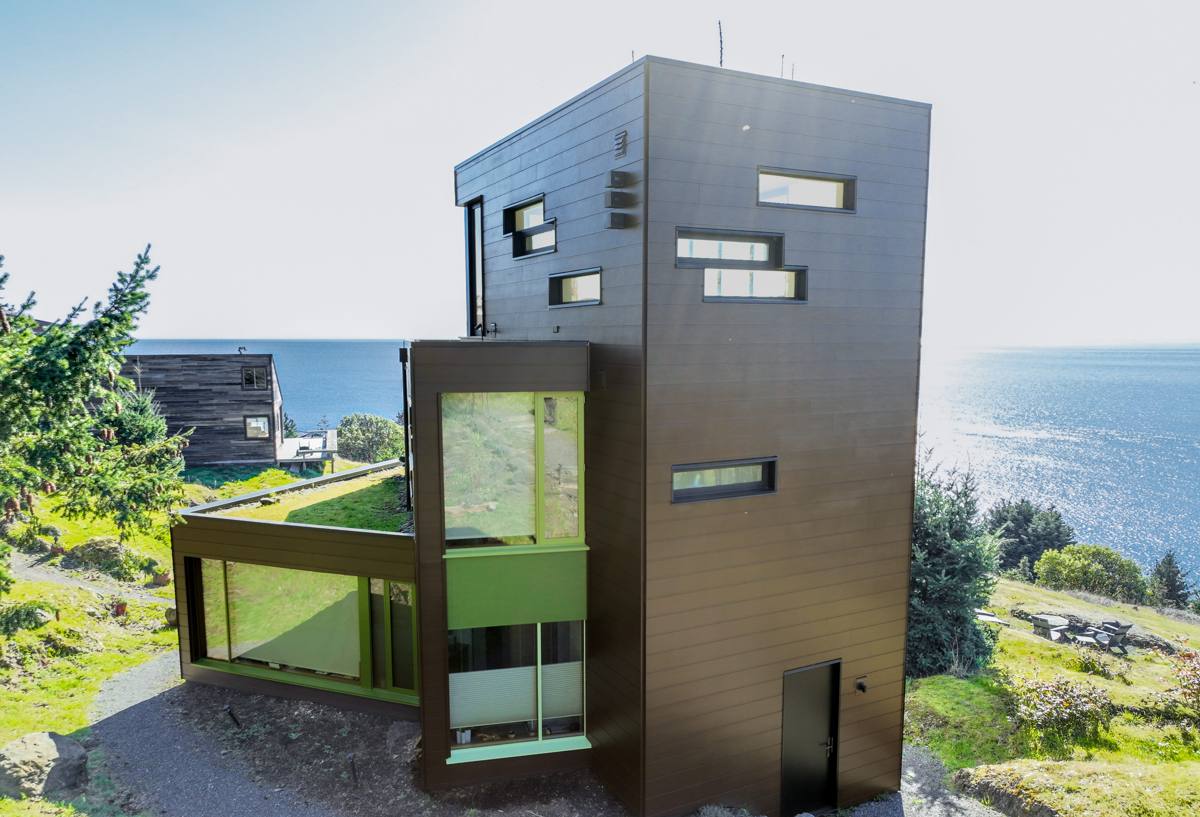
Why We Only Install James Hardie in This Area
We install James Hardie fiber cement siding exclusively — not vinyl, not LP SmartSide, not primed wood, not other fiber cement brands. That's a deliberate standard, not a sales pitch, and it matters more in a place like Laurel than it would somewhere with a milder, drier climate.
Hardie's fiber cement is non-combustible and dimensionally stable, meaning it doesn't expand, contract, warp, or absorb moisture the way wood-based or wood-fiber products can. For a coastal home dealing with near-constant humidity and rain, that stability is the difference between siding that holds its shape and paint line for decades and siding that starts showing waves, soft spots, or joint failure within a handful of years.
Hardie also makes climate-specific product engineering part of the actual manufacturing spec, not just marketing language. Their HZ5 formulation is engineered for regions with significant moisture exposure and freeze-thaw cycling — which describes Whatcom County's marine climate well. The ColorPlus factory finish is baked on in a controlled environment, cured harder than a field-applied coat can be, and backed by a finish warranty that doesn't depend on perfect weather during application. In an area where a painter might be fighting rain and humidity for half the year, having the finish already cured before the boards reach the jobsite is a real practical advantage, not a nice-to-have.
What This Means Specifically for Salt Air
Salt air doesn't damage fiber cement the way it damages some metals and untreated woods, but it does attack fasteners, flashing, and trim components if they're not corrosion-resistant. Part of doing this correctly in Laurel is fastener and flashing selection — not just the siding panel itself.
What a Correct James Hardie Installation Actually Involves
Buying the right product and installing it correctly are two different things. Most of the siding failures we get called out to inspect in this area aren't product failures — they're installation shortcuts that let moisture in behind siding that was otherwise fine. Hardie publishes detailed installation requirements for a reason, and skipping them voids the warranty and creates the exact problems the product was designed to avoid.
Clearances and Drainage
Hardie siding needs proper clearance from grade, roofing, decks, and any horizontal surface — generally a minimum of a few inches, more in areas with heavy rain exposure. It also needs a drainage plane behind it: a weather-resistant barrier and, ideally, a rainscreen gap that lets any moisture that does get behind the siding drain and dry out instead of sitting against the sheathing.
Fastening and Flashing
Fasteners have to be corrosion-resistant, driven to the correct depth (not overdriven, which cracks the board or seats it too tight to allow for any movement), and placed according to Hardie's fastening schedule. Flashing at windows, doors, and butt joints has to actually shed water outward rather than channeling it inward — a detail that's easy to get wrong and hard to spot once the siding is buttoned up.
Joints, Caulking, and Finish
Butt joints, corners, and trim intersections need to be treated with the right sealant and gap spacing — too tight and the boards have no room to move seasonally, too loose and you've got a water entry point. Since ColorPlus finish is factory-applied, any field cuts need sealed and touched up with the matching Hardie product, not generic paint, to preserve both the look and the warranty.
Our Process for Laurel Siding Projects
- Inspection and assessment — we look at the existing siding, sheathing condition, and any signs of past moisture intrusion, rot, or moss buildup before quoting anything.
- Scope and product selection — we confirm the right Hardie plank, panel, or shingle profile and color for the home, factoring in sun exposure and how exposed the wall is to prevailing wind-driven rain.
- Tear-off and substrate check — old siding comes off and we inspect the sheathing underneath for hidden water damage before anything new goes up. This step catches problems that would otherwise get sealed behind new siding.
- Weather barrier and drainage plane — a proper moisture barrier and drainage gap go in before a single piece of Hardie siding is installed.
- Installation to Hardie spec — correct clearances, fastening schedule, flashing details, and joint treatment, all matching Hardie's published requirements so the manufacturer warranty stays intact.
- Trim, caulking, and finish detailing — corners, trim boards, and any field cuts get sealed and finished to match.
- Final walkthrough — we go over the finished job with the homeowner before calling it done.
Cost Factors on a Laurel Hardie Siding Project
Every home is different, so we don't quote off a flat per-square-foot number without seeing the house. These are the factors that actually move the price up or down:
| Factor | Why It Matters |
|---|---|
| Tear-off vs. new construction | Removing and disposing of old siding, and repairing any hidden sheathing damage, adds labor beyond a straightforward new install. |
| Home size and number of stories | More square footage and taller walls mean more material, more staging/equipment, and more labor hours. |
| Trim and architectural detail | Homes with more corners, gables, dormers, or decorative trim take longer to flash and finish correctly than a simple rectangular footprint. |
| Siding profile chosen | Lap siding, shingle-style panels, and board-and-batten each have different material and labor costs. |
| Site access | Tight lots, landscaping, decks, or limited staging space near the water can slow down material handling. |
| Existing moisture damage | Rot or mold found under old siding needs to be remediated before new siding goes up — this is common enough in this climate that we always budget contingency time for it. |
Why a Crew That Already Works in Laurel Matters
Siding installation isn't just following a manual — it's judgment calls about how a specific home sits relative to wind, sun, and moisture. A crew that's worked a number of homes in and around Laurel already knows which wall orientations take the worst of the wind-driven rain, which parts of a roofline tend to dump extra water onto a sidewall, and which areas stay damp and shaded long enough to grow moss fastest. That local pattern recognition shows up in small decisions — extra flashing at a vulnerable transition, a wider drainage gap on a north-facing wall — that a crew unfamiliar with the area might not think to make.
It also matters for permitting and code familiarity specific to Whatcom County, and for knowing realistic timelines around this area's weather windows, since scheduling a tear-off around back-to-back rain systems is a real planning consideration here, not an afterthought.
Signs Your Current Siding Is Already Losing the Fight
- Persistent moss or algae staining that returns within weeks of cleaning, especially on north- or shaded-facing walls
- Visible cupping, warping, or soft spots when you press on the siding
- Paint that's chalking, peeling, or fading unevenly, particularly on walls facing prevailing wind and rain
- Rust streaks or corrosion around fasteners, vents, or trim
- Gaps opening up at butt joints, corners, or window trim
- Any soft or spongy sheathing felt through the siding near the base of walls or below windows
Any of these on their own might be minor. Several together usually mean moisture has been getting behind the siding for a while, which is worth having looked at before it becomes a sheathing or framing problem.
Living With Hardie Siding in a Salt Air, High-Moss Climate
Correctly installed Hardie siding is genuinely low-maintenance, but "low-maintenance" doesn't mean "no maintenance" in this climate. A periodic gentle rinse to keep salt residue and organic buildup from accumulating, keeping gutters clear so water isn't sheeting down the wall face, and trimming back vegetation that keeps a wall shaded and damp all go a long way toward keeping the finish looking like it did on install day. Because the ColorPlus finish is factory-cured, it holds color and resists the chalking and fading that field-painted siding tends to show first in coastal, high-UV, high-moisture conditions.
If you're weighing a siding replacement on a Laurel home and want to talk through what your house specifically needs given its orientation, age, and current condition, we're glad to come take a look. The estimate is free, there's no pressure, and you'll get a straight answer about what's actually going on with your siding — use the form below to get started.