 Custer
 Window Installation in Lynden Needs to Account for Whatcom County Weather
Lynden sits close enough to the Salish Sea and the Nooksack lowlands that homes here take a different kind of weather beating than houses even twenty miles inland. Salt-tinged marine air moves through on the prevailing westerlies, driving rain comes in sideways during the fall and winter storm cycles, and a long, damp moss season sets in early and doesn't let go until late spring. Windows are one of the first places that shows up. A window that was installed correctly for a drier climate can still fail here within a decade if it wasn't detailed for this specific combination of wind-driven moisture and near-constant humidity.
We work on homes in Lynden and around Custer regularly, and the patterns repeat: failed seals around older aluminum-frame windows, soft trim boards under sills that were never flashed, and condensation between panes that shows up two or three winters after a "fine" installation. None of that is inevitable. It's a product-and-process problem, and it's fixable when the install is done right the first time.
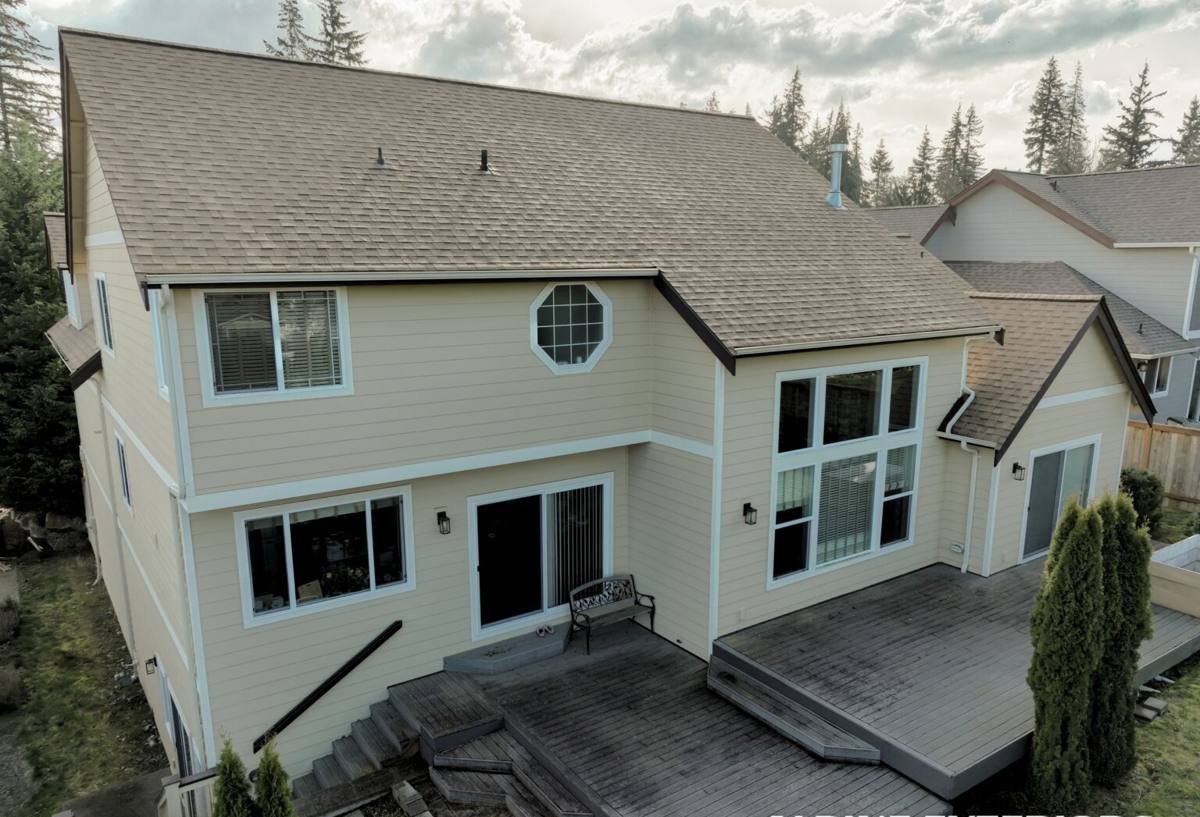
What This Climate Actually Does to Windows Over Time
Wind-Driven Rain
Rain that falls straight down is easy to shed. Rain that's being pushed sideways by wind off the water finds every gap in a window's flashing and trim. Over years, that moisture works its way behind the siding and into the wall cavity around the window opening, even when the window itself still looks fine from inside the house.
Salt Air and Hardware Corrosion
Homes closer to the water pick up a fine salt content in the air that accelerates corrosion on lower-grade window hardware — hinges, locks, and roller tracks in particular. It's slow and easy to miss until a window starts sticking or a lock stops seating cleanly.
Moss, Algae, and Trapped Moisture
Whatcom County's moss season isn't a cosmetic issue by itself, but where moss and algae take hold on sills, trim, and the siding around a window, they hold moisture against those surfaces far longer than open air would. That prolongs every drying cycle and speeds up rot in wood trim and OSB sheathing that's already marginal.
Condensation and Indoor Humidity
Between rainy months and typical Pacific Northwest indoor humidity levels, older single-pane or poorly sealed dual-pane windows fog up, sweat on the interior glass, and can feed mold growth on nearby drywall and trim if it's not addressed.
Signs Your Windows Are Due for Replacement
Not every symptom means a full replacement — some are fixable with re-caulking or hardware service. But if you're seeing more than one or two of these, it's worth having a real assessment rather than patching around the problem:
- Fog or moisture trapped between the panes of a double-pane window (a failed seal — this one is not repairable, only replaceable)
- Soft or discolored wood trim or sill boards, especially on the west- or south-facing sides that catch the most wind-driven rain
- Windows that are hard to open, close, or lock, or that have visibly corroded hardware
- Noticeable drafts or cold spots near the window even when it's fully closed
- Visible gaps between the window frame and the siding or trim
- A jump in heating costs without another clear explanation
- Moss or dark staining building up on the sill or the trim directly below the window
- Peeling paint or bubbling on interior window trim, which usually means moisture is already inside the wall
What a Correct Installation Actually Involves
The window unit itself is only part of the job. Most of the failures we get called out to fix trace back to what happened — or didn't happen — around the window opening, not to the window itself. A correct install in this climate includes:
Sill Pan Flashing
A sloped, sealed pan at the bottom of the rough opening gives any water that does get past the window a way to drain back outward instead of sitting on the sill and soaking into the framing. This is one of the most commonly skipped steps in older installs, and it's the single biggest reason we see rot at window sills specifically.
Proper Weather Barrier Integration
The window's flanges need to be integrated into the house wrap or weather-resistant barrier in the correct shingle-lap order — sides and bottom first, top last — so water is always directed down and out over the layers below it, never trapped behind them.
Backer Rod and Sealant, Not Just Caulk
Gaps around the frame need to be air-sealed with backer rod and a quality sealant rated for exterior movement, not just a bead of caulk smeared over a visible seam. Caulk alone cracks and fails within a few seasons in this kind of weather cycling.
Correct Shimming and Squaring
A window that's not shimmed level and square will bind, won't seal evenly around its full perimeter, and puts uneven stress on the frame that shortens the life of the seals and hardware.
Insulation of the Gap
The space between the window frame and the rough opening needs to be filled with a low-expansion foam or backer material — not packed solid with standard expanding foam, which can bow the frame, and not left empty, which leaves a direct path for drafts and condensation.
Choosing the Right Window for a Lynden Home
Frame material matters more here than it does in a drier inland climate, because it determines how the window handles years of damp exposure. Here's how the common options stack up for this specific environment:
| Frame Material | Moisture Resistance | Maintenance | Typical Lifespan |
|---|---|---|---|
| Vinyl | Very good — won't rot or corrode; check weep holes stay clear of debris and moss | Low — occasional cleaning | 20–30+ years |
| Fiberglass | Excellent — dimensionally stable, holds paint and finish well in wet/dry cycling | Low | 30+ years |
| Wood-clad | Good on the clad exterior; interior wood needs the seal maintained | Moderate — periodic finish upkeep | 20–30 years with upkeep |
| Bare Aluminum | Poor in this climate — conducts cold, prone to condensation and corrosion near salt air | Higher — hardware and seals need earlier attention | 15–20 years, often less near the water |
We generally steer homeowners in this area toward vinyl or fiberglass for the exterior-facing frame, specifically because they don't give moisture or salt air a foothold the way bare aluminum or unprotected wood does. That's a maintenance and longevity call, not a knock on any particular manufacturer — every frame material has a place, and if you already have wood or aluminum windows in good condition, that's a legitimate case for careful repair and re-sealing rather than replacement.
Our Installation Process
- On-site assessment — we look at the existing window, the condition of the trim and sheathing around it, and how exposed that side of the house is to wind-driven rain before recommending anything.
- Measure and order — accurate rough-opening measurements matter more than people expect; a window that's slightly undersized for its opening creates gaps that are hard to seal correctly later.
- Remove the old window and inspect the opening — this is where we find out if there's hidden rot or moisture damage that needs to be addressed before a new window goes in. Installing a new window over a compromised opening just hides the problem for a few more years.
- Repair the opening if needed — replace any soft framing or sheathing before the new unit goes in.
- Install sill pan flashing and integrate the weather barrier — set the window level and square, flash it in the correct shingle-lap sequence.
- Insulate and seal the gap — low-expansion foam or backer rod around the frame, backer rod and sealant on the exterior seams.
- Finish trim and exterior detailing — trim, caulking, and paint or finish matched to the surrounding siding.
- Final walkthrough — check operation, locks, and seals with you before we call it done.
What Affects the Cost
Every job is different, but the same handful of factors drive most of the price variation we see on window installations in this area:
| Factor | Why It Matters |
|---|---|
| Number of windows | Per-window cost typically drops on multi-window jobs since setup and site work are shared |
| Frame material | Vinyl is generally the most budget-friendly; fiberglass and wood-clad cost more upfront but can outlast vinyl |
| Condition of the existing opening | Hidden rot or water damage found during removal adds repair time before the new window can go in |
| Window size and configuration | Large picture windows, bays, or custom shapes cost more than standard single- or double-hung units |
| Access and site conditions | Second-story or hard-to-reach windows take longer and may need staging or lift equipment |
We give straightforward, itemized estimates so you can see exactly where the cost is coming from, rather than a single lump number.
Why It Matters That We Already Work in Lynden and Custer
A crew that mostly works dry-climate installs will default to dry-climate habits — lighter flashing details, standard caulk instead of proper sealant systems, skipping the sill pan because "it usually doesn't come up." Those shortcuts don't show up as a problem on day one. They show up two, three, or five winters later, after the damage is already inside the wall.
Working across Whatcom County, including Lynden and the Custer area, means we're already accounting for wind-driven rain exposure, salt air proximity, and moss-season moisture retention as standard practice, not as an afterthought. We know which sides of a house typically take the worst weather in this area and which details actually hold up here versus which ones look fine on installation day and fail quietly over the next few winters.
Get a Free, No-Pressure Estimate
If your windows are showing any of the signs above, or you're just planning ahead, we're happy to take a look and give you an honest read on what's needed — replacement, repair, or just better maintenance. There's no pressure and no cost to have us come out and walk through it with you using the form below.