 Custer
 Why California Creek Siding Takes More Punishment Than People Expect
California Creek sits in that band of Whatcom County where the Salish Sea's salt air, near-constant winter rain, and a moss season that can run eight or nine months a year all land on the same exterior walls at once. It's not one harsh condition siding has to survive — it's three, stacked on top of each other, day after day. Salt-laden air corrodes fasteners and trim faster than inland exposure. Driving rain off the water finds every gap in a wall assembly that a calmer climate would forgive. And the shaded, damp stretches common on tree-lined lots here give moss and algae a long runway to take hold on anything that stays wet.
None of that is unique to one house on one lot. It's the baseline for this part of Custer, and it's why siding choice and installation quality matter more here than they would forty miles inland.
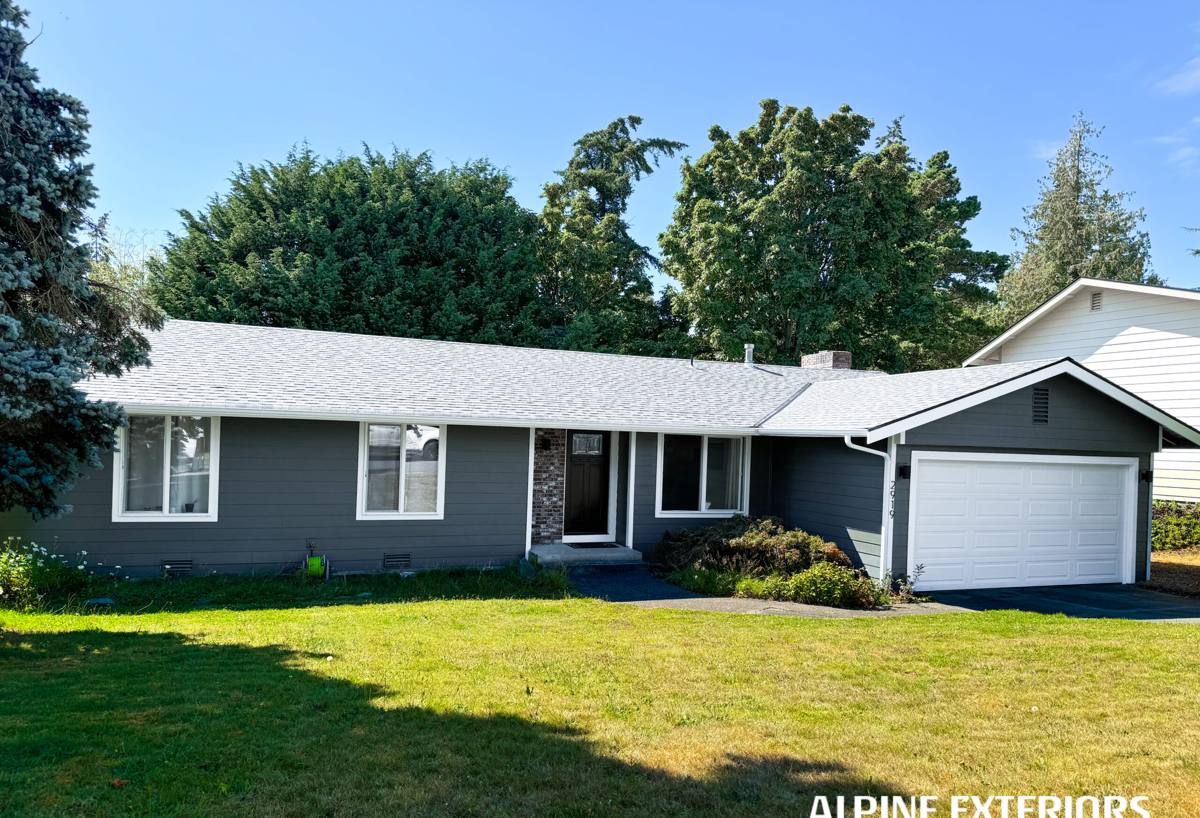
What James Hardie Brings to This Specific Climate
We install James Hardie fiber cement exclusively, and in a coastal, high-moisture, high-moss environment like California Creek, the reasons are practical rather than theoretical. Fiber cement doesn't absorb water the way wood-based products do, so it doesn't swell, cup, or rot from the kind of prolonged dampness this area sees every winter. It's also dimensionally stable, meaning it doesn't expand and contract with humidity swings the way engineered wood siding can — which matters when a wall assembly is dealing with salt-laden fog one week and a hard rain event the next.
James Hardie's ColorPlus finish is baked on at the factory rather than field-applied, and it's formulated to resist the kind of algae and moss staining that shows up fast on shaded, damp exterior walls in this region. That's not a cosmetic afterthought here — it's one of the more visible ways a coastal climate wears down a house year over year. Hardie also engineers its products by climate zone (their HZ5 line is built for the wetter, more variable weather patterns found in the Pacific Northwest), which means the product itself is matched to conditions like Whatcom County's rather than a one-size-fits-all national spec.
Non-Combustible Is a Real Feature, Not a Marketing Line
Fiber cement is non-combustible. That matters less for wildfire exposure in a coastal community like California Creek than it does inland, but it still plays into insurance considerations and general fire safety for homeowners, and it's part of why we standardized on the product rather than treating it as a footnote.
What a Correct Installation Actually Involves Here
Fiber cement siding performs the way it's rated to perform only when it's installed to spec. In a climate that pushes this much water and salt at a wall, the installation details matter as much as the product itself.
Water Management Behind the Siding
A correctly built wall assembly in this climate includes a weather-resistant barrier and, where the wall design calls for it, a drainage gap that lets any moisture that does get behind the siding find its way back out instead of sitting against the sheathing. Driving rain off the water will find weak points in a wall over time — the goal isn't to make the wall waterproof, it's to make sure water that gets in has somewhere to go.
Fasteners, Clearances, and Flashing
Salt air accelerates corrosion on the wrong hardware. We use fasteners and flashing rated for the exposure this area actually sees, not generic hardware-store stock. Hardie's installation instructions also specify minimum clearances from grade, roofing, and decks — those clearances exist specifically to keep splash-back and standing moisture off the bottom edge of the boards, which is usually the first place a poorly installed job fails.
Joints and Caulking
Hardie's install guidelines are specific about which joints get caulked, which get flashed, and which are designed to be left as tight butt joints. Over-caulking a wall doesn't make it more weathertight — it can trap moisture in the wrong places. Under-caulking leaves gaps for driving rain. Getting this balance right is a detail crews that install a lot of different products tend to get inconsistent, because it's specific to how Hardie's system is engineered to shed water.
Our Process for a California Creek Home
- Assessment — we look at the existing siding, sheathing condition, and how the house is oriented to prevailing wind and rain (west- and southwest-facing walls generally take the worst of it here).
- Tear-off and substrate check — old siding comes off and we inspect the sheathing underneath for rot or moisture damage before anything new goes on. This is the step that gets skipped on rushed jobs and causes problems years later.
- Weather barrier and drainage plane — installed per manufacturer spec for the wall assembly and climate zone.
- Hardie installation — boards, panels, and trim installed to James Hardie's published fastening, clearance, and joint specifications, using corrosion-appropriate hardware.
- Final inspection and cleanup — checking clearances, caulk lines, and flashing before we call the job done.
Why a Crew That Already Works California Creek Matters
Installation quality is only half the equation — the other half is knowing what a specific area actually throws at a house. A crew that works this stretch of Custer regularly already knows which wall orientations take the worst driving rain, how much moss pressure to expect on shaded north- and east-facing walls, and what fastener and flashing spec holds up against the salt exposure this close to the water. That's the kind of knowledge that doesn't come from a manufacturer's install manual alone — it comes from doing the work here repeatedly and seeing what holds up and what doesn't.
It also matters for permitting and inspection. Whatcom County's permitting process and local inspection expectations are things a crew that works the area regularly navigates as routine, not as a learning curve on your project.
How Siding Materials Actually Hold Up in This Climate
Homeowners comparing options often get sold on upfront cost or a single feature without seeing how a material behaves after five or ten winters in a coastal, moss-heavy environment. Here's a straightforward comparison based on how these materials generally perform under sustained moisture, salt air, and moss pressure:
| Material | Moisture/Rot Risk | Moss & Algae Resistance | Salt Air Durability | Typical Maintenance |
|---|---|---|---|---|
| James Hardie fiber cement | Low — doesn't absorb and swell | Factory finish resists staining | High with correct fasteners | Occasional rinse, repaint decades out |
| Vinyl siding | Low absorption, but seams and panels can trap moisture | Moderate — algae films can build in shaded areas | Can become brittle over time in coastal wind exposure | Low, but panels warp/fade and aren't repaintable in the same way |
| Cedar / primed wood | High if finish isn't maintained | Low — organic material, prone to moss growth | Moderate; finish breaks down faster in salt air | Regular refinishing, higher long-term labor cost |
| Engineered wood (LP SmartSide-type) | Moderate — engineered to resist moisture but still wood-based | Moderate | Moderate; edge sealing is critical | Careful joint/edge maintenance to prevent swelling |
This is why we made the call to install James Hardie only. In this specific climate, the trade-offs on the other products show up faster than they do in drier regions — and California Creek is about as wet, salty, and moss-prone as it gets in Whatcom County.
Signs Your Current Siding Is Losing the Fight
If you're not sure whether it's time to look at replacement, these are the practical warning signs we look for on homes in this area:
- Soft or spongy spots when you press on the siding, especially near the bottom courses
- Persistent moss or dark green/black staining that comes back within weeks of cleaning
- Paint that's peeling or bubbling rather than just fading
- Visible gaps, warping, or panels pulling away from the wall at seams
- Rust streaking from fasteners or trim hardware
- A musty smell near exterior walls, which can point to moisture getting behind the siding
- Cracking or splitting at butt joints and corners
Any one of these can be a minor fix. Several at once, especially on a house that's twenty-plus years old, usually means the siding system itself is past the point where patching makes sense.
Living With Hardie Siding in a Coastal Climate
Correctly installed James Hardie siding is low-maintenance, not zero-maintenance. In an area like California Creek, that means an occasional rinse to clear salt residue and airborne debris, keeping gutters clear so water isn't sheeting down the face of the siding, and a periodic look at caulk lines and trim joints — the same spots that take the most weather exposure are the ones worth checking every year or two. None of this is heavy lifting, but it's the difference between a siding job that looks good for decades and one that starts showing problems early because small issues went unaddressed.
Get a Straight Answer for Your House
Every property on California Creek sits a little differently — some are more exposed to wind and salt spray, some deal with heavier shade and moss pressure, some have wall assemblies that need more attention during tear-off than others. If you'd like a straightforward look at what your home actually needs, we offer a free, no-pressure estimate — use the form below to get started.