 Custer
 Why Blaine's Coastal Climate Is Hard on Siding
Blaine sits right on the water at the northern edge of Whatcom County, close enough to Semiahmoo Bay and the Salish Sea that salt-laden air is a daily fact of life, not an occasional event. That salt air settles on exterior surfaces year-round, and combined with the near-constant marine moisture in this part of Washington, it accelerates corrosion of fasteners, breaks down cheaper coatings, and works its way into any gap or seam a siding product wasn't designed to resist. Add in the driving, wind-pushed rain that comes off the water during winter storms and the long, damp, low-light stretch from fall through spring that lets moss and algae take hold on north- and west-facing walls, and you have a climate that is genuinely tougher on siding than most inland parts of the county.
Homes in and around Custer and Blaine also deal with more wind exposure than sites further inland, which matters for how siding is fastened and how well it holds a paint or factory finish over time. None of this means siding is doomed here — it means the material and the installation both have to be chosen with this specific exposure in mind, not treated the same as a job forty miles inland.
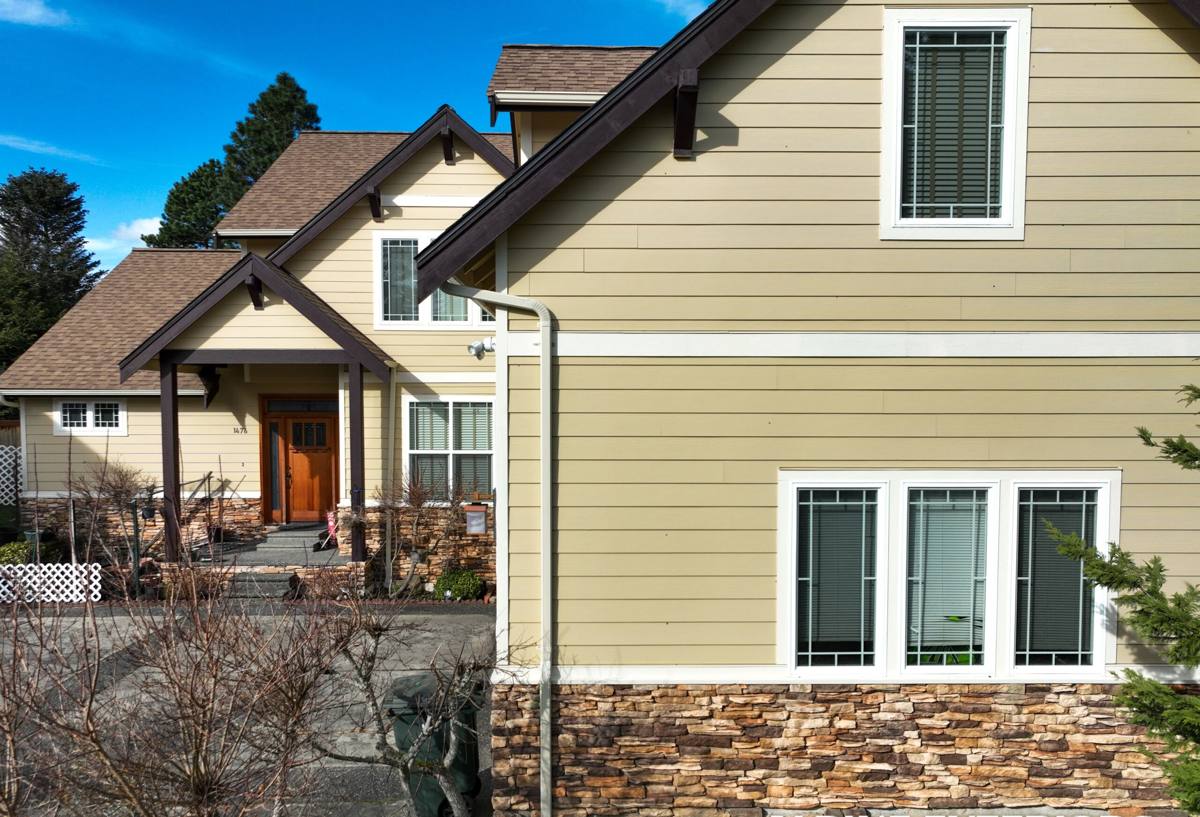
What Fiber Cement Actually Needs to Do on a Blaine Home
Given that climate, siding on a Blaine property has a short, specific job description:
- Resist moisture absorption so wind-driven rain doesn't wick into the panel and cause swelling, delamination, or rot at the substrate
- Hold a factory finish that doesn't chalk, fade, or peel under repeated salt exposure
- Resist mold, mildew, and moss growth on shaded and north-facing elevations
- Stay dimensionally stable through the county's wet winters and drier summers without cupping or warping
- Be non-combustible, which matters given Whatcom County's periodic wildfire smoke and dry-season fire risk even this close to the water
This is exactly the profile fiber cement siding is engineered for, and it's a big part of why we don't install alternatives that fall short on one or more of these points in this specific climate.
Why We Only Install James Hardie — Not the Alternatives
We install James Hardie fiber cement exclusively, and Blaine's exposure is a good example of why. Vinyl siding can work fine in milder, more sheltered locations, but it's a petroleum-based product that expands and contracts with temperature swings, can crack in wind-driven debris impacts, and its seams and J-channels give salt-laden moisture more places to work into the wall assembly over time. LP SmartSide and other engineered wood products use a wood-strand core that, however well treated, is still wood — it depends on an intact factory coating to keep moisture out, and any breach at a cut edge, fastener, or joint gives water and eventually rot a way in. Primed spruce and cedar are honest, attractive materials, but they require an ongoing paint and caulk maintenance cycle that a heavy-salt, heavy-moss climate like Blaine's makes more demanding, not less.
Fiber cement doesn't share those weaknesses. It's roughly 90% sand, cement, and cellulose fiber — it doesn't rot, it isn't a food source for moss and mildew the way wood is, and it holds up to direct salt spray far better than vinyl's plastic seams. James Hardie backs its siding with a factory-applied ColorPlus finish engineered to resist fading and chalking, and their HardieZone system includes an HZ10 product line specifically formulated for the kind of wet, moderate-temperature Pacific climate Whatcom County sits in. We standardized on Hardie because it's the one product in this category that consistently performs the way manufacturers claim it will, in exactly the conditions Blaine homes deal with.
What This Doesn't Mean
We're not saying vinyl or wood siding is junk — plenty of it is out there performing fine in more sheltered spots. It means that for the specific combination of salt air, driving rain, and moss pressure this stretch of coastline sees, we've made a professional call that fiber cement is the material worth standing behind, and we'd rather turn down a vinyl or LP job than install something we don't think will hold up here.
What Correct Installation Looks Like in a Marine Climate
Fiber cement siding only performs as well as its installation. In a coastal, high-moisture environment like Blaine, a handful of details separate a job that lasts decades from one that fails early:
- Rainscreen or proper drainage gap behind the siding so any moisture that does get past the surface can drain and dry instead of sitting against the wall sheathing
- Correct flashing at every window, door, and penetration — this is where wind-driven rain finds its way in if it's skipped or done wrong
- Manufacturer-specified fastener spacing and type — corrosion-resistant fasteners matter more here than in a dry inland climate
- Proper clearance between the bottom of the siding and grade, decks, and roof lines to keep splash-back moisture off the panel edges
- Correct caulking at butt joints and trim, using sealants rated for the movement and moisture exposure the assembly will actually see
- Pre-primed or factory-finished cut edges sealed before installation, since an exposed cut edge is one of the few ways moisture can get into fiber cement
Skipping any one of these doesn't usually cause an immediate, visible problem — it shows up two, five, or ten years later as staining, soft trim, or premature finish failure, often in the exact wall orientations that catch the most weather off the water.
Fiber Cement vs. the Alternatives, for This Climate Specifically
| Factor | James Hardie Fiber Cement | Vinyl Siding | Wood / LP SmartSide |
|---|---|---|---|
| Salt air / coastal exposure | Engineered for it (HZ10 line) | Seams and plastic degrade faster | Depends entirely on coating integrity |
| Wind-driven rain resistance | Strong with correct flashing | Moderate; seams are weak points | Weak if coating is breached |
| Moss / mildew resistance | Cement-based, not a food source | Resistant but doesn't stop growth on surface | Wood core vulnerable if exposed |
| Fire resistance | Non-combustible | Combustible | Combustible |
| Maintenance cycle | Low; factory finish lasts years | Low, but limited repair options | Regular repaint/recaulk needed |
| Warranty | Long, transferable manufacturer warranty | Varies widely by product | Often shorter, coating-dependent |
Our Process for a Blaine Fiber Cement Job
We walk every Blaine property in person before writing a quote, because the right approach depends on which direction a wall faces relative to the water, how exposed it is to wind, and what condition the existing wall assembly is in. From there:
- Assessment — check the sheathing, existing moisture damage, window and door flashing, and drainage plane needs before touching siding at all
- Prep — repair or replace any compromised sheathing or trim, and correct any existing flashing or drainage issues rather than sealing them over
- Installation — install James Hardie panels or lap siding to manufacturer spec, with the fastening, flashing, and clearance details this climate requires
- Finish detail — seal cut edges, caulk joints with an appropriate sealant, and confirm trim and transitions are watertight
- Walkthrough — go over the finished work with the homeowner and explain what maintenance, if any, is actually needed going forward
Realistic Maintenance for a Salt-Air Home
One of the real advantages of fiber cement over wood in this climate is how little upkeep it needs — but "little" isn't "none." A short annual routine keeps a Blaine home looking right and catches small issues before they become expensive ones:
- Rinse salt film and general grime off the siding once or twice a year, especially on water-facing walls
- Check north- and shade-facing sections for early moss or algae growth and clean it before it spreads
- Inspect caulking at trim and joints for cracking or gaps, particularly after a hard winter
- Keep gutters clear so overflow isn't running down the wall face
- Trim back vegetation that's holding moisture against the siding
Why Local Experience in Blaine Actually Matters
A crew that mostly works drier, more sheltered parts of Whatcom County can install fiber cement correctly on paper and still miss the details that matter specifically here — how much clearance to leave near the water, which walls take the worst of the winter storms, or how aggressively moss establishes itself on a shaded gable in this microclimate. Working Blaine and Custer regularly means we've seen how these homes actually weather over time, not just how a spec sheet says a product should perform. That local pattern recognition is what turns a correct installation into one that's also right for the specific site.
If you're weighing a siding replacement or new siding project on a Blaine property, we're happy to take a look and give you a straightforward, no-pressure estimate — no obligation, just an honest read on what your home actually needs.