 Custer
 Why Bellingham's Climate Is Harder on Siding Than It Looks
Bellingham sits close enough to the water that salt-laden air is a constant, low-grade stress on anything attached to the outside of a house. Add Whatcom County's long stretch of wet months, where rain doesn't so much fall as linger, and you get a climate that quietly works against siding materials that aren't built for it. It's rarely a single storm that causes damage here. It's the cumulative effect of moisture that never fully dries out, combined with salt air that accelerates corrosion on fasteners and finishes, month after month, year after year.
Homeowners in Bellingham often don't notice the toll until it shows up as soft trim boards, streaked and stained siding faces, or a persistent green cast of moss and algae that seems to come back no matter how often it's cleaned off. None of that is bad luck. It's what happens when siding material and installation detailing aren't matched to the actual conditions the house sits in.
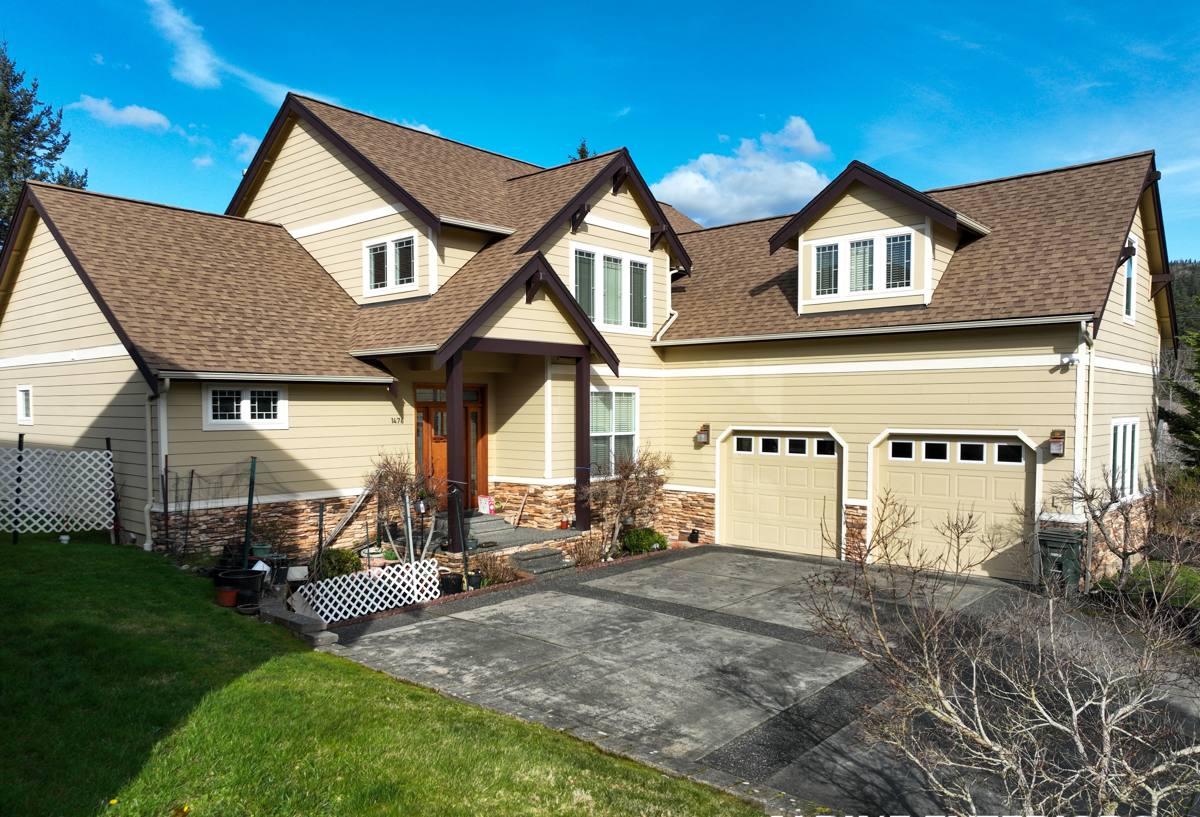
What Salt Air, Driving Rain, and Moss Actually Do
Salt Air
Airborne salt is corrosive to metal fasteners, flashing, and trim hardware, and it settles into surface pores on porous or poorly sealed siding materials. Over years, that corrosion can loosen fastening points and stain lighter-colored siding, especially on the sides of a home that face open air and prevailing wind.
Driving Rain
Bellingham's rain frequently comes in sideways, driven by wind off the water. That means siding isn't just getting rained on from above — it's getting rain pushed into every horizontal seam, panel joint, and window opening. Any installation that relies on caulk alone to keep water out, rather than proper flashing and drainage detailing, is going to fail here faster than it would in a drier, calmer climate.
Moss and Algae
The long wet season in Whatcom County creates ideal conditions for moss and algae growth on north-facing walls, shaded elevations, and anywhere siding stays damp for extended periods. Beyond the cosmetic issue, sustained moisture trapped under moss growth can degrade certain siding materials from the surface inward, particularly wood-based products.
Why We Only Install James Hardie Fiber Cement
Given what Bellingham's climate does to exterior materials, we made a decision to standardize on one product line rather than offer a menu of options with different long-term outcomes. James Hardie fiber cement siding is non-combustible, dimensionally stable in wet-dry cycling, and finished at the factory with ColorPlus technology — a baked-on finish that holds color and resists the fading and chalking that field-applied paint experiences under UV exposure and salt air.
We don't install vinyl, LP SmartSide, Cemplank, Allura, primed spruce, or cedar siding. Each of those products has legitimate uses and loyal customers elsewhere, and we're not going to tell you they're worthless — they're not. But each carries trade-offs that matter more in a marine, high-moisture climate than they might in a drier region: vinyl can warp and become brittle with age and doesn't hold up well against physical impact; engineered wood products depend heavily on flawless installation and ongoing maintenance to keep moisture out of the substrate; cedar and primed spruce require regular refinishing to resist the rot and moss growth that Bellingham's wet season practically guarantees over time. Fiber cement sidesteps most of those failure modes by being inorganic, moisture-resistant, and factory-finished rather than field-painted.
James Hardie also builds region-specific product engineering into its HZ5 line, formulated for climates like the Pacific Northwest that see extended wet seasons. That's not a marketing detail — it affects how the material performs against the exact conditions Bellingham homes deal with every winter.
What a Correct Siding Installation Actually Involves
The siding material is only part of the equation. In our experience, the majority of premature siding failures we see on Bellingham homes trace back to installation shortcuts, not the product itself. A correct installation in this climate means:
- A weather-resistive barrier installed continuously across the wall sheathing, lapped correctly so water sheds outward rather than behind the barrier
- Rigid flashing at every window, door, and horizontal trim transition — not caulk used as a substitute for flashing
- Proper fastener placement and spacing per the manufacturer's installation guide, using corrosion-resistant fasteners suited to a coastal environment
- Correct clearance between the bottom of the siding and grade, decks, patios, and roof lines to prevent standing water and wicking
- A drainage gap or rainscreen detail where wall assembly and code call for it, so incidental moisture can escape rather than get trapped against the sheathing
- Caulking and sealant used only where specified, with the right product for the joint — sealant is a backup to good flashing, not a replacement for it
Skip any one of these steps and you can end up with premature siding failure even when the material itself is rated for the climate. This is where hiring a crew with real fiber cement experience, not just general contracting experience, actually shows up in how the house performs over the following decade.
Our Installation Process
1. On-Site Assessment
We start by walking the exterior with you, looking at current siding condition, trim and flashing details, any moisture staining or soft spots, and the specific exposure each elevation of the house gets to wind, rain, and salt air.
2. Tear-Off and Substrate Inspection
Once old siding comes off, we inspect the sheathing underneath for rot, delamination, or existing moisture damage. This is often the first time hidden problems become visible, and it's addressed before anything new goes on the wall — covering up a compromised substrate just locks the problem in.
3. Weather Barrier and Flashing
We install or replace the weather-resistive barrier and flashing at every penetration and transition point. This step does more to determine long-term performance than any other part of the job.
4. Hardie Panel or Lap Siding Installation
Panels or lap boards go up per James Hardie's fastening and clearance specifications, with attention to butt joints, corner details, and consistent reveal lines.
5. Trim, Caulking, and Final Detailing
Trim boards, corner posts, and touch-up caulking are finished last, using sealants appropriate for the joint and the ColorPlus finish.
6. Final Walkthrough
We walk the finished job with you before considering it done, checking reveal consistency, seams, and overall finish quality against what was quoted.
Choosing the Right Hardie Line and Finish for Bellingham
James Hardie offers several siding profiles and its HZ5 climate-engineered formulation, which is the line we typically spec for Whatcom County homes given the wet-season exposure. Beyond the technical formulation, homeowners usually have a choice between lap siding, panel siding, and shingle-style profiles, along with a range of ColorPlus factory finishes. We'll walk through what fits your home's architecture and exposure, but a few general points are worth knowing going in:
| Consideration | What It Affects |
|---|---|
| Lap vs. panel profile | Traditional vs. modern appearance; different reveal and shadow-line options |
| ColorPlus vs. field-painted | Factory finish resists fading and chalking far longer than site-applied paint |
| Elevation exposure | North-facing and wind-exposed walls may warrant different detailing or accessory trim to manage moisture and moss |
| Warranty coverage | Hardie's product warranty is transferable, which matters if you sell the home within the coverage period |
What Drives Cost on a Bellingham Siding Job
Every home is different, and we don't publish blanket pricing because it would be misleading — but the main variables that move a quote up or down are consistent from job to job:
| Factor | Why It Matters |
|---|---|
| Home size and wall complexity | More corners, gables, and dormers mean more cutting, fitting, and trim work |
| Substrate condition | Rot or moisture damage found during tear-off adds repair scope before new siding goes on |
| Siding profile and accessories | Panel vs. lap, trim width, and corner detailing all affect material and labor |
| Access and site conditions | Tight lots, elevation changes, and landscaping can affect staging and labor time |
| Existing flashing and barrier work needed | Bringing older moisture detailing up to current standards adds scope but reduces future risk |
We'll walk your specific home and give you a real number based on what we actually find, not a generic square-footage estimate.
Signs a Bellingham Home May Need New Siding Soon
- Persistent moss or algae growth that returns quickly after cleaning, especially on shaded or north-facing walls
- Soft or spongy spots when you press on siding or trim boards, particularly near the bottom edges and window sills
- Visible warping, cupping, or separation at panel seams and corners
- Paint that's peeling, bubbling, or chalking noticeably faster than it used to
- Rust streaking from fasteners or trim hardware
- Rising energy bills that coincide with drafts or cold spots near exterior walls
- Visible daylight or gaps at trim and corner boards
Any one of these on its own isn't necessarily an emergency, but a few showing up together usually means the current siding and its underlying moisture detailing are starting to lose the battle against the climate.
Why Hiring a Crew That Already Works in Bellingham Matters
Siding installation isn't uniform across regions, and a crew that mostly works drier inland climates will make different — sometimes reasonable, sometimes wrong — assumptions about flashing, drainage gaps, and fastener spacing than a crew that installs siding on homes exposed to salt air and driving rain every week. Knowing which elevations of a Bellingham home typically take the hardest weather, how much drainage detailing a given wall assembly actually needs, and how James Hardie's HZ5 product behaves in this specific climate isn't something that transfers automatically from experience elsewhere. It comes from doing this work, on this coastline, repeatedly.
That local pattern recognition is part of what you're paying for when you hire a siding crew — not just the labor to hang panels, but the judgment to catch the details that determine whether the job still looks and performs well ten or fifteen years from now.
Get a Free, No-Pressure Estimate
If your Bellingham home's siding is showing its age, or you're planning ahead before the next wet season sets in, we're happy to take a look and give you an honest assessment — no obligation. Fill out the form below to schedule a free estimate.