 Custer
 Why Siding Wears Out Faster in Nooksack and Custer
Nooksack sits in the same weather pattern as the rest of northwest Whatcom County: marine air moving in off the water, long wet winters, and a growing season that never really lets exterior surfaces dry out. Siding here doesn't fail because homeowners neglected it — it fails because most siding products simply weren't built for this specific combination of salt, rain, and moss. If you're looking at a home in Nooksack that's showing its age on the outside, understanding why matters as much as knowing what to replace it with.
Salt Air From the Bay
Homes in this part of Whatcom County sit close enough to the water that salt-laden air is a constant, low-grade factor in how exterior materials age. Salt air accelerates corrosion on fasteners and metal trim, and it breaks down paint films faster than it would further inland. Siding that isn't engineered to resist that kind of exposure tends to chalk, fade, or develop soft spots years ahead of schedule.
Driving Rain and Wind-Driven Moisture
Rain in this region rarely falls straight down. Wind off the water pushes it sideways into wall assemblies, which means siding, flashing, and the water-resistive barrier behind it all have to work together — not just shed water on a calm day, but hold up when rain is being driven horizontally into a wall for hours at a time. Gaps, poor caulking, or a missing drip edge that would be a minor issue in a drier climate becomes a real moisture problem here.
A Long Moss Season
Between the shade from mature trees common on Custer-area lots and the extended damp season, moss and algae have a lot of time to establish themselves on north-facing walls and anything close to grade. Once moss takes hold on a porous or absorbent siding surface, it holds moisture against the wall long after the rain has stopped, which is exactly the condition that leads to rot underneath.
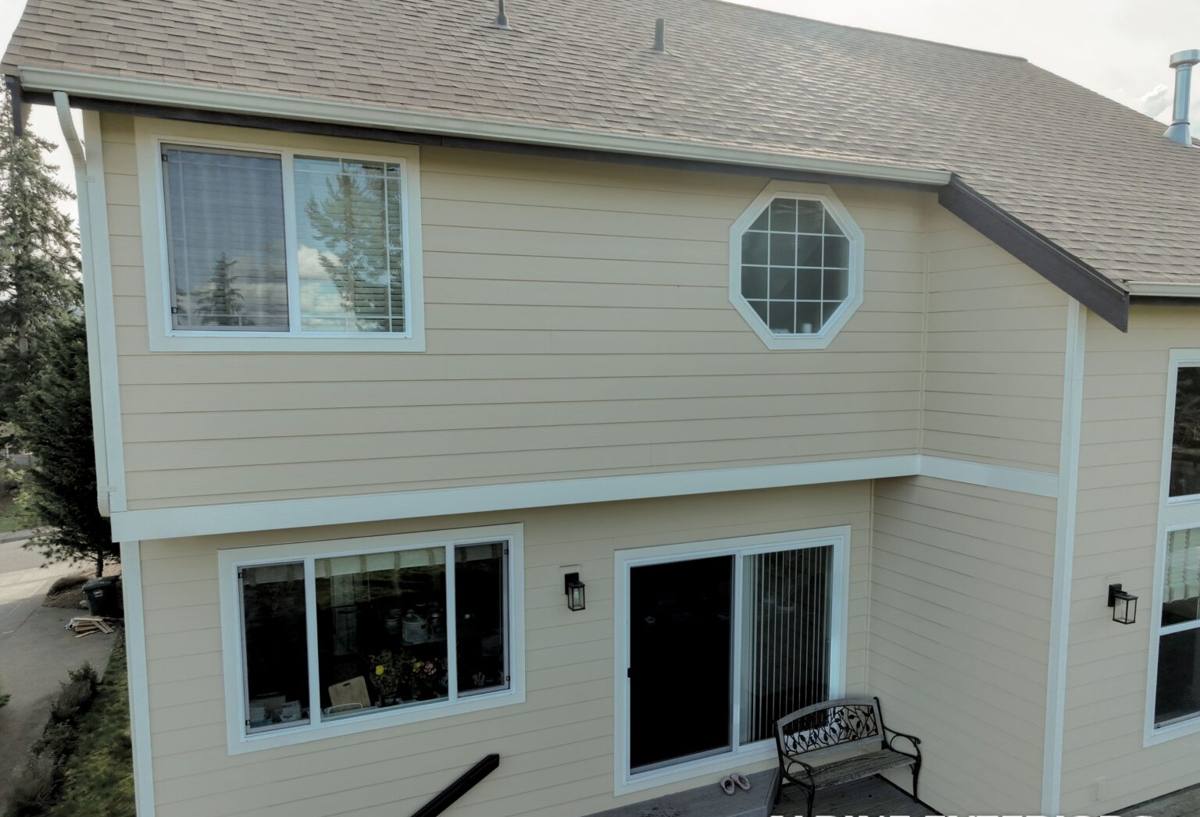
Signs a Nooksack Home Needs Replacement, Not Just Repair
Not every siding problem calls for a full tear-off. But there's a point where patching individual boards stops making sense and a full replacement becomes the more honest recommendation. Look for:
- Soft or spongy spots when you press on the siding, especially near the bottom courses or below windows
- Paint that's failing across large sections rather than in one or two spots
- Persistent moss or dark staining that comes back within a season of cleaning
- Visible warping, cupping, or delamination on wood or wood-composite siding
- Gaps opening up at seams, corners, or where siding meets trim
- Rising energy bills with no other explanation, which can point to a compromised wall assembly
- Multiple past patch jobs that no longer blend or seal properly
If you're seeing two or more of these, it's worth having someone look at the wall assembly itself, not just the surface.
What a Correct Siding Replacement Job Actually Involves
Full Tear-Off, Not an Overlay
Installing new siding over old, damaged siding is a shortcut that hides problems instead of fixing them. A proper replacement means stripping the wall back to the sheathing so we can actually see what's underneath — sheathing condition, any rot, and whether the framing needs attention before new siding goes up. In a climate that drives moisture into walls the way this one does, skipping that step just buries a problem under new material.
Weather-Resistive Barrier and Flashing Done Right
Once the wall is open, the housewrap or weather-resistive barrier, window and door flashing, and any penetrations (vents, hose bibs, electrical) get addressed before a single piece of new siding is installed. This layer is what actually keeps water out of the wall — the siding itself is the first line of defense, but it's not the only one, and in a wind-driven-rain climate it can't be the only one.
Fastening and Clearances Matched to the Climate
Correct nailing patterns, proper clearance from grade and roof lines, and gapping at joints all matter more here than they would in a dry climate, because any shortcut shows up as a moisture problem within a few wet seasons instead of a decade. This is also where corrosion-resistant fasteners earn their keep, given the salt air.
Why This Is a James Hardie-Only Job for Us
We install James Hardie fiber cement siding exclusively — we don't install vinyl, LP SmartSide, or wood siding, including cedar or primed spruce. That's not a marketing position, it's a standard we hold because of what we see happen to other materials in exactly this kind of coastal, wet climate.
Fiber cement doesn't absorb water the way wood-based products can, so it isn't feeding the kind of rot that shows up on older Custer-area homes. It's also non-combustible, which matters given regional wildfire risk in dry summer stretches. And because it comes from the factory with a baked-on ColorPlus finish rather than a job-site paint job, it holds color and resists the chalking and fading that salt air accelerates on field-painted surfaces. None of that means other products are junk — vinyl is inexpensive and low-maintenance in the right setting, and wood has real appeal for people who want it. We simply won't put our name on an install we don't believe will hold up here for the long haul, and for this climate, that means Hardie.
The Hardie Product Lines We Use in Whatcom County
James Hardie engineers its siding to specific climate zones, called HardieZone. Whatcom County falls into the HZ5 zone, which accounts for freeze-thaw cycling, sustained moisture, and coastal exposure. That's the version of Hardie board we install here — not a generic national product.
- HardiePlank lap siding — the standard horizontal siding profile, available in several textures and widths
- HardieShingle — for homes that want a shingle-style look without the maintenance of real wood shingles
- HardieTrim — matched trim boards so the whole exterior system, not just the field siding, resists moisture the same way
- ColorPlus finish — factory-applied color with a stronger warranty against fading and chipping than field-applied paint
Our Nooksack Siding Replacement Process
- On-site assessment — we walk the exterior with you, check for soft spots and moisture damage, and look at what's actually happening at the sheathing level where we can access it
- Written estimate — a clear scope covering tear-off, any sheathing repair, weather barrier, flashing, the Hardie product line and color, and a realistic timeline
- Tear-off and inspection — old siding comes off, sheathing gets inspected and repaired as needed before anything new goes up
- Weather barrier and flashing installation — the part of the job you won't see once it's finished, but the part that determines whether the wall stays dry
- Hardie installation — installed to manufacturer specifications for fastening, clearance, and joint treatment, matched to HZ5 requirements
- Final walkthrough and cleanup — site cleaned, work reviewed with you before we consider the job done
What Siding Replacement Costs in the Nooksack Area
Every home is different, but the factors that move the price are consistent. Rather than quote a number that won't mean much without seeing your home, here's what actually drives cost:
| Cost Factor | Why It Matters |
|---|---|
| Sheathing condition | Hidden rot found during tear-off adds repair work that can't be priced until the wall is opened |
| Home size and wall complexity | More corners, dormers, and trim details mean more labor and more cuts |
| Siding profile and finish | Lap width, shingle-style siding, and ColorPlus color options carry different material costs |
| Story height and access | Second-story and steep-site work require more equipment and time |
| Trim and detail scope | Replacing trim and fascia alongside siding costs more up front but avoids a mismatched look later |
| Existing siding removal | Multiple layers of old siding or extensive rot removal add disposal and labor time |
A full siding replacement is a significant investment, but it's also one of the few home improvements that protects everything behind it — framing, insulation, interior finishes — from ongoing water damage. We'll give you an honest, itemized number once we've actually seen your walls.
Why Hiring a Crew That Already Works in Custer and Nooksack Matters
A siding crew that only works occasionally in this climate can miss things that a crew working here regularly won't. Knowing how far moss typically travels up a north wall in this area, how much clearance to leave near grade given how wet the ground stays, and which details tend to fail first on homes exposed to salt air isn't something you learn from a manual — it's something you learn from doing the work here, repeatedly, and following up on it. We work in Custer, Nooksack, and the surrounding Whatcom County area because it's where we know the conditions, and we'd rather do fewer jobs well in a place we understand than spread thin somewhere we don't.
If your Nooksack home's siding is showing its age, we're happy to take a look and give you a straightforward, no-pressure estimate — no obligation, just an honest read on what your home actually needs.