 Custer
 Why Point Roberts Is Harder on Siding Than Most Whatcom County Neighborhoods
Point Roberts sits out on the water in a way most of Whatcom County doesn't. It's a peninsula surrounded on three sides by the Strait of Georgia and Boundary Bay, which means almost every home there deals with some level of salt-laden air, even the ones set back from the shoreline. Salt air doesn't just sit on a wall — it works into fasteners, seams, and any spot where a coating has thinned or a caulk line has failed, and it accelerates corrosion and finish breakdown faster than the same siding would wear a few miles inland in Custer.
Add in the driving rain that comes off the water during winter storms. Wind-driven rain doesn't fall straight down — it gets pushed sideways into wall assemblies, which puts real pressure on laps, butt joints, and trim details that would barely see moisture on a more sheltered lot. And because a lot of Point Roberts properties have mature tree cover and damp, shaded north walls, moss and algae get a long growing season here — often close to year-round — which holds moisture against the siding surface and keeps it from drying out between storms.
None of that means siding is doomed on this peninsula. It means the material and the installation details matter more here than they do in a lot of other places, and a replacement that isn't built for this exposure will show its age early.
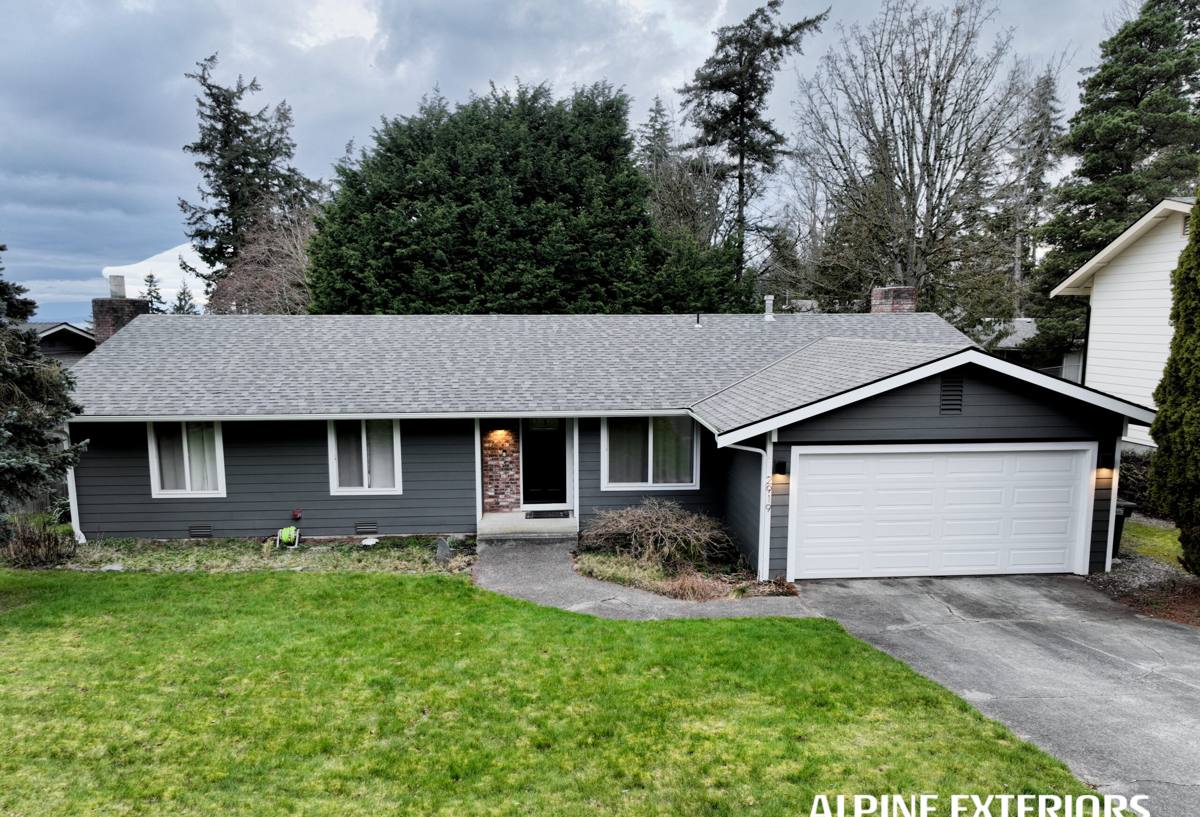
Signs a Point Roberts Home Actually Needs Replacement, Not a Repair
Not every problem calls for a full tear-off. But there's a point where patching stops making sense and a full replacement becomes the more honest recommendation. Walk your exterior and look for:
- Soft or spongy spots when you press on the siding, especially near the bottom courses and around window and door trim
- Paint or finish that's peeling, chalking heavily, or won't hold a fresh coat
- Persistent moss or dark streaking on north- and west-facing walls that comes back within a season of cleaning
- Visible warping, cupping, or buckling panels, particularly on walls that face the water directly
- Gaps opening up at seams, corners, or trim where caulk has failed and won't stay sealed
- A musty smell or visible staining on interior walls that share an exterior with problem siding
- Siding that's original to a home built more than 25-30 years ago and has never been fully replaced
One or two of these on their own might just need attention. Several at once, especially combined with soft sheathing underneath, usually means the wall assembly has been taking on moisture for a while and a repair would just be patching over a problem that's still active.
What a Correct Siding Replacement Actually Involves
Full Tear-Off and Sheathing Inspection
You can't properly diagnose or fix what's happening behind old siding without taking it off. A correct replacement starts with removing the existing material down to the sheathing and inspecting for rot, delamination, or soft framing — especially around window openings, at the base of walls, and anywhere the old siding showed problems. Any compromised sheathing or framing gets replaced before anything new goes back on. Skipping this step is the single most common shortcut that lets a new siding job fail early.
Water-Resistive Barrier and Flashing
Given how much wind-driven rain this peninsula sees, the water-resistive barrier and flashing details matter as much as the siding itself. Every penetration — windows, doors, hose bibs, vents — needs to be flashed so water sheds outward and down, never inward. Seams in the barrier get lapped correctly, shingle-style, so gravity is always working in your favor.
A Drainage Gap Behind the Siding
In a climate with this much rain and this long a moss season, giving water a path to escape matters. A rainscreen or drainage gap behind the siding lets any moisture that does get past the outer layer drain and dry out instead of sitting against the back of the panel or the sheathing. It's a small detail that makes a real difference in how long a wall assembly stays dry.
Fastening to Spec
Fiber cement has a specific fastening schedule — nail type, spacing, and depth — and it's engineered differently for high-wind and coastal exposure than it is for a sheltered inland wall. Getting this wrong doesn't show up immediately; it shows up as popped fasteners, cracked panels, or water intrusion a few years down the road.
Why We Only Install James Hardie Fiber Cement
We get asked why we don't offer vinyl, cedar, or engineered wood siding, especially since they're often cheaper up front. Here's the honest comparison, based on how these materials actually hold up in a salt air, high-moisture environment like Point Roberts:
| Material | Salt air / moisture behavior | Maintenance burden | Long-term concern |
|---|---|---|---|
| Vinyl | Doesn't rot, but can warp or crack in temperature swings and fades faster under UV and salt exposure | Low, but color can't be renewed once it fades | Seams and J-channels can let water behind the panel with nowhere good to drain |
| Cedar / wood | Attractive, but absorbs moisture readily; in a long moss season it stays damp longer between dry stretches | High — regular staining, sealing, and moss treatment | Rot risk climbs sharply if maintenance schedule slips even one season |
| Engineered wood | Better moisture resistance than solid wood, but the wood-based core is still sensitive to sustained damp exposure at cut edges and seams | Moderate — finish and edge sealing need attention over time | Performance depends heavily on installers sealing every cut and edge correctly |
| James Hardie fiber cement | Non-combustible, dimensionally stable, and engineered specifically for high-moisture climates in its HZ product lines | Low — factory ColorPlus finish resists fading and doesn't need repainting on a fixed schedule | Performance depends on correct installation, backed by a strong transferable warranty |
Every one of these products has a legitimate place somewhere. But for a peninsula getting direct salt exposure, driving rain, and a moss season that barely lets up, we've standardized on Hardie because it holds its finish, resists moisture at the material level rather than relying on coatings alone, and comes with a warranty structure that reflects real confidence in how it performs over decades — not just years.
Our Process for a Point Roberts Project
Point Roberts is part of Whatcom County, but geographically it's cut off from the rest of the county by water and by Canada — the only land route in and out crosses international border checkpoints. That's not a small detail when you're scheduling a construction crew and material deliveries.
We plan Point Roberts jobs differently than a job in Custer or elsewhere on the mainland side of the county:
- Materials, fasteners, and trim are fully staged and confirmed before the crew crosses, so we're not making repeat trips mid-project
- Crew scheduling accounts for border wait times so a work day doesn't get eaten by a crossing delay
- We do a full site walk and measurement before ordering material, since a lot of Point Roberts properties are seasonal or part-time residences and we want the homeowner's sign-off locked in before we're on-site
- We coordinate access and communication in advance for owners who aren't local day-to-day, so decisions during the job don't stall waiting on someone to be reachable
None of this is complicated once you've done it a few times, but it's a real difference from a standard mainland job, and it's the kind of thing that causes delays and change orders for a crew that hasn't worked out this side of the county before.
What Drives the Cost of a Siding Replacement
There's no honest flat price for siding replacement — too much depends on the specifics of the house. The factors that actually move the number are:
| Factor | Why it matters |
|---|---|
| Home size and wall complexity | More square footage and more corners, dormers, and trim details mean more material and more labor |
| Condition of the sheathing underneath | Rot or moisture damage found during tear-off has to be repaired before new siding goes up |
| Current siding type | Some materials come off faster and cleaner than others; layered or brittle siding takes longer to remove |
| Siding profile and accessories | Lap width, trim style, soffit and fascia work all affect both material and labor cost |
| Site access and exposure | Waterfront lots, tight setbacks, or difficult staging areas can add time and equipment needs |
We walk every property and give a written estimate based on what we actually find — not a per-square-foot guess made from a photo or a phone call.
Caring for New Siding in This Climate
A correctly installed Hardie replacement is genuinely low-maintenance, but "low-maintenance" isn't "no-maintenance" in a place with this much salt air and shade. A few habits keep it performing the way it should:
- Rinse salt residue off the siding a couple of times a year, especially on walls facing the water directly
- Keep gutters clear so water isn't overflowing and running down the wall face
- Trim back trees and shrubs that keep a wall shaded and damp, since that's exactly what extends moss growth
- Check caulking at trim and penetrations annually and re-seal anything that's cracked or pulled away
The ColorPlus factory finish on Hardie siding is baked on and resists fading far better than field-applied paint, so you're not on a repainting schedule the way you would be with wood siding — but a quick seasonal check still catches small issues before they become expensive ones.
Why It Matters to Hire a Crew That Already Works Point Roberts
A contractor who's only worked the mainland side of Whatcom County can still do competent work, but they're learning this peninsula's quirks on your project. A crew that already works Point Roberts regularly knows the border logistics, has already sorted out how to stage a job so delays don't compound, and has seen firsthand how differently a direct-waterfront wall ages compared to one set back among trees just a short distance away. That local track record shows up as fewer surprises, fewer delays, and a job that's planned around the realities of this specific stretch of coastline rather than treated like any other address in the county.
If your siding is showing its age, or you just want an honest read on whether it's a repair or a full replacement, we're happy to take a look. Reach out for a free, no-pressure estimate — there's a form right below to get started.