 Custer
 Why Nooksack's Climate Is Hard on Siding
Homes in the Nooksack area of Custer sit in one of the tougher climates in Whatcom County for exterior materials. It isn't one single problem — it's three working together, year after year. Salt-laden air moves in off the water and settles on anything facing the wrong direction, driving rain comes sideways during fall and winter storms and finds every seam and gap a siding job left open, and shaded, damp conditions keep moss and mildew alive on north- and west-facing walls for most of the year. Any one of those would shorten the life of ordinary siding. Together, they do it faster than most homeowners expect.
The failures we see aren't usually dramatic. It's paint that starts chalking and peeling years ahead of schedule, fastener heads that streak with rust, caulk joints that split and let water behind the wall plane, and moss mats that hold moisture against the surface long after the rain has stopped. By the time any of that is visible from the ground, there's a good chance moisture has already been working on the sheathing behind it for a while. Siding in this part of Whatcom County has to be chosen and installed with all of that in mind from the start — not patched around later.
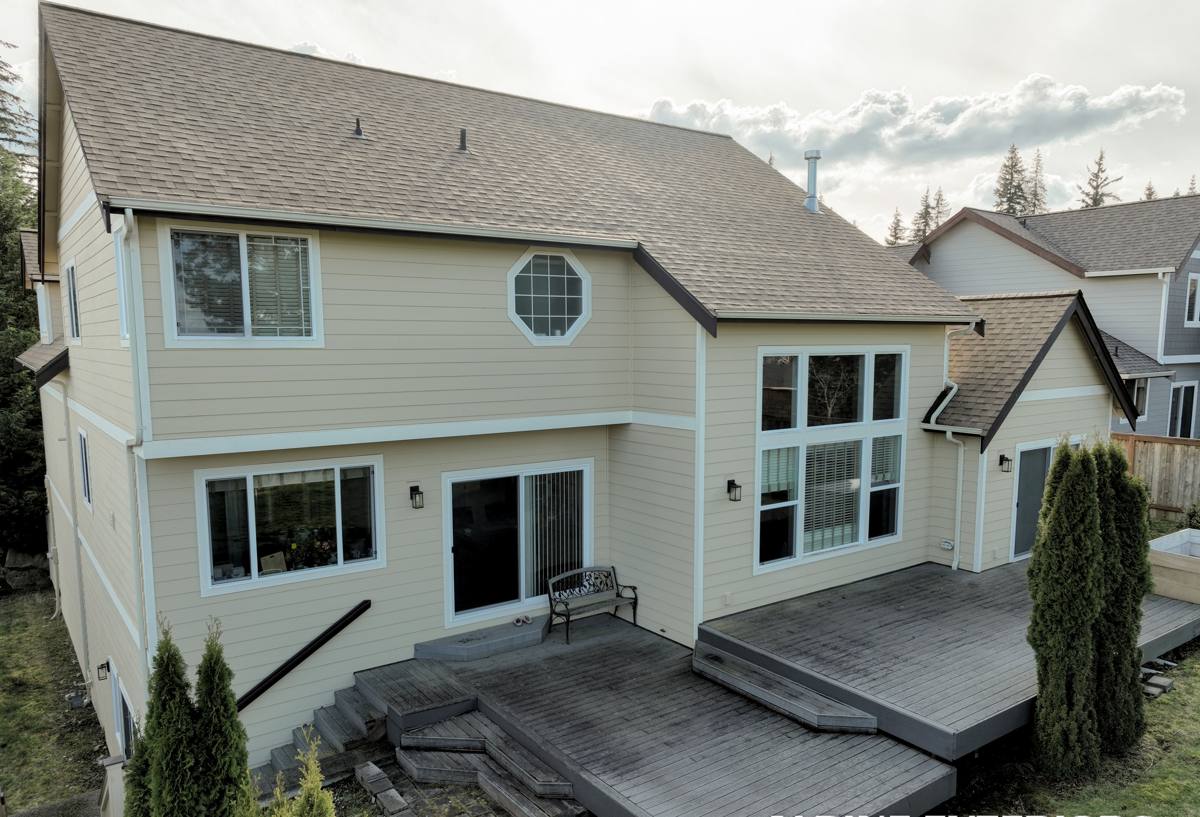
What James Hardie Siding Brings to a Nooksack Home
Built for This Climate, Not Just This Region
James Hardie engineers its siding by climate zone, and the HZ5 line used throughout the Pacific Northwest is formulated for exactly the conditions Custer and the surrounding area deal with — sustained moisture, freeze-thaw cycling, and long wet seasons. Fiber cement itself doesn't absorb water the way wood does, doesn't rot, and won't feed mold the way some engineered wood products can if their surface is compromised. That's a real advantage in a climate where siding rarely gets a long dry stretch to fully shed the moisture it's picked up.
ColorPlus Finish and Salt Air
Most of the color failures we see on older siding come from field-applied paint that was never meant to hold up against salt air and constant damp. Hardie's ColorPlus finish is baked on in a factory-controlled process rather than brushed or sprayed on site, which gives it stronger adhesion and better resistance to fading and moisture intrusion than a typical field finish. It doesn't make the siding maintenance-free, but it does mean touch-up painting isn't something a homeowner should expect to be doing every few years.
What a Correct James Hardie Installation Actually Involves
Hardie siding performs the way it's supposed to only when it's installed to spec. A lot of the problems attributed to "bad siding" over the years are actually installation shortcuts — and in a climate this wet, those shortcuts show up faster than they would somewhere drier.
Moisture Management Starts Before the First Board Goes Up
Correct installation starts with a properly lapped weather-resistant barrier over the sheathing, with flashing integrated at every window, door, and horizontal transition so water is directed out and down rather than trapped behind the cladding. In a climate that gets as much driving rain as this one, we also install a drainage gap (a rainscreen) behind the siding wherever the assembly calls for it, so any moisture that does get past the outer surface has somewhere to go instead of sitting against the wall.
Fastening, Clearances, and Caulking
Fasteners matter more here than in a dry climate — we use corrosion-resistant fasteners appropriate for coastal exposure, placed according to Hardie's nailing pattern rather than "close enough." Siding also needs proper clearance from grade, roof lines, decks, and other transitions so water and moss-holding debris don't accumulate against the bottom edge. And caulking gets used only where Hardie's installation instructions actually call for it — sealing every joint on principle can trap moisture just as easily as it can keep it out.
Our Process for a Nooksack Job
Assessment and Product Selection
We start by walking the exterior and checking the condition of the existing siding, trim, and — where accessible — the sheathing underneath, particularly at corners, below windows, and near grade, since those are the spots where moisture problems in this climate tend to start. From there we talk through siding profile (lap, shingle, or panel), trim details, and ColorPlus color options based on the home's exposure and what will actually hold up on the sides that take the worst of the weather.
Prep, Installation, and Walkthrough
Tear-off comes next, along with repair of any damaged sheathing we find before it gets covered back up — that's the point in the job where hidden problems either get fixed or get sealed in for another decade. Then it's weather-resistant barrier, flashing, rainscreen where called for, and the Hardie siding itself installed to manufacturer spec, followed by trim and a final walkthrough where we go over the finished work with the homeowner before calling the job done.
Siding Materials in This Climate: A Practical Comparison
We get asked fairly often why we don't offer vinyl or engineered wood as a lower-cost alternative. The honest answer is in how each material actually holds up under salt air, driving rain, and a long moss season — not in a sales pitch.
| Material | Moisture & Rain | Salt Air | Moss & Mildew | Ongoing Maintenance |
|---|---|---|---|---|
| James Hardie fiber cement | Does not absorb or swell; engineered for wet climates (HZ5) | Non-combustible material, factory finish holds up well | Doesn't feed mold growth; surface cleans easily | Occasional wash; touch-up rarely needed |
| Vinyl | Sheds water but seams and fasteners can allow moisture behind panels | Can become brittle and discolor faster near salt exposure | Moss holds moisture against panel joints | Low, but panels crack/warp over time and can't be repainted easily |
| Untreated or cedar wood | Absorbs moisture, prone to swelling and rot if finish fails | Salt accelerates finish breakdown | Highly susceptible without regular treatment | Frequent refinishing/sealing required |
| Engineered wood (e.g. LP SmartSide) | Resin-treated but edges and cut ends are vulnerable if not fully sealed | Moderate; depends on finish integrity | Can be affected if moisture reaches the wood substrate | Field-applied finish needs monitoring and upkeep |
None of these products are without merit for the right application. We simply standardized on Hardie because, installed correctly, it holds up the longest against the specific combination of moisture and salt exposure homes in this area deal with — and because a warranty backed by consistent factory-controlled manufacturing gives homeowners something more dependable than a field finish.
Why a Crew That Already Works This Area Matters
Siding installation isn't identical everywhere, and a crew that only occasionally works this part of Whatcom County doesn't always catch the details that matter here. A crew based in Custer and working the Nooksack area regularly already knows which wall orientations take the worst wind-driven rain, which older homes in this pocket tend to have thinner or outdated moisture barriers behind the existing siding, and how much of a drainage gap actually makes a difference given how long walls here stay damp after a storm. That local pattern recognition shows up in fewer surprises during tear-off and a installation that's built for the exposure the house actually gets, not a generic assumption about "coastal Pacific Northwest."
It also matters after the job is done. If a warranty question or a callback ever comes up, a local crew can get back out to the property quickly instead of a homeowner waiting on a crew that has to travel in from somewhere else.
Signs Your Current Siding Is Already Struggling
Because moisture damage in this climate tends to start behind the siding before it's visible on the surface, it helps to know the early warning signs:
- Paint that's chalking, bubbling, or peeling well ahead of its expected lifespan
- Moss or dark staining that keeps returning to the same spots after cleaning
- Soft or spongy spots when you press on siding, especially near the bottom edge or corners
- Visible gaps, warping, or boards that no longer sit flush against the wall
- Rust streaking below fastener heads or trim
- A musty smell near exterior walls inside the home
- Noticeably higher heating costs, which can point to moisture-compromised insulation behind the siding
Any one of these on its own isn't necessarily an emergency, but a few appearing together is usually a sign it's worth having someone take a closer look before it turns into a sheathing repair.
What Affects the Cost of a Nooksack Siding Job
There's no single number that applies to every home, but the same handful of factors drive cost up or down on most jobs in this area:
| Factor | Why It Matters |
|---|---|
| Home size and number of stories | More square footage and taller walls mean more material and labor, plus added access requirements |
| Condition behind the existing siding | Rotted sheathing or trim found during tear-off adds repair work that a quote can't fully predict in advance |
| Siding profile chosen | Lap, shingle, and panel systems have different material and labor requirements |
| Trim and architectural detail | Corners, dormers, and multiple roof lines all add cutting and fitting time |
| Site access | Tight lot lines, landscaping, or limited staging space can add time and equipment needs |
We walk every home in person before giving a number, because the condition behind the old siding — which you usually can't see from the ground — has as much influence on the final cost as the size of the house itself.
Maintenance After Installation
Hardie siding installed correctly is low-maintenance, not no-maintenance, and that distinction matters in a climate like this one. An occasional rinse to clear salt residue and moss spores before they get a foothold goes a long way. It's also worth a quick visual check of caulking and trim joints once a year, since even good caulk eventually needs to be redone, and making sure gutters and downspouts are actually directing water away from the walls rather than dumping it against them during the wetter months.
If you're weighing a siding replacement or just want a straight answer on what your current siding will and won't hold up to, we're happy to take a look and put together a free, no-pressure estimate — no obligation either way.