 Custer
 Why Lynden Roofs Wear the Way They Do
Lynden sits in that stretch of Whatcom County where three things gang up on a roof at once: salt-laden air drifting in off the Strait, long stretches of driving, wind-pushed rain, and a moss season that can run from October well into spring. None of those three is dramatic on its own. Together, over ten or fifteen years, they're what actually ends a roof's life out here — not one big storm, but slow, steady wear that shows up as granule loss, soft spots at the eaves, and moss mats that hold moisture against the shingle mat long after a dry spell has passed.
A roof built for a drier inland climate, or installed without local ventilation and moisture habits in mind, will underperform in Lynden even if every shingle is nailed correctly. That's the gap a lot of homeowners don't see until they're already dealing with soft decking or a stained ceiling.
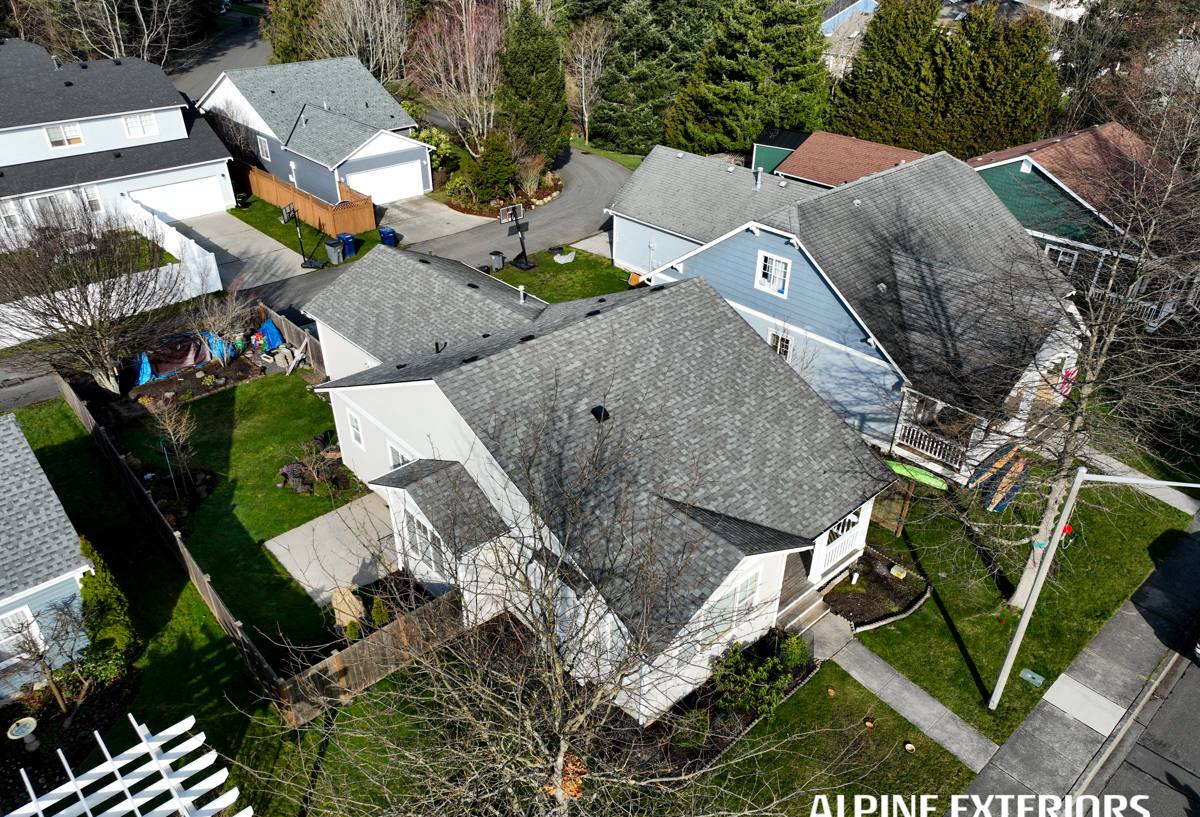
Signs a Lynden Home Needs Replacement, Not Another Repair
Repairs make sense when the problem is isolated — a few lifted shingles after a windstorm, a cracked pipe boot, a small flashing leak. Replacement becomes the honest recommendation when the damage is systemic. Common signals we look for on Lynden roofs:
- Granules collecting heavily in gutters and downspouts, leaving shingles looking bald or blotchy
- Moss established in mats rather than a light surface dusting — especially on north-facing slopes that stay shaded and damp
- Curling, cupping, or cracked shingles across multiple slopes, not just one section
- Soft or spongy decking felt underfoot during inspection, a sign moisture has been getting past the shingle layer for a while
- Daylight or water staining visible in the attic along the ridge, valleys, or roof-to-wall transitions
- A roof already at or past the manufacturer's expected service life for this climate
If it's one or two of these in isolation, repair is usually the right call — we'll say so. When several show up together, patching becomes a short-term fix on a roof that's already failing underneath.
What Salt Air and Moss Actually Do
Salt air accelerates corrosion on any exposed metal — flashing, nail heads, vent caps, gutter hardware. Over years that means fasteners and flashing can fail before the shingles themselves do, which is why we pay close attention to metal component quality and placement, not just the shingle brand. Moss is a moisture problem disguised as a cosmetic one: its root structure holds water against the roof surface and can lift shingle edges, which is exactly where wind-driven rain finds its way in.
What a Correct Roof Replacement Actually Involves
A roof replacement is more than swapping old shingles for new ones. Done right, it's a system, and every layer matters for a climate like this one:
- Full tear-off — removing old roofing down to the deck so we can actually see the condition of what's underneath, rather than roofing over hidden problems
- Deck inspection and repair — replacing any soft or delaminated sheathing before anything new goes down
- Ice-and-water or synthetic underlayment — placed at eaves, valleys, and other vulnerable transitions where wind-driven rain is most likely to intrude
- Proper flashing — new step flashing, valley flashing, and pipe boots rather than reusing corroded originals
- Balanced ventilation — intake at the eaves and exhaust at the ridge, sized to the attic, so moisture doesn't get trapped and encourage rot or mold from the inside
- Correct nailing and exposure — installed to manufacturer spec, which is also what keeps a warranty valid if something ever goes wrong
Skipping any one of these doesn't always show up right away. It shows up in year six or seven, as a leak that seems to come from nowhere or a shingle that fails years before it should.
Material Options for This Climate
Most Lynden homes are well served by a quality architectural asphalt composition shingle — it handles wind-driven rain well when installed with proper underlayment and flashing, and it's a known, serviceable product with straightforward warranty coverage. Metal roofing is a legitimate option too, particularly for homeowners prioritizing longevity and shedding moss and debris more easily, though it comes with a higher upfront cost and different installation requirements around fasteners and expansion.
| Material | Moss / Moisture Behavior | Typical Lifespan Here | Trade-offs |
|---|---|---|---|
| Architectural asphalt shingle | Good with proper ventilation and zinc/copper strips; needs periodic moss maintenance | 25–30 years | Best value; wide color/style range; easiest to repair in sections |
| Standing seam metal | Sheds moisture and moss buildup well due to smooth, steep-shed surface | 40–50+ years | Higher upfront cost; installation sensitivity around fasteners and flashing details |
| Basic 3-tab shingle | More prone to moss anchoring in flatter tab profile | 15–20 years | Lowest upfront cost, but shortest service life in this climate |
We don't push one product line over another based on what pays us the best commission — we recommend based on your roof's slope, sun exposure, and how long you plan to be in the home. If a lower-tier product isn't going to hold up to a Whatcom County moss season, we'll say that plainly rather than let a homeowner find out the hard way.
Our Process, Start to Finish
1. On-Site Inspection and Honest Assessment
We look at the roof, the attic ventilation, the decking condition where accessible, and the specific exposure of your property — how shaded it is, which slopes face north, how close you are to open water or heavy tree cover. That shapes the recommendation more than a generic checklist would.
2. Clear, Itemized Estimate
You'll see what's included — tear-off, decking allowance, underlayment type, flashing, ventilation work, cleanup — so there's no guessing what you're paying for.
3. Scheduling Around Local Weather
We plan around the wet stretches typical to this area rather than pretending they don't exist. Tear-off and dry-in happen in a sequence designed to minimize the window your home is exposed.
4. Installation and Daily Cleanup
Job sites are kept clean day to day — magnetic sweeps for nails, tarped landscaping, debris hauled rather than left to pile up.
5. Final Walkthrough
We walk the finished roof and the attic with you, point out the ventilation and flashing work, and answer questions before we call the job done.
Ventilation and Moisture Control Deserve Real Attention
In a climate this wet, an under-ventilated attic is one of the fastest ways to shorten a new roof's life. Warm, moist air trapped under the deck condenses, and that moisture works against the underside of the sheathing and shingles from the inside — sometimes faster than the weather works on them from the outside. Balancing intake and exhaust ventilation isn't an upsell; it's part of what makes the rest of the materials perform the way they're supposed to.
What Drives Cost on a Lynden Roof Replacement
| Factor | Why It Matters Here |
|---|---|
| Roof size and pitch | Steeper roofs take longer and require more safety setup |
| Number of layers to remove | Some older homes have multiple layers, adding tear-off time and disposal cost |
| Decking condition | Moisture damage from long-term moss or leaks may require sheathing replacement |
| Material selection | Asphalt vs. metal changes both material and labor cost significantly |
| Ventilation upgrades | Adding proper intake/exhaust venting where a home currently lacks it |
| Access and site conditions | Tree cover, steep lots, or tight access can add setup time |
We'll walk you through which of these apply to your specific roof rather than quoting a flat number that doesn't reflect your home.
Why a Crew That Already Works Lynden Matters
A roofer who works this specific area regularly — not just Whatcom County broadly, but this pocket of it near Custer and Lynden — has already seen how these homes weather over the years: which slopes moss up fastest, how salt-air corrosion tends to show on flashing and fasteners, and what wind-driven rain does to valleys and roof-to-wall transitions that aren't detailed correctly. That's knowledge you don't get from a crew passing through on a one-off job. It shows up in the small decisions — where extra underlayment goes, how ventilation is sized, which flashing details get extra attention — that separate a roof that holds up for decades from one that starts causing problems in year six.
After Your New Roof: A Simple Maintenance Checklist
- Have moss growth treated or removed before it establishes into thick mats, not after
- Clean gutters and downspouts at least twice a year given the tree cover common in this area
- Do a visual check after major windstorms for lifted or missing shingles
- Keep overhanging branches trimmed back to reduce shade, debris, and moss-friendly conditions
- Have your attic ventilation checked periodically, especially if you notice condensation or musty smells
- Address small leaks immediately rather than waiting — they rarely stay small in this climate
A new roof done right shouldn't need much beyond this. The goal of a correct installation is to make the roof low-maintenance, not maintenance-free — this climate doesn't really allow for the latter.
Get a Straightforward Estimate
If your Lynden home's roof is showing its age — heavy moss, granule loss, soft spots, or a roof that's simply reaching the end of its expected life — we're happy to take a look and give you an honest read on repair versus replacement. There's no pressure and no obligation. Use the form below to request a free estimate, and we'll walk the roof with you and explain exactly what we find.