 Custer
 Building a Deck in Laurel That Actually Holds Up
A deck in Laurel isn't the same project as a deck in a dry inland climate, and it shouldn't be built the same way. This part of Whatcom County deals with salt-tinged air, long stretches of driving rain, and a moss season that can run most of the year. A deck that looks great the day it's finished but wasn't built with those conditions in mind will show its age fast — soft spots underfoot, rusted fasteners bleeding rust streaks down the boards, slick green film on every horizontal surface by the second winter. This page walks through what a deck built for Laurel conditions actually requires, from the ground up.
We're not trying to talk you into the most expensive materials on the market. We're trying to help you understand which choices actually matter here, and which ones are marketing. Some of that comes down to the wood or composite you pick. A lot of it comes down to details most homeowners never think to ask about — flashing, fastener grade, joist spacing, drainage under the frame — that determine whether a deck lasts 10 years or 30.
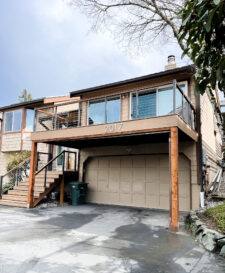
What Whatcom County Weather Does to a Deck Over Time
Salt Air and Corrosion
Proximity to the water means airborne salt finds its way onto every exposed surface, including your deck. Salt accelerates corrosion in ordinary fasteners, hinges, and hardware. A deck built with standard hot-dip galvanized screws might look fine for a couple of years, then start showing rust bleed exactly where the fastener heads sit. Once a fastener starts corroding, it weakens the connection it's holding together — which matters a lot more on structural framing hardware than it does on a cosmetic trim piece.
Driving Rain and Moisture Intrusion
Rain here doesn't just fall straight down — wind-driven rain gets pushed sideways into ledger boards, under railing posts, and into any gap in the decking that isn't properly spaced or flashed. Water that gets trapped rather than shed is what rots framing lumber from the inside, long before the surface boards show visible damage. Most of the deck failures we get called out to inspect started as a moisture problem at a connection point, not as general wear on the decking itself.
The Long Moss Season
Shade, moisture, and mild temperatures are exactly what moss and algae need to establish themselves, and Laurel gets all three for much of the year. Moss on a deck isn't just cosmetic — it holds moisture against the wood surface, and on stairs or a ramp it turns into a real slip hazard. A deck design that ignores airflow and drainage is signing you up for a moss problem no amount of cleaning will permanently solve.
Decking Material Choices for This Climate
There's no single "best" decking material for every homeowner — it depends on your budget, how much upkeep you're willing to do, and how long you want the deck to last without major work. Here's how the common options compare under Whatcom County conditions specifically:
| Material | Moisture & Moss Resistance | Maintenance | Typical Lifespan |
|---|---|---|---|
| Pressure-treated lumber | Good if properly sealed and re-sealed; moss still grows on the surface film | Needs cleaning and re-sealing every 1-2 years in this climate | 15-20 years with upkeep |
| Cedar | Naturally rot-resistant, but the surface still hosts moss without regular cleaning | Periodic cleaning and oiling to keep its color and resistance | 15-25 years with upkeep |
| Composite decking | Doesn't absorb water or rot, but moss and algae can still grow on the surface film | Occasional washing; no sealing or staining required | 25-30+ years |
| PVC/capped decking | Fully sealed surface, best resistance to staining and moisture | Lowest maintenance of the group; occasional washing | 25-30+ years |
Composite and PVC decking cost more up front, typically in the range of a few dollars more per square foot than pressure-treated lumber, but for homeowners who don't want to re-seal a deck every year or two in a wet climate, that upfront difference often pays for itself in avoided maintenance. Real wood still has a place — it's less expensive initially and some homeowners simply prefer the look and feel of natural cedar. Either way, moss will grow on any decking surface that stays shaded and damp; material choice affects how the deck holds up structurally, not whether it needs occasional cleaning.
Framing and Structural Details We Don't Skip
The decking surface is what you see, but the framing underneath is what determines whether the deck is safe and how long it actually lasts. In a climate like ours, a few details matter more than they would somewhere drier:
- Fastener grade: stainless steel or high-corrosion-resistant coated fasteners at every structural connection, not just standard galvanized, given the salt air exposure here
- Ledger flashing: proper flashing where the deck attaches to the house, so wind-driven rain can't work its way behind the siding and rot the rim joist
- Joist protection: flashing tape or a comparable barrier on top of joists so screw penetrations don't become a hundred small entry points for water
- Footing depth and drainage: footings set below frost depth and sited so standing water doesn't pool against the posts
- Board spacing and airflow: decking spaced to shed water and allow air movement underneath, which slows moss growth and lets framing dry out between rain events
None of these show up in a photo of a finished deck, but they're the difference between a deck that needs a full rebuild in 12 years and one that's still solid in 30.
Our Deck Building Process
1. On-Site Assessment
We look at the site itself — slope, drainage, sun exposure, how the deck will attach to the house, and any existing moisture problems on the structure it's connecting to. A deck that's shaded and low to the ground needs different drainage and material thinking than one that's elevated and gets more sun.
2. Design and Material Selection
We talk through decking material, railing style, and layout based on how you'll actually use the space and how much maintenance you want to take on going forward. This is also when we flag anything about the site — like heavy shade or poor drainage — that will affect how the deck performs over time.
3. Permitting
Most new decks and many deck replacements in Whatcom County require a building permit, particularly if the deck is attached to the house or elevated above a certain height. We handle that process as part of the job so it's not left for you to sort out.
4. Foundation and Framing
Footings, posts, beams, and joists go in first, built to the fastener, flashing, and spacing standards described above. This stage is largely invisible once the deck is finished, which is exactly why it needs to be done right the first time.
5. Decking, Railing, and Finish Work
Decking boards, railings, stairs, and any trim go on last. We check spacing and fastening as we go rather than rushing to get boards down, since gaps and fastener placement are what determine how well the deck sheds water for years afterward.
6. Final Walkthrough
We walk the finished deck with you, cover basic care for whatever material you chose, and make sure everything meets code before we call the job done.
Cost Factors for a Laurel Deck Project
Every deck is priced based on its own size, materials, and site conditions, so exact numbers depend on your specific project. In general, these are the factors that move the price up or down:
| Factor | Effect on Cost |
|---|---|
| Decking material (treated wood vs. composite vs. PVC) | Composite and PVC typically run higher per square foot than pressure-treated lumber; cedar falls in between |
| Deck height and railing requirements | Elevated decks need taller railings and more substantial framing/footings, adding cost |
| Site access and slope | Difficult access or a sloped yard adds labor time for footings and material handling |
| Attachment vs. freestanding | Ledger-attached decks require flashing work at the house; freestanding decks need their own full support structure |
| Stairs and multiple levels | Each added stair run or level adds material and framing complexity |
As a rough starting point, most straightforward deck projects in this region run somewhere in the range of $35 to $75 per square foot depending on the factors above — but the only way to get a real number is to look at your specific site and goals.
Maintaining a Deck in a Moss-Prone Climate
Even a well-built deck needs some seasonal attention here. This isn't complicated, but skipping it lets moss and moisture problems get ahead of you:
- Sweep debris (leaves, needles, seed pods) off the decking regularly, especially in fall, so it doesn't trap moisture against the boards
- Wash the deck surface at least once a year with a deck cleaner rated for the material — pressure washing wood decking too aggressively can damage the surface fibers
- Check and reapply sealant or stain on wood decking on the schedule recommended for that product, typically every 1-2 years in this climate
- Look at fastener heads periodically for early rust staining, which is easier to address early than after it's spread
- Trim back overhanging branches or vegetation that keeps sections of the deck shaded and damp longer than the rest
- Check under the deck occasionally for standing water or blocked drainage paths around the footings
Why a Crew That Already Works Laurel Matters
Deck building looks straightforward from the outside, but a crew that regularly works in Laurel and the surrounding Custer area already knows which framing and fastener choices hold up here and which ones cause callbacks two winters later. That local experience means fewer surprises during the permitting process, fewer material choices that look fine on paper but perform poorly once salt air and moss season set in, and a finished deck that's actually built for the conditions it has to survive — not a generic spec that happens to look right in a showroom.
If you're planning a new deck or replacing one that's showing its age, we're glad to take a look and talk through what makes sense for your site. Reach out for a free, no-pressure estimate using the form below.