 Custer
 Why Cherry Point Siding Takes a Different Kind of Beating
Cherry Point sits right on the water in Whatcom County, and that location shapes everything about how siding performs here. Homes in this stretch face a combination most inland Washington properties never deal with at the same time: salt-laden air coming off the Strait, wind-driven rain that gets pushed sideways into wall assemblies, and a long, damp moss season that keeps north-facing walls and shaded corners wet for weeks at a stretch. Any one of those factors is manageable. Together, they narrow the list of siding products that actually make sense out here.
Salt air is corrosive to fasteners and hard on paint films. Wind-driven rain doesn't just wet a surface — it drives moisture into laps, seams, and butt joints if they weren't detailed correctly the first time. And moss doesn't just look bad; it holds moisture against the siding face far longer than a dry summer day would suggest, which is exactly the condition that rots wood-based products and delaminates weaker composites. If you're planning a siding project for a Cherry Point home, the climate isn't a footnote — it's the starting point for every decision.
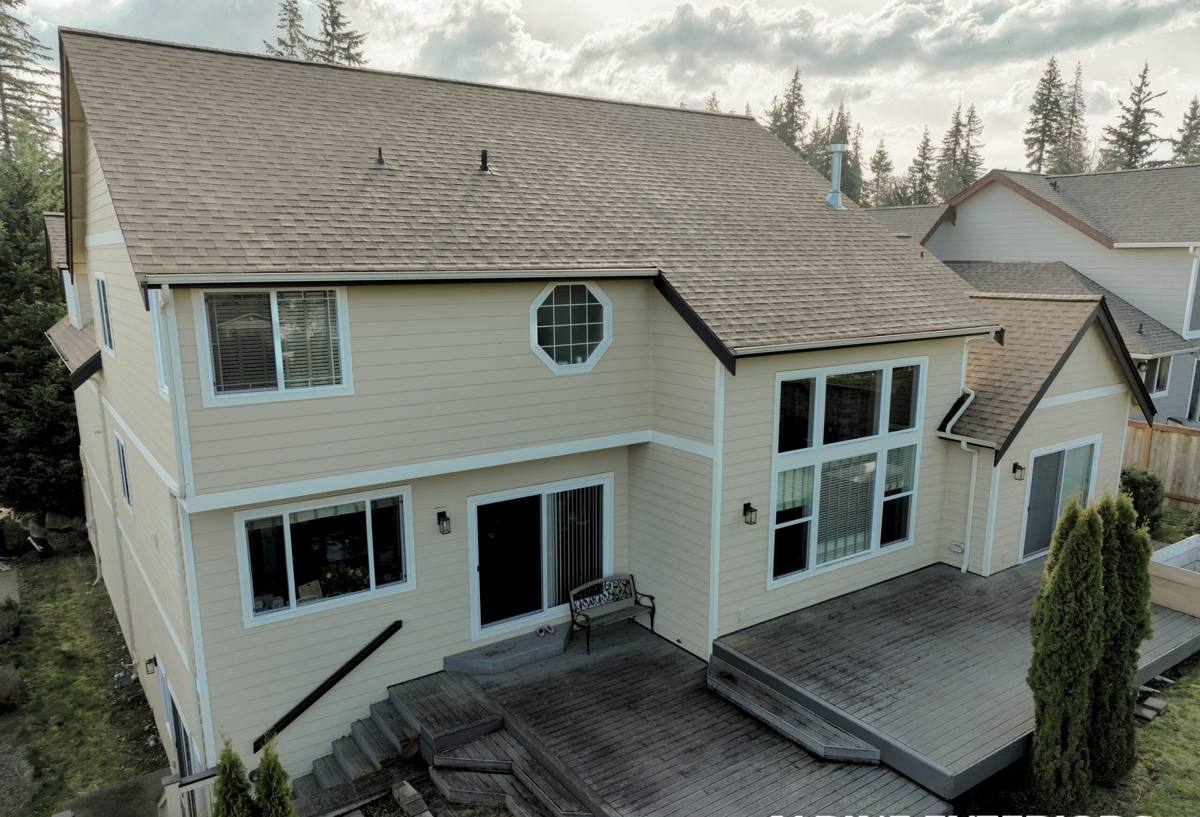
What This Specific Climate Demands From Siding
We install James Hardie fiber cement exclusively, and on a shoreline property like this, the reasons aren't abstract. Fiber cement is cement, sand, and cellulose fiber — there's no wood fiber core to absorb water and swell, and no organic material for moss and mildew to feed off the way they can with cedar or engineered wood products. That matters enormously in a location where a wall can stay damp for a large part of the year.
Salt Air and Coastal Exposure
Salt air degrades a lot of building materials over time, but it's especially hard on anything relying on a factory or field-applied coating to keep moisture out. James Hardie's ColorPlus finish is baked on in a controlled factory process, which gives it better adhesion and UV resistance than most site-applied paint jobs — important on a home where salt spray and constant humidity are working against the finish year-round.
Wind-Driven Rain
Rain that comes in at an angle finds every gap in a siding installation. This is where product choice matters less than installation quality — but it's also where fiber cement's dimensional stability helps. It doesn't cup, warp, or telegraph movement the way some wood-based sidings can after repeated wet-dry cycles, so laps and joints that were sealed correctly on day one tend to stay sealed.
Moss and Prolonged Dampness
Moss thrives on shaded, north-facing, and tree-sheltered walls — common conditions around Cherry Point properties with mature landscaping or tree lines buffering the wind. Because fiber cement has no organic food source, moss can grow on its surface but won't degrade the material underneath the way it can with wood or wood-fiber products. Regular gentle cleaning keeps it looking sharp; it isn't a structural threat the way it is with other sidings.
What a Correct Fiber Cement Job Actually Involves
A lot of siding problems in this region don't trace back to the product — they trace back to installation shortcuts that don't show up until the second or third wet season. On a Cherry Point home, we treat the following as non-negotiable:
- Proper weather-resistive barrier and flashing integration behind the siding, not just at window and door openings but at every horizontal transition
- Correct fastener type and spacing per the James Hardie installation manual — coastal exposure makes fastener corrosion resistance a real consideration, not a formality
- Rain-screen or drainage gap detailing where the wall assembly calls for it, so incidental moisture has somewhere to go instead of sitting against the back of the siding
- Factory-cut and field-cut edges properly sealed, since exposed raw edges are where moisture intrusion typically starts
- Minimum clearance maintained between the bottom of the siding and grade, decks, patios, or roof lines to avoid wicking
- Caulking only where James Hardie specifies it, using a high-quality sealant rated for exterior movement — over-caulking traps moisture just as often as under-caulking lets it in
None of this is exotic. It's the difference between following the manufacturer's installation manual to the letter and treating it as a rough guideline. On a shoreline property, that gap in discipline shows up faster than it would fifteen miles inland.
How Our Process Works for Cherry Point Homes
1. On-Site Assessment
We walk the property and look specifically at exposure: which walls face prevailing wind and rain, which stay shaded and damp longer, where existing moss or moisture staining is already showing, and how the current siding or trim has held up. This tells us where extra attention to flashing and drainage detail is worth it.
2. Removal and Sheathing Check
Once old siding comes off, we inspect the sheathing underneath. In a marine climate, this step matters more than usual — hidden moisture damage behind old wood or composite siding is common, and it needs to be addressed before anything new goes up, not covered over.
3. Weather Barrier and Flashing
We install or verify the weather-resistive barrier and flashing at every penetration, transition, and opening before a single piece of Hardie board goes on. This is the layer that does the real waterproofing work; the siding itself is the second line of defense.
4. Installation to Manufacturer Spec
Fastening, gapping, and clearances follow the James Hardie manual for the specific product line and climate zone. We don't deviate to save time on details that determine how the wall performs in year five, not just at the final walkthrough.
5. Final Detailing and Walkthrough
Trim, caulking, and touch-up work are finished last, followed by a walkthrough where we point out what was done and why, including anything homeowners should watch for seasonally.
Choosing the Right James Hardie Product Line
James Hardie makes climate-engineered product lines, and for a coastal Whatcom County property, that distinction is worth understanding rather than skipping past.
| Product Line | Best Fit For | Relevant Cherry Point Factor |
|---|---|---|
| HardiePlank Lap Siding (HZ10) | Most home styles; primary siding field | Engineered for wetter, harsher climates — the standard choice for this area |
| HardieShingle | Accent areas, gables, coastal/cottage aesthetics | Popular look for shoreline homes without sacrificing durability |
| HardieTrim | Corners, fascia, window and door trim | Resists the moisture wicking that rots wood trim in damp corners |
| HardiePanel | Modern or vertical-siding designs | Clean lines with the same moisture and salt-air performance |
We'll walk through which combination fits the home's style and exposure during the estimate — there's rarely a single "right" answer, but there is usually a clearly better one once we've looked at the specific walls involved.
Why Hardie Instead of Alternatives, Specifically Here
We get asked, reasonably, why we don't offer vinyl, LP SmartSide, or cedar as options. In a climate like Cherry Point's, the honest answer is about long-term performance under conditions that are tougher than most of Washington sees.
Vinyl siding can warp and become brittle with UV and temperature cycling, and its seams and J-channels give wind-driven rain more opportunities to work behind the cladding over time. Engineered wood products like LP SmartSide use a wood-strand core that, however well-treated, is still an organic material — in a location with a long moss season and near-constant humidity, that's the exact profile of conditions that shorten its service life if any edge or seam is compromised. Cedar and primed spruce are genuinely attractive materials, but they demand a maintenance schedule — repainting, resealing cut ends, watching for rot at grade — that's a bigger ask on a property exposed to salt air and prolonged dampness than it would be somewhere drier and more sheltered.
None of those products are poorly made. They're simply built around trade-offs that get more expensive to manage the closer a home sits to conditions like these. Fiber cement's non-organic composition, factory-applied finish, and dimensional stability line up with what this specific stretch of coastline actually demands, which is why we standardized on it rather than offering a menu of options with very different long-term outcomes.
Why Local Experience With This Exact Area Matters
A crew that already understands how Cherry Point's exposure differs from a sheltered inland lot in Whatcom County isn't guessing at flashing details or fastener choices — they've seen how the wind and moisture actually move across these properties across multiple seasons. That translates into fewer callbacks, better-placed drainage details, and a finished job that's tuned to the site instead of installed the same way it would be twenty miles from the water. It also means a straighter answer up front about what a given wall or elevation actually needs, rather than a one-size-fits-all quote.
What Homeowners Should Budget and Plan For
Costs vary with home size, number of stories, existing siding removal, trim complexity, and product line selection, so we won't quote a number without seeing the property. What we can say is that the line items that matter most for long-term performance in this climate — proper flashing, drainage detailing, and correct fastening — are not places to cut corners for a lower bid. A cheaper quote that skips these details tends to cost more within a decade than a correct installation does up front.
If you're planning ahead, it helps to think through a few things before we come out for an estimate:
- Which walls or elevations show existing moss, staining, or paint failure
- Whether you've noticed soft spots, gaps, or visible damage at trim, corners, or the base of the siding
- Any past water intrusion, even minor, around windows or doors
- Whether you want to change the home's look (color, plank width, accent shingle areas) or match what's there now
- Your general timeline, since siding work is best scheduled around the wetter months when possible
If you'd like a straight answer about what your home's siding actually needs given its exposure, we're happy to walk the property with you. Reach out for a free, no-pressure estimate — there's no obligation, and we'll tell you plainly what we see.