 Custer
 Why Point Roberts Is a Different Siding Job
Point Roberts sits on its own little peninsula hanging off the bottom of Boundary Bay, surrounded on three sides by water and cut off from the rest of Whatcom County by the international border. That geography is exactly why siding wears differently out there than it does a few miles inland in Custer or Bellingham. Homes get near-constant exposure to salt-laden air coming off the Strait of Georgia, driving rain that comes in sideways off the water during winter storms, and long stretches of damp, shaded conditions that keep moss and algae established on north- and west-facing walls almost year-round.
None of that is exotic weather — it's the same Pacific Northwest coastal pattern that hits Whatcom County generally — but Point Roberts gets a concentrated version of it because there's water on every side and nothing to block the wind. Siding that's marginal in Custer tends to fail faster out on the Point. That's the lens we bring to every James Hardie job we do there.
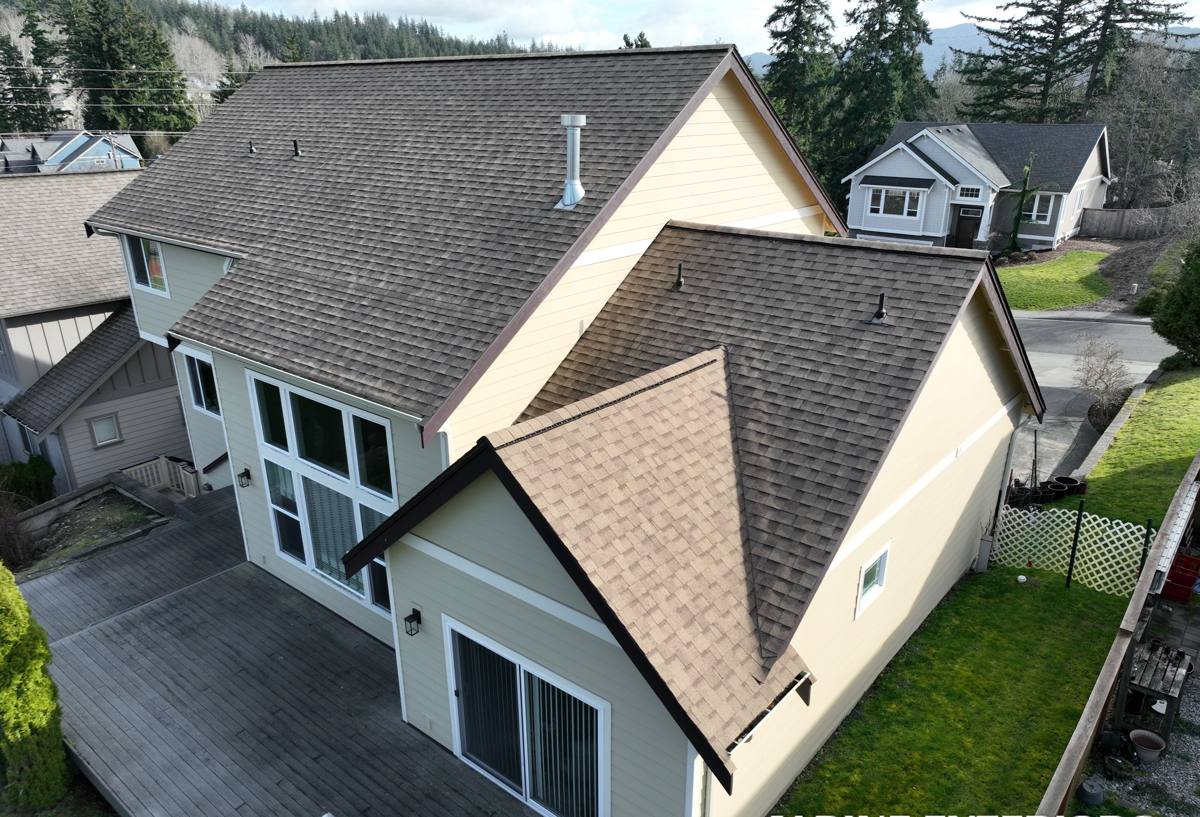
What Salt Air, Rain, and Moss Actually Do to Siding
Salt Air
Salt spray carried on coastal wind settles on exterior surfaces and accelerates corrosion of anything metal — nail heads, flashing, fasteners, trim screws. On siding materials that rely on paint film or a factory coating to keep moisture out, salt residue also holds humidity against the surface longer between rain events, which speeds up coating breakdown at seams and cut edges.
Driving Rain
Wind-driven rain doesn't just wet a wall — it pushes water sideways and upward, into laps, seams, and any gap in the water-resistive barrier. A siding system that depends on perfect caulking to stay water-tight is a bad match for this kind of exposure, because caulk is the first thing that fails under repeated wetting and UV cycling.
Moss and Algae
Shaded, damp wall sections — common on the north and west sides of homes near the water — stay wet longer after each rain and rarely get direct sun to dry them out. That's ideal moss and algae growth conditions. Beyond looking bad, sustained moss growth holds moisture against the siding surface, which is a problem for any product that can absorb water or swell.
Why We Only Install James Hardie Out Here
We standardized on James Hardie fiber cement for every home we side, and Point Roberts is one of the clearest cases for why. Hardie's siding is engineered from cement, sand, and cellulose fiber — it doesn't rot, it isn't a food source for moss or mold the way wood-based products can be, and it holds up to repeated wetting and drying without swelling or delaminating at the edges. It's also non-combustible, which matters anywhere with dry summer stretches and wildfire smoke seasons, even on the wet side of the state.
Hardie makes climate-specific product lines under its HZ5 engineering for the Pacific Northwest, which accounts for exactly the freeze-thaw and moisture cycling this region sees. And with ColorPlus factory-applied finish, the color coat is baked on under controlled conditions rather than field-applied — it resists fading and chipping far better than a site-painted finish, which matters when you're fighting salt exposure and UV off the water every day.
We get asked why we don't offer vinyl, LP SmartSide, or cedar as alternatives. The honest answer is maintenance burden and moisture behavior in exactly this kind of climate. Vinyl can warp and fade faster under sustained salt exposure and doesn't hold paint if a homeowner ever wants to change the color. Engineered wood products depend on intact factory coatings and careful field sealing at every cut — miss one spot in a driving-rain environment and moisture finds it. Cedar is a beautiful material but requires an ongoing maintenance commitment (staining, sealing, monitoring for rot) that most homeowners underestimate until it's overdue. Hardie removes those failure points, which is why it's the only product we put on homes.
What a Correct Installation Involves Here
Fiber cement siding is only as good as the installation behind it. In a coastal-exposure environment like Point Roberts, a few details matter more than they would on a sheltered inland lot:
- Rainscreen or proper drainage plane: a ventilated gap behind the siding lets any moisture that does get past the cladding drain and dry instead of sitting against the wall assembly.
- Correct fastener spec: in a salt-air environment, fastener material and coating matter — corroded fasteners are one of the most common causes of premature siding failure near saltwater.
- Flashing at every penetration: windows, doors, vents, and any wall penetration need properly lapped flashing, not just caulk, because caulk alone isn't a reliable long-term water barrier under driving rain.
- Manufacturer-spec clearances: Hardie specifies minimum clearance from grade, roofing, and decks so water doesn't wick up into the bottom edge of the siding — a detail that's easy to shortcut and expensive to ignore.
- Joint and butt-seam treatment: using Hardie's specified joint treatment rather than relying on caulk alone at every seam, since caulk is the first material to degrade under repeated coastal wetting.
- Factory-cut edges kept intact where possible: ColorPlus finish is most durable at factory-cut edges; field cuts should be sealed with the manufacturer's touch-up product to protect the exposed cement core.
Skip any of these and you don't get a Hardie failure — you get a Hardie board doing exactly what an improperly installed board does anywhere: letting water find the one gap you left it.
Our Process on a Point Roberts Job
1. Site Assessment
We walk the exterior and identify which elevations take the worst of the wind-driven rain and which stay shaded and damp longest — that tells us where to be most careful with flashing and drainage detail, and where moss has likely already been working on the existing siding or sheathing underneath.
2. Tear-Off and Sheathing Check
Once the old siding is off, we check the sheathing and water-resistive barrier underneath for hidden moisture damage. This is often where problems on older coastal homes actually live — not in the siding itself, but in what was happening behind it for years.
3. Weather Barrier and Drainage Plane
We install or verify a proper water-resistive barrier and drainage gap before any Hardie board goes up, since this layer does most of the real work of keeping bulk water out of the wall assembly.
4. Installation to Hardie Spec
Fasteners, clearances, flashing, and joint treatment are all done to manufacturer specification — not shortcuts, because shortcuts are what show up as callbacks in three to five years on an exposed site like this.
5. Trim, Caulk, and Touch-Up
Final sealant at trim and penetrations, and ColorPlus touch-up paint at any field cuts, so the factory finish's protection extends across the whole job, not just the uncut sections.
6. Walkthrough
We go over the finished exterior with the homeowner, including what routine care looks like given the site's exposure — covered further below.
Cost Factors on a Coastal, Cross-Border Site
| Factor | Why It Affects the Job |
|---|---|
| Access and logistics | Point Roberts is only reachable by crossing into and back out of Canada, or by boat or small plane — material delivery and crew scheduling need to account for border crossings and wait times. |
| Existing wall condition | Homes with long-term moss coverage or past water intrusion may need sheathing repair before new siding goes on, which isn't known until tear-off. |
| Elevation exposure | Walls facing the open water or prevailing wind may need more careful flashing detail than sheltered elevations, which can add labor time. |
| Trim and detail complexity | Homes with more windows, dormers, and roof-to-wall transitions have more flashing points, each of which needs to be done correctly in a driving-rain climate. |
| Product line and finish | HardiePlank lap, HardiePanel, and HardieShingle all price differently, and ColorPlus finish options vary by line. |
We won't quote a number without seeing the house — every one of these factors moves the estimate, and a fair quote accounts for what the tear-off actually reveals, not just the square footage.
Why Hiring a Crew That Already Works Point Roberts Matters
Point Roberts isn't a neighborhood a contractor can swing by casually. Getting a crew, equipment, and materials out there means planning around the border crossing every single day of the job — and a crew that hasn't done it before will underestimate that friction, which shows up as delays, missed days, or a job that gets rushed to compensate. We already build that logistics reality into how we schedule and staff jobs out there, so it doesn't become the homeowner's problem.
There's also a site-knowledge piece. A crew that's worked multiple homes on the Point has already seen how the wind and rain actually behave on that peninsula, which elevations take the worst of it, and how moss establishes itself on shaded walls near the water. That's not something you learn from a spec sheet — it's something you learn by doing the work there repeatedly, and it directly affects where we spend extra care on flashing, drainage, and fastening.
Homeowner Maintenance Checklist for This Climate
- Rinse siding annually (a garden hose is usually enough) to clear salt residue before it has a chance to sit on the surface long-term.
- Check north- and west-facing walls each fall for early moss or algae growth and treat it before it spreads across a wider area.
- Walk the exterior after major winter storms and look for anything loose at trim, flashing, or caulk joints — catching a small gap early is far cheaper than repairing hidden water damage later.
- Keep gutters and downspouts clear so rainwater is directed away from the wall rather than sheeting down the siding face.
- Trim back vegetation that keeps a wall section shaded and damp longer than the rest of the house.
- Touch up any nicked or scratched siding promptly with Hardie's specified touch-up product to keep the cement core protected.
What to Expect From Hardie Long-Term
Installed correctly, James Hardie siding is built to handle this kind of exposure for decades, backed by a strong transferable warranty on the product itself and the ColorPlus finish. It won't rot, it won't feed moss the way some wood-based products can, and it doesn't rely on an intact paint film the way vinyl or engineered wood does to keep moisture out. That's the whole reason we standardized on it — on a site like Point Roberts, the material needs to be doing most of the work, because the weather isn't going to ease up.
If you're planning a siding project in Point Roberts or anywhere else around Custer, we're happy to take a look at your home and walk you through what a correct James Hardie installation would involve for your specific exposure. Reach out for a free, no-pressure estimate using the form below.