 Custer
 Why Nooksack Homes Wear Out Their Siding Faster Than the Brochure Says
Nooksack sits in a part of Whatcom County that asks more of an exterior wall than most manufacturers' spec sheets account for. Homes here deal with a triple punch: salt-tinged marine air drifting in off the Strait of Georgia and the bay, long stretches of driving rain that hits siding sideways instead of straight down, and a moss season that can run eight or nine months out of the year under the tree cover and overcast skies typical of this part of the county. None of those three things alone is unusual for the Pacific Northwest. Together, over a decade or two, they're what separates a siding job that still looks sharp at year fifteen from one that's chalking, cupping, or growing a green film by year six.
Salt air is corrosive to fasteners and hard on paint film, even well inland from open water, because it rides on wind and settles on any north- or west-facing wall that catches the weather. Driving rain finds every gap in flashing and every under-caulked joint, and it doesn't just wet the surface — it drives moisture behind trim and around penetrations if those details weren't built right the first time. And moss doesn't just look bad; it holds moisture against the siding surface and grout lines longer than open air would, which is exactly the condition that accelerates rot in wood-based products and finish failure in anything with a weak factory coating.
We don't say any of this to scare a homeowner into a bigger project than they need. We say it because it's the honest starting point for any siding decision in this area, and it's why we've standardized on one product system rather than offering the full lineup of options you'll find at a big box store.
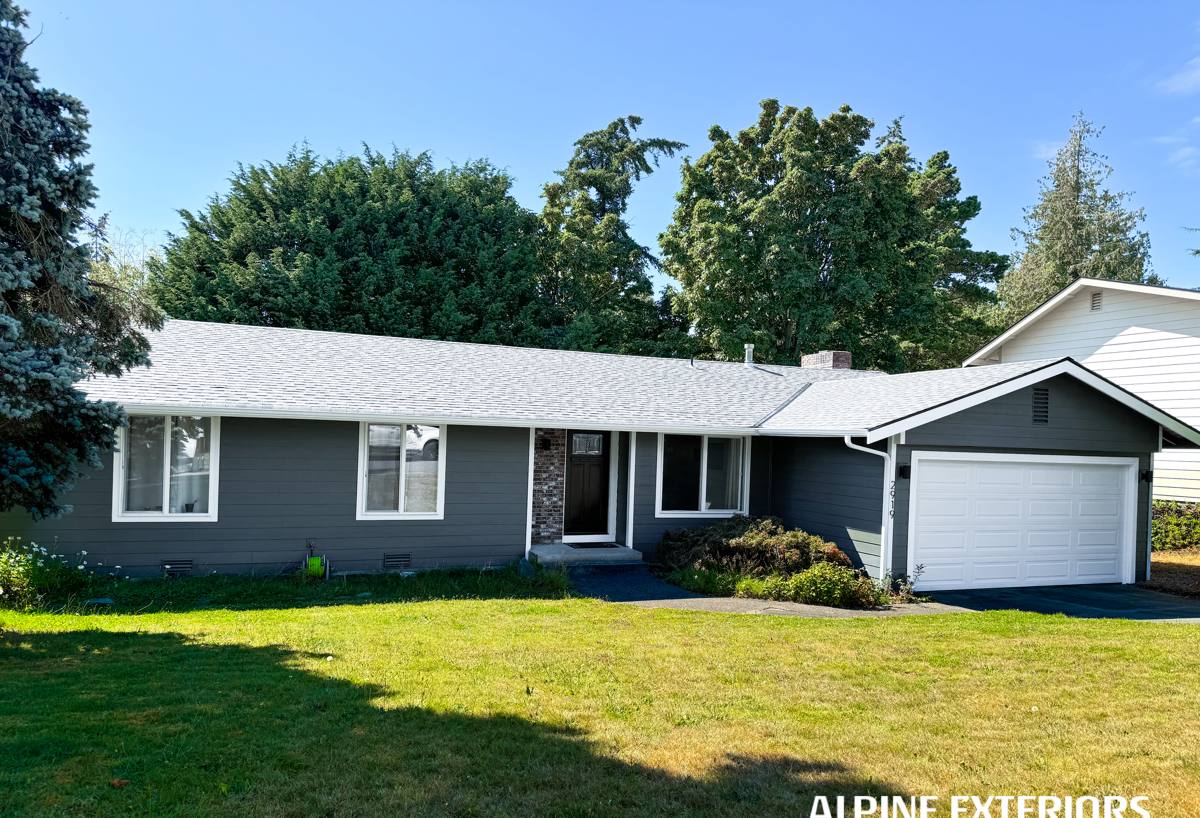
What Siding Actually Needs to Do in This Climate
Strip away the marketing language and a siding product covering a Nooksack home needs to handle four jobs at once, continuously, for decades:
- Shed wind-driven rain without absorbing it into the substrate
- Resist a finish that fades, chalks, or peels under repeated wet-dry cycling
- Stay dimensionally stable through the area's swings between soaked winters and drier summers, so caulked joints don't work themselves open
- Hold up to organic growth — moss, algae, mildew — without the surface degrading every time it gets scrubbed or pressure-washed off
Not every siding material clears all four bars equally well, and that's the honest reason our answer for Nooksack homeowners is fiber cement — specifically James Hardie fiber cement, not the category in general.
Why We Install Only James Hardie, Not the Full Fiber Cement Lineup
Fiber cement as a category has other manufacturers in it, and some of them make a reasonable product. We don't install them, and we think homeowners deserve the real reason rather than a vague "it's not what we carry." James Hardie engineers its HardieZone products specifically for regional moisture and temperature patterns, backs the color with a factory-baked ColorPlus finish rather than relying on job-site paint, and has the longest track record of any fiber cement manufacturer for how the product actually performs after quality installation in wet marine climates like ours. That combination — climate-matched engineering, a finish that doesn't depend on a painter's skill or weather conditions on install day, and a manufacturer with the field history to back a real warranty — is what we're willing to put our own labor warranty behind. We'd rather install one product system correctly, every time, than stock five and hope each crew gets each one right.
That standard also means we don't install vinyl, LP SmartSide, primed spruce, or cedar on the homes we work on. Each of those has an honest case somewhere — vinyl is inexpensive, cedar is beautiful when maintained, LP has its fans — but none of them combine non-combustible material, a factory-cured finish, and the long-term moisture performance we want to guarantee against Nooksack's rain and moss exposure. We're happy to talk through those trade-offs with any homeowner who's comparing options; we just don't put those materials on the wall ourselves.
What ColorPlus Actually Buys You Here
In a climate with this much wet-dry cycling, the weak point on most siding jobs isn't the board — it's the paint. Field-applied paint on any substrate is at the mercy of the temperature and humidity on the day it's sprayed or rolled, and it has to be recoated on a schedule. ColorPlus is baked onto the plank at the factory in a controlled environment, which is why it carries its own separate finish warranty against fading and peeling. For a wall that's going to see salt-laden wind and months of gray, damp weather every year, that's not a cosmetic upgrade — it's the difference in how many times a homeowner has to touch up or repaint over the life of the siding.
What a Correct Installation Involves
Fiber cement is only as good as the installation underneath it. James Hardie publishes detailed installation requirements, and in a climate like Nooksack's, skipping any of them shows up faster than it would in a drier region.
Water Management Comes Before the Siding Goes Up
Correct weather-resistive barrier, properly lapped and taped seams, and flashing at every window, door, and penetration have to be right before a single plank is hung. This is the step that determines whether wind-driven rain stays on the outside of the wall assembly or works its way behind it over the years.
Clearances and Gaps
Hardie siding needs proper clearance from grade, roof lines, decks, and other horizontal surfaces, plus gapping at butt joints and trim per the manufacturer's fastening guide. Tight, caulked-solid joints with no room for the material to move are one of the most common shortcuts that lead to cracking and moisture intrusion later.
Fasteners and Fastening Pattern
Corrosion-resistant fasteners, driven at the correct depth and spacing, matter more here than in a dry inland climate because of the salt content in the air. Overdriven or underdriven nails are a common cause of premature siding failure, and it's a detail that's invisible once the job looks finished — which is exactly why it has to be done right the first time.
Caulking and Sealant Joints
Only sealants compatible with fiber cement and rated for the exposure should be used at trim and penetration joints, applied to a clean, primed edge. This is a small line item that gets skipped or rushed on a lot of jobs and is one of the first places driving rain finds its way in.
How Our Process Works
- Walk-through and assessment — we look at your current siding's failure points, wall orientation relative to prevailing wind and rain, roofline details, and any moss or moisture staining already present.
- Written estimate — scope, product line, color, and a clear breakdown of what's included, no vague allowances.
- Tear-off and inspection — once old siding is off, we check the sheathing underneath for hidden rot or moisture damage before closing anything up.
- Water management install — barrier, flashing, and taping done to spec, inspected before siding goes on.
- Hardie installation — correct clearances, fastening, and joint treatment throughout.
- Final walk-through — we go over the finished work with you before calling the job done.
Fiber Cement Compared to Other Common Siding Choices
| Material | Moisture Behavior | Finish Durability | Fire Resistance | Typical Lifespan |
|---|---|---|---|---|
| James Hardie Fiber Cement | Engineered for wet climates when installed to spec | Factory ColorPlus finish, separate warranty | Non-combustible | 30+ years with proper install |
| Vinyl | Doesn't absorb water but can warp or gap over time | Field color only, fades over time | Combustible | 20-30 years |
| LP SmartSide (engineered wood) | Sensitive to sustained moisture exposure at cut edges and joints | Factory-primed, still wood-based | Combustible | 25-30 years, install-dependent |
| Cedar | Absorbs and releases moisture; needs ongoing sealing | Requires repainting/staining on a schedule | Combustible | Varies widely with maintenance |
This isn't a claim that the alternatives fail outright — it's why, weighing moisture behavior, finish durability, and fire resistance together for this specific climate, fiber cement is where we've drawn our line.
What Drives the Cost of a Fiber Cement Job Here
| Factor | Why It Matters in Nooksack |
|---|---|
| Existing wall condition | Hidden moisture damage from years of driving rain or moss cover often isn't visible until tear-off |
| Siding profile and trim complexity | Lap width, shingle-style panels, and trim detail all affect labor time |
| Water management upgrades | Homes with older or missing flashing systems need that addressed as part of the job, not after |
| Color and finish line | ColorPlus color selections and premium textures price differently than base lines |
| Access and site conditions | Tree cover, slope, and outbuilding proximity affect setup and staging time |
Keeping Fiber Cement Siding Looking Right in This Climate
Correctly installed Hardie siding is low-maintenance, not no-maintenance. A short, honest checklist for homeowners in this area:
- Rinse siding annually, especially on shaded or north-facing walls where moss and algae take hold first
- Keep gutters clear so overflow doesn't run down the wall face during heavy rain events
- Trim back vegetation and tree limbs that keep a wall section damp and shaded longer than the rest of the house
- Re-caulk trim joints if you notice cracking or gapping, rather than waiting for water staining to appear
- Have flashing and joints checked periodically at roof lines, decks, and window heads, where most real leaks originate
Why It Matters That We Already Work in This Area
A crew that installs Hardie siding across Whatcom County, including homes around Custer and Nooksack, has already seen how the local wind exposure, rain patterns, and moss growth play out on actual houses — not just in a manual. That translates into practical decisions on your job: where extra flashing attention matters most based on a home's orientation, which trim details tend to fail first in this specific climate, and how to sequence the work around the wetter stretches of the year. It also means warranty support and follow-up don't require finding an out-of-area contractor months or years later. We're not asking you to take our word for a national reputation — we're asking you to hold us to how the work looks on your own house.
If you're weighing a siding replacement in Nooksack and want a straight answer about what your home actually needs, we're glad to walk the exterior with you and put together a free, no-pressure estimate — no obligation, no pressure to sign anything on the spot.