 Custer
 Siding Repair for Everson and Custer Homes
Everson sits close enough to the Nooksack River and the surrounding farmland that its homes see a specific mix of weather stress: damp air off the water, wind-driven rain rolling in from the Strait, and long stretches of gray, moss-friendly winters. Add in the salt-laden air that reaches this far inland from Bellingham Bay on stronger weather systems, and you get siding that ages faster here than it would in a drier part of the state. When we get repair calls from Everson and Custer, the damage almost always traces back to one of these three things: moisture that got behind the cladding, moss and algae that sat too long, or an impact that cracked a panel and let water start working on the substrate underneath.
Siding repair isn't just patching a hole. Done right, it's a diagnostic process — figure out why that section failed, fix the underlying cause, then repair the surface so it matches and performs like the rest of the wall. Skip the diagnosis and you'll be back out here in two years fixing the same spot.
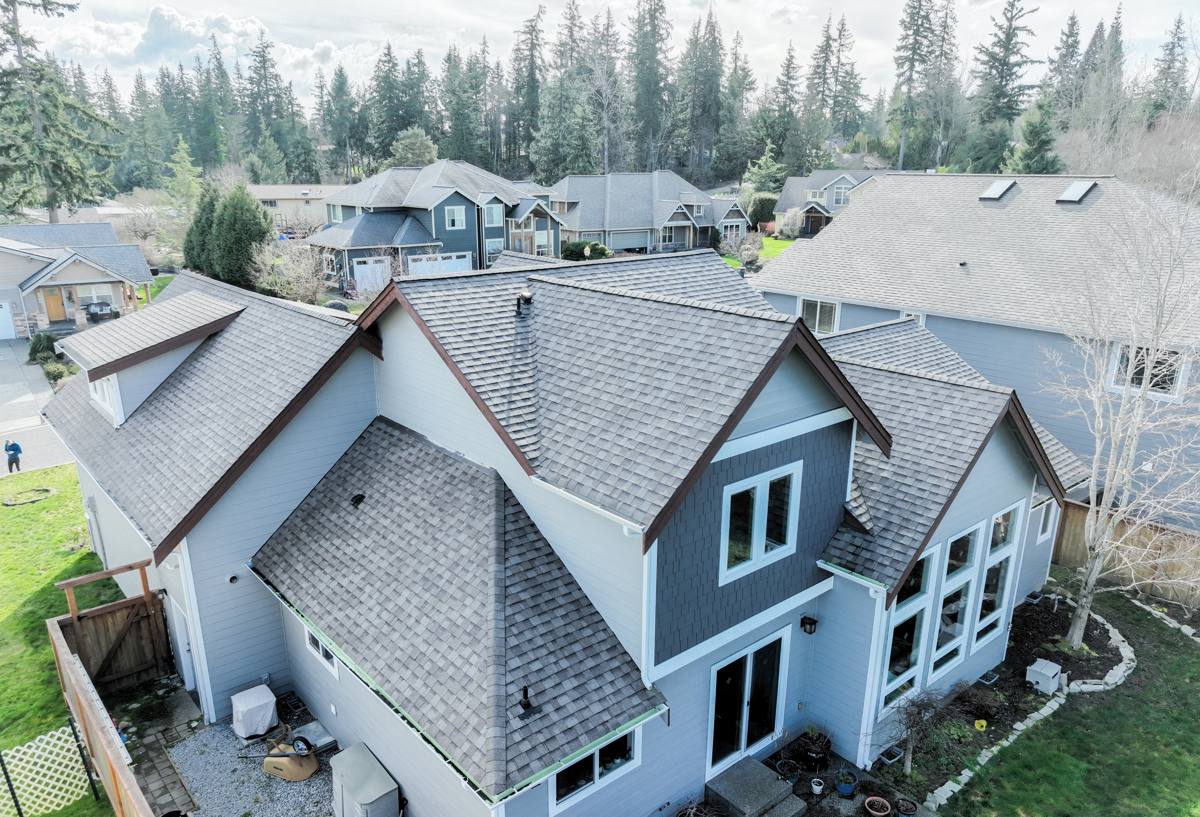
What Whatcom County Weather Does to Siding
Moisture and driving rain
Whatcom County gets rain that doesn't just fall straight down — wind pushes it sideways into wall assemblies, especially on west and southwest-facing elevations that catch weather off the Strait of Georgia. Over years, that driving rain finds every gap in caulking, every under-flashed window, every spot where siding was nailed too tight or too loose. Once water gets behind the cladding, it doesn't dry out fast in our climate — humidity stays high enough, long enough, that trapped moisture can sit for weeks. That's when you start seeing soft spots, staining, and eventually rot in the sheathing behind the siding.
Moss and biological growth
Everson's moss season runs long — shaded north walls, tree-lined lots, and mild damp winters give moss, algae, and lichen months to establish themselves on any siding surface that holds moisture. Moss isn't just cosmetic. It holds water against the siding surface, keeps that section from drying between rains, and on wood-based or poorly sealed products it accelerates rot right at the point of contact.
Salt air
Custer and Everson aren't waterfront, but they're close enough to Bellingham Bay and the Strait that salt-laden air reaches this far inland, especially during winter storms. Salt accelerates corrosion on fasteners and trim hardware and can degrade some paint and coating systems faster than inland exposure would. It's a slower factor than rain or moss, but it adds up over the life of a siding system.
Common Repair Situations We See in This Area
- Cracked or split panels from impact — branches, hail, equipment, or simple age-related brittleness in older wood or composite siding.
- Soft, spongy, or delaminating sections where moisture has been getting behind the siding for a while, often near ground level, under windows, or at butt joints that were never properly sealed.
- Moss and algae staining on north-facing and shaded walls that's gone past a simple wash and started to hold moisture against the surface.
- Failed caulk and flashing around windows, doors, and trim — the entry point for most of the moisture problems we trace back on repair calls.
- Fastener and hardware corrosion where trim nails or fasteners have started to bleed rust or lose their grip.
- Mismatched or discontinued siding from a prior repair or partial replacement that doesn't match the rest of the wall in color or profile.
What a Correct Siding Repair Actually Involves
A repair that's done right isn't just "cut out the bad piece, nail in a new one." It has a sequence:
- Diagnose the cause. We pull back the damaged section and look at what's underneath — sheathing condition, house wrap, flashing detail, fastener pattern. If we don't understand why that spot failed, we haven't earned the right to close it back up.
- Address the underlying issue. That might mean re-flashing a window, replacing a section of sheathing, correcting a caulk joint, or fixing a grading or drainage issue that was keeping water against the wall.
- Match the replacement material correctly. Panel profile, exposure, and color need to line up with the existing siding — this is where a lot of DIY and low-bid repairs go wrong and leave a visibly patched wall.
- Reinstall to spec. Correct fastener type, correct nailing pattern, correct gaps at joints for expansion, correct caulk and sealant at the right joints (and not at the ones that need to breathe).
- Finish and blend. On factory-finished products this means matching the coating; on field-painted products it means a proper primer and topcoat that will hold up to the same weather that damaged the original section.
Repair vs. Replacement: How We Help You Decide
| Factor | Repair usually makes sense | Replacement usually makes sense |
|---|---|---|
| Extent of damage | Isolated to one or two sections/elevations | Spread across multiple walls or the whole house |
| Cause of damage | Single identifiable event (impact, one failed flashing point) | Systemic moisture issue, widespread rot, or aged-out material |
| Material condition elsewhere | Rest of the siding is sound and holding up | Rest of the siding is near end of life or the same product line has recurring problems |
| Material match | Product is still available or a close match exists | Discontinued profile/color with no reasonable match |
| Underlying structure | Sheathing and framing are dry and sound | Sheathing shows rot or damage beyond the immediate repair area |
We'll always tell you honestly which side of that table your house falls on. A repair that's going to leave you with a patchwork wall or that's masking a bigger moisture problem isn't a good use of your money — and we'd rather lose a small job than sell you a fix that doesn't hold.
Why Product Choice Matters for Repairs, Not Just New Installs
This is also where original material choice comes back to matter. Vinyl siding can crack in cold snaps and is hard to source in an exact color match years later since dye lots shift. Wood and primed spruce need consistent repainting and are the most vulnerable to the rot patterns we see from driving rain and long moss seasons. LP SmartSide and other engineered wood products perform reasonably when installed and maintained correctly, but they're still wood-based at the core, which means cut edges and any moisture intrusion point need real diligence to keep from becoming a bigger repair later.
We install James Hardie fiber cement exclusively, and one reason is that it repairs cleanly. It's non-combustible, doesn't swell or rot from moisture the way wood-based products can, and the ColorPlus factory finish is engineered to hold color and resist the exact climate stress — UV, moisture cycling, salt air — that this area puts on a wall. When we do have to repair a Hardie installation, we're working with a material that behaves predictably and takes a color-matched patch cleanly, instead of fighting a product that's already degrading unevenly.
Our Repair Process
- On-site assessment. We look at the damaged area and the surrounding wall, not just the obvious spot, so we don't miss a related issue nearby.
- Honest scope and estimate. You get a clear explanation of what's actually wrong, what we recommend, and a written estimate before any work starts.
- Correct repair, not a patch job. We fix the cause, not just the symptom, and match materials and finish as closely as the situation allows.
- Cleanup and walkthrough. We show you what we found and what we did, so you understand your home's exterior better than before we showed up.
Maintenance That Prevents the Next Repair Call
- Rinse moss and algae off siding annually, especially on shaded and north-facing walls, before it has a chance to hold moisture against the surface all winter.
- Keep gutters clear and downspouts directed away from the foundation so runoff isn't sheeting down or pooling against lower siding courses.
- Trim back vegetation and tree limbs that keep a wall section shaded and damp longer than the rest of the house.
- Recaulk window and door trim joints every few years — this is the single most common failure point we trace moisture damage back to.
- Walk the exterior once a year, especially after a hard winter, and look for cracked panels, soft spots, or lifted trim before they turn into a bigger repair.
Why It Matters to Hire a Crew That Already Works Everson
Everson and Custer aren't a generic climate zone — they're a specific combination of river-valley moisture, farmland exposure, and enough proximity to the Strait to bring salt air into the mix on the wrong wind. A crew that works this area regularly already knows which elevations tend to take the worst of the driving rain, how aggressive the moss season really gets on shaded walls here, and what a correctly flashed window looks like versus one that's about to fail. That local pattern recognition is what turns a repair visit into an actual fix instead of a guess.
If you've got a section of siding that's cracked, soft, stained, or just not holding up the way the rest of your home's exterior is, we're happy to take a look. Reach out for a free, no-pressure estimate — we'll tell you straight whether it's a repair or something bigger, and what we'd do about it.